



Below is the edited article with corrected grammar, the term “unit” changed to “article,” headings clarified and bolded for relevance, and originality maintained. Following the article, 6 frequently asked questions (FAQs) with answers are provided based on the content.
Assessing the Microbiological Safety of Meat, Fish, and Dairy Products
Meat, fish, and dairy products provide excellent growth media for bacteria when suitable temperatures exist. This is in direct contrast to natural waters, which lack the essential nutrients for pathogens.
The introduction of a few pathogens into meat, fish, and dairy products becomes a much more serious problem because of the ability of these substances to support tremendous increases in bacterial numbers.
Many milk-borne epidemics of human diseases have been spread by contamination of milk by soiled hands of dairy workers, unsanitary utensils, flies, and polluted water supplies.
The same can be said for improper handling of foods in the home, restaurants, hospitals, and other institutions. Bacteriological testing of meat, fish, and dairy products may also be performed in this same manner, using similar media and procedures to detect the presence of coliforms.
However, most testing by public health authorities is quantitative. Although the presence of small numbers of bacteria in these substances does not necessarily mean that pathogens are absent, low counts do reflect better care in handling of food and milk than is true when high counts are present.
Read Also: Poultry Management during Winter Cold
Standard Plate Count for Evaluating Milk Quality

The bacterial count in meat, fish, and dairy products is the most reliable indication of their sanitary quality. Although human pathogens may not be present in a high count, it may indicate a diseased udder, unsanitary handling of meat, fish, or dairy products, or unfavorable storage temperatures.
In general, therefore, a high count means that there is a greater likelihood of disease transmission. On the other hand, it is necessary to avoid the wrong interpretation of low plate counts, since it is possible to have pathogens such as the brucellosis and tuberculosis organisms when counts are within acceptable numbers.
Direct Microscopic Count for Rapid Milk Quality Assessment
When it is necessary to determine milk quality in a much shorter time than is possible with a standard plate count, one can make a direct microscopic count on a slide. This is accomplished by staining a measured amount of meat, fish, or dairy samples that has been spread over an area one square centimeter on a slide.
The slide is examined under oil, and all of the organisms in an entire microscopic field are counted. To increase accuracy, several fields are counted to get average field counts. Before the field counts can be translated into organisms per milliliter, however, it is necessary to calculate the field area.
High-quality milk will have very few organisms per field, necessitating the examination of many fields. A slide made of poor-quality milk, on the other hand, will reveal large numbers of bacteria per field, thus requiring the examination of fewer fields.
It is widely used for testing raw milk in creamery receiving stations and for diagnosing the types of contamination and growth in pasteurized milk products.
Read Also: Types and Recommended Duration for your Physical Activity
Reductase Test for Measuring Bacterial Activity in Milk
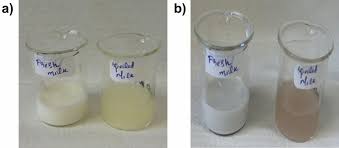
Meat, fish, and dairy products that contain large numbers of actively growing bacteria will have a lowered oxidation-reduction potential due to the exhaustion of dissolved oxygen by microorganisms. The fact that methylene blue loses its color (becomes reduced) in such an environment is the basis for the reductase test.
In this test, 1 ml of methylene blue (1:25,000) is added to 10 ml of milk. The tube is sealed with a rubber stopper and slowly inverted three times to mix. It is placed in a water bath at 35°C and examined at intervals up to 6 hours.
The time it takes for the methylene blue to become colorless is the methylene blue reduction time (MBRT). The shorter the MBRT, the lower the quality of the milk. An MBRT of 6 hours is very good. Milk with an MBRT of 30 minutes is of very poor quality.
The validity of this test is based on the assumption that all bacteria in milk lower the oxidation-reduction potential at 35°C. Large numbers of psychrophiles, thermophiles, and thermodurics, which do not grow at this temperature, would not produce a positive test.
Raw milk, however, will contain primarily Streptococcus lactis and Escherichia coli, which are strong reducers; thus, this test is suitable for screening raw milk at receiving stations. Its principal value is that less technical training of personnel is required for its performance.
Bacterial Counts for Assessing Meat and Fish Quality
The standard plate count, as well as the multiple tube test, can be used on meat and fish products much in the same manner that they are used on milk and water to determine total counts and the presence of coliforms.
Frequently Asked Questions (FAQs)
- What makes meat, fish, and dairy products susceptible to bacterial growth?
Meat, fish, and dairy products provide excellent growth media for bacteria due to their nutrient-rich composition and ability to support bacterial proliferation when stored at suitable temperatures, unlike natural waters, which lack essential nutrients for pathogens. - Why is the standard plate count important for assessing the quality of milk, meat, and fish?
The standard plate count is the most reliable indicator of sanitary quality in meat, fish, and dairy products. High bacterial counts may suggest unsanitary handling, diseased udders, or improper storage, increasing the likelihood of disease transmission, though low counts do not guarantee the absence of pathogens. - How does the direct microscopic count method help in evaluating milk quality?
The direct microscopic count allows for rapid assessment of milk quality by staining and counting organisms in a sample spread over a slide. High-quality milk shows few organisms per microscopic field, while poor-quality milk reveals many, making it useful for testing raw and pasteurized milk. - What is the purpose of the reductase test in milk testing?
The reductase test measures bacterial activity in milk by adding methylene blue and observing how quickly it loses color due to reduced oxygen levels caused by bacterial growth. A shorter methylene blue reduction time (MBRT) indicates lower milk quality, with 6 hours being very good and 30 minutes indicating poor quality. - Why might low bacterial counts in meat, fish, or dairy products still pose a risk?
Low bacterial counts do not necessarily mean pathogens are absent, as dangerous organisms like those causing brucellosis or tuberculosis can be present even when counts are within acceptable limits, requiring careful interpretation of results. - How are bacterial counts performed on meat and fish compared to milk?
Bacterial counts for meat and fish use the same methods as for milk, such as the standard plate count and multiple tube test, to determine total bacterial counts and detect coliforms, ensuring consistency in assessing microbiological safety across these products.
Do you have any questions, suggestions, or contributions? If so, please feel free to use the comment box below to share your thoughts. We also encourage you to kindly share this information with others who might benefit from it. Since we can’t reach everyone at once, we truly appreciate your help in spreading the word. Thank you so much for your support and for sharing!