


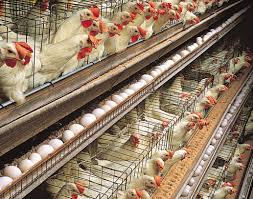
The poultry industry keeps growing worldwide. More people want chicken, eggs, and other poultry products every year. If you’re thinking about starting a poultry business, you need to pick the right type of birds for your farm.
Your choice depends on several things. What does your local market want? What’s your climate like? How much money can you invest? Do you have the right facilities? These questions matter because they affect your success.
You also need to think about how fast the birds grow, how much feed they need, and whether they get sick easily. And of course, what your customers prefer to buy.
1. Broiler Chickens (Meat Production)

Broilers are the most common choice for meat production. They grow fast and people buy them everywhere.
i. Primary Breeds and Hybrids
The main breeds you’ll see are Cornish Cross, Ross 308, Cobb 500, and Arbor Acres. These breeds have been developed specifically for meat production. They’re not your backyard chickens.
ii. Time to Maturity
Broilers reach market weight in just 5-7 weeks. At that point, they weigh between 4 and 6 pounds. This quick turnaround means you can make money faster than with most other poultry types.
iii. Advantages
Broilers have the fastest growth rate in the poultry world. Their feed conversion ratio sits at 1.6-1.9:1, which means they turn feed into meat very efficiently. You get a high meat yield per bird, and there’s always demand in the market.
People buy chicken year-round. It’s not seasonal like turkey. This gives you steady business throughout the year.
iv. Challenges
But broilers aren’t easy. They need precise management. You can’t just wing it and hope for the best. The rapid growth causes health problems if you’re not careful. Their legs sometimes can’t support their body weight. Heart issues pop up too.
You need to keep producing continuously to make good money. One batch won’t cut it. This means constant work and attention.
v. Market Applications
You can sell broilers as whole birds, cut them into parts, or supply them to processing plants. The market is flexible, which works in your favor.
Read Also: 6 Ways to Enhance Egg Production and Maximize Profits on Layers
2. Layer Chickens (Egg Production)
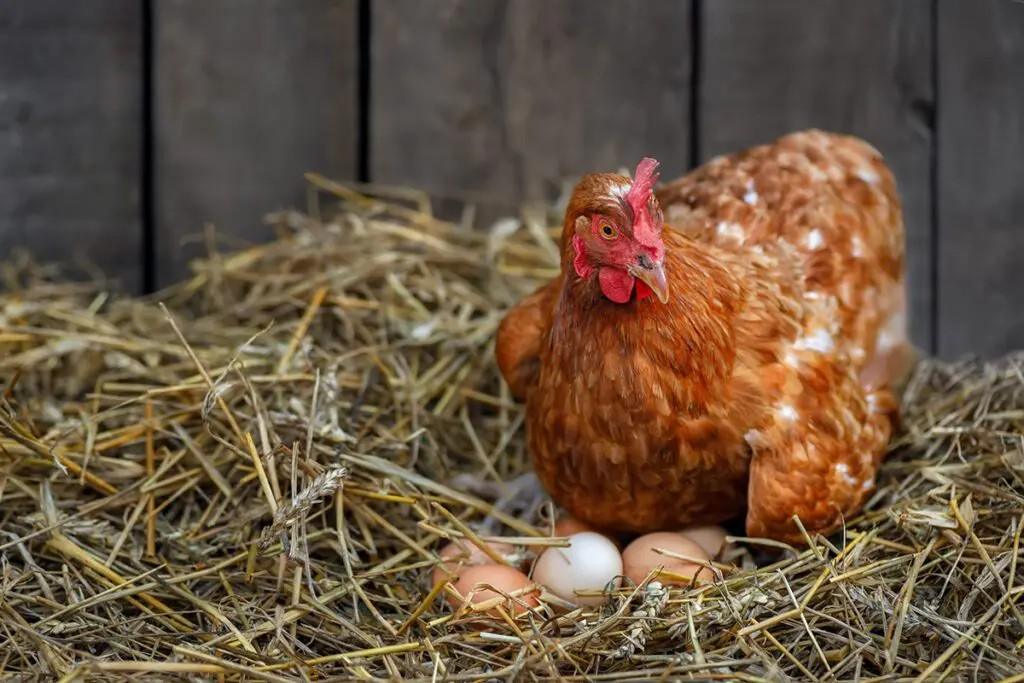
Layers are all about egg production. They’re different from meat birds in almost every way.
i. Primary Breeds
White Leghorn is the classic layer breed. ISA Brown, Lohmann Brown, and Hyline are other popular choices. Each has slightly different characteristics, but they all produce lots of eggs.
ii. Time to Maturity
Layers start producing eggs at 18-20 weeks old. But they hit peak production between 25 and 30 weeks. This longer wait time means you’re feeding birds for months before seeing returns.
iii. Production Lifespan
A layer hen stays productive for 72-78 weeks. That’s about 18 months of good egg production. After that, egg quality drops and production slows down.
iv. Advantages
Layers give you a steady income. Every day, you collect eggs that you can sell. They have lower mortality rates than broilers, which means fewer unexpected losses. And when they stop laying well, you can still sell them as spent hens for meat.
This dual revenue stream helps cushion your business against market fluctuations.
v. Challenges
The initial investment period is longer. You’re paying for feed and care for nearly 5 months before the first egg arrives. You need proper storage for eggs, especially if you’re producing at scale. And egg prices go up and down based on market conditions.
vi. Production Rates
A good layer produces 250-320 eggs per year. That’s almost an egg a day during peak production. Your goal is to keep them healthy and productive throughout their laying cycle.
3. Turkeys
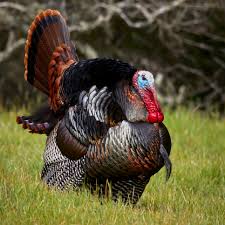
Turkeys are bigger birds with bigger profit potential. But they also take more time and resources.
i. Primary Breeds
Broad Breasted White dominates commercial turkey production. Broad Breasted Bronze, Nicholas, and Hybrid Converter are also used. These breeds have been bred for size and meat yield.
ii. Time to Maturity
Female turkeys (hens) reach market weight in 14-18 weeks. Males (toms) take longer at 18-22 weeks. This is about three times longer than broilers.
iii. Market Weights
Hens finish at 14-16 pounds. Toms can reach 30-40 pounds. These bigger birds mean more meat per bird, but also more feed costs.
iv. Advantages
You make more profit per bird with turkeys. Thanksgiving and Christmas create strong seasonal demand in many markets. People pay premium prices during these times.
If you time your production right, you can cash in on holiday demand.
v. Challenges
The longer growing period ties up your capital. Feed costs add up when you’re feeding birds for 4-5 months. Turkeys need more space than chickens. They’re also more susceptible to diseases, especially when young.
vi. Market Considerations
You need to decide between seasonal production (targeting holidays) or year-round production. Seasonal production means big sales in November and December but quiet months in between. Year-round production smooths out your income but may mean lower prices outside peak times.
4. Ducks

Ducks are less common in commercial production, but they have their place. The market is growing in some regions.
i. Primary Breeds
Pekin (White Pekin) is the go-to breed for meat. Muscovy ducks are popular in some markets, especially for foie gras. Khaki Campbell is the egg-laying champion among ducks. Rouen is more of a specialty breed.
ii. Time to Maturity
Pekin ducks reach market weight in 7-8 weeks for meat production. That’s similar to broiler chickens. Layer ducks start producing at 16-20 weeks, comparable to chickens.
iii. Advantages
Ducks are hardy. They resist disease better than chickens in many cases. Some breeds work for both meat and eggs, giving you options. And there’s a growing niche market for duck products, especially in urban areas and ethnic communities.
iv. Challenges
Ducks need more water than chickens. Not just for drinking, but for their overall health and cleanliness. The market isn’t as developed in many regions, so you might struggle to find buyers. Processing ducks is different from processing chickens, which can complicate things.
v. Special Considerations
Muscovy and Moulard ducks are used for foie gras production in some areas. Duck is also popular in Asian cuisine and in upscale restaurants. If you’re near these markets, ducks might work well for you.
5. Geese
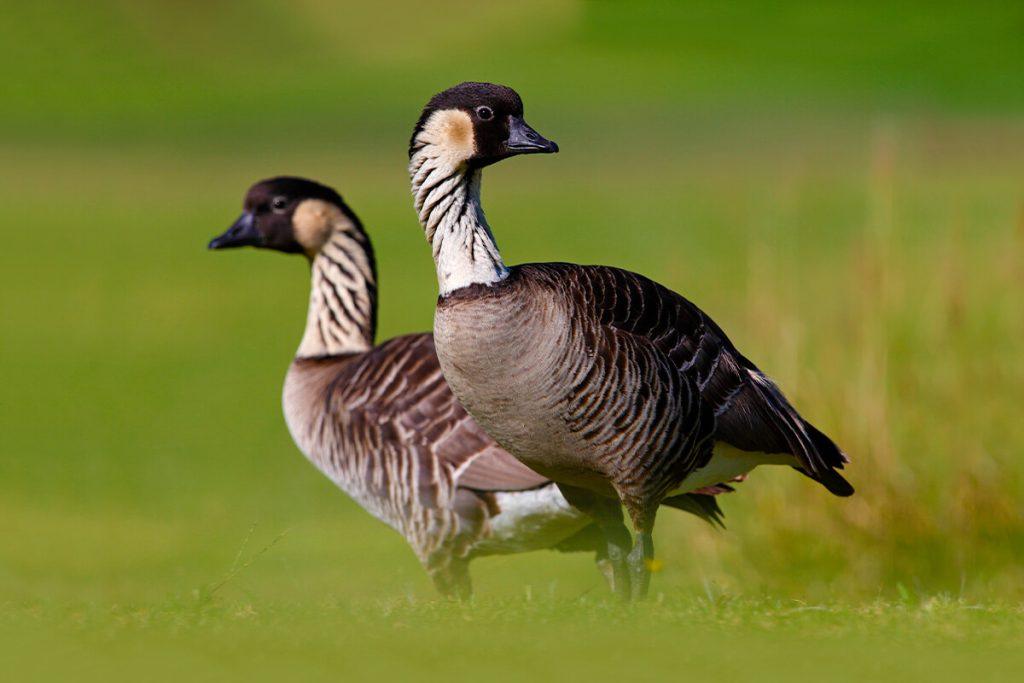
Geese are niche birds in commercial production. They’re not common, but they can be profitable in the right situation.
i. Primary Breeds
Embden and Toulouse are the main meat breeds. Chinese and African geese are smaller but still commercially viable.
ii. Time to Maturity
Geese reach market weight in 12-14 weeks. But they don’t reach full maturity until 2-3 years old. This long timeline makes them less attractive for meat production alone.
iii. Advantages
Geese are efficient grazers. They can get much of their nutrition from grass, which cuts feed costs. They produce high-value products including meat, liver, and down feathers. And they live and produce for many years once mature.
iv. Challenges
The longer maturity period is a major drawback. Geese breed seasonally, not year-round like chickens. And the market is much smaller than for chicken or turkey.
v. Niche Markets
Holiday markets (especially Christmas) are big for geese in some regions. Eastern European and Chinese communities often have a strong demand. Down production can add significant income if you set up for it.
6. Quail
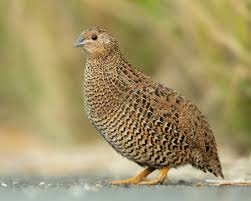
Quail are tiny birds, but they’re surprisingly productive. They work well for small-scale operations or as a side business.
i. Primary Species
Coturnix (Japanese) quail is the main commercial species. Bobwhite quail is used less often but has its place in some markets.
ii. Time to Maturity
Quail reach market weight in just 6-8 weeks. They start laying eggs at 6-7 weeks. This incredibly fast maturity means quick returns on your investment.
iii. Advantages
Quail need minimal space. You can raise hundreds in the space needed for a few dozen chickens. Initial investment is low. And they’re highly productive for their size, with good feed conversion.
iv. Challenges
The birds are small, so you need to sell many to make decent money. The market is niche. Most people don’t regularly buy quail meat or eggs. You’ll need to work harder on marketing and finding customers.
v. Production
Quail hens lay 250-300 eggs per year. You can raise them in cages or floor systems. Cages are more common for commercial operations because they’re more efficient.
Read also: Introduction to Poultry Farming
7. Guinea Fowl
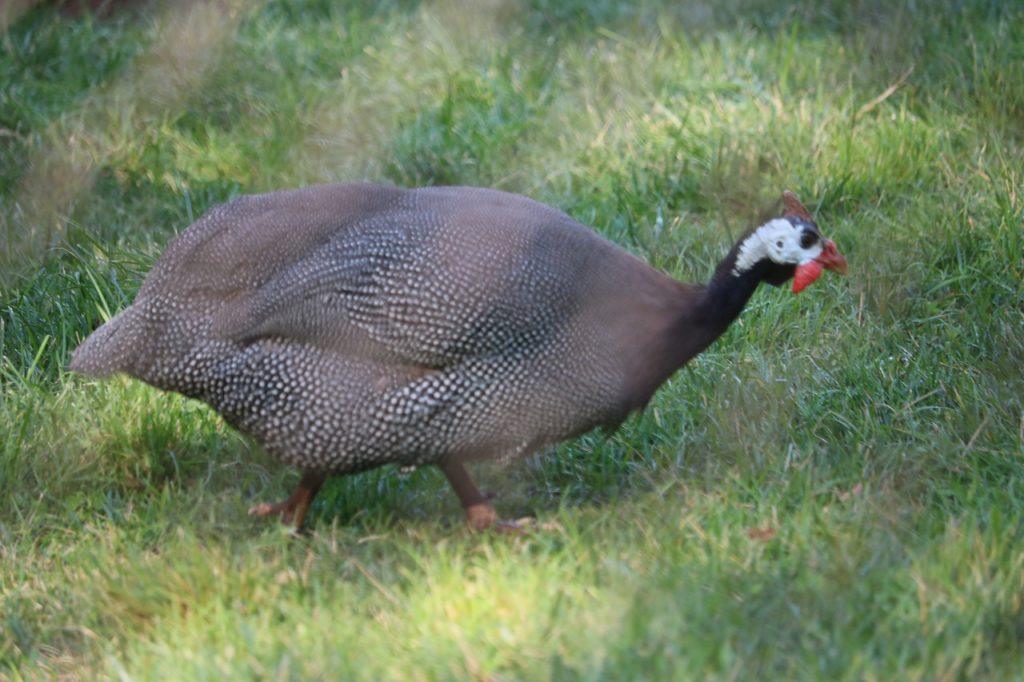
Guinea fowl are specialty birds. They’re not mainstream, but they have unique advantages.
i. Time to Maturity
Guinea fowl reach market weight in 12-14 weeks. This is longer than a chicken but reasonable compared to other specialty poultry.
ii. Advantages
Guineas resist disease well. They also eat lots of insects and ticks, providing natural pest control if you free-range them. Their meat has a unique, gamey flavor that some people prefer.
iii. Challenges
Guineas are loud. Really loud. This makes them unsuitable for urban or suburban areas. They lay eggs seasonally, not year-round. Market demand is limited. And they behave more like wild birds than domestic chickens, which makes management trickier.
iv. Market Applications
Specialty restaurants and gourmet markets are your best bet. Some ethnic cuisines use guinea fowl regularly. But you’ll need to identify and develop these markets yourself.
Comparative Analysis of Poultry for Commercial Production and Time of Maturity

Let’s compare these different poultry types directly.
i. Fastest to Market
Quail win at 6 weeks, with broiler chickens close behind at 6-7 weeks. If you need quick returns, these are your options.
ii. Best Feed Conversion
Broiler chickens convert feed to meat most efficiently. This matters because feed is your highest ongoing cost.
iii. Lowest Investment
Quail and broiler chickens require the least upfront capital. You can start small and grow as you learn.
iv. Highest Profit Margins
Turkeys during the holiday season offer great margins. Specialty ducks and geese can also command premium prices if you find the right markets.
v. Most Reliable/Established Market
Broiler chickens and layer chickens have the most stable, year-round demand. You’ll always find buyers for chicken and eggs.
vi. Best for Beginners
Start with broiler chickens or layers. The market is established, information is readily available, and you can find help when you need it.
Economic Considerations of Poultry for Commercial Production and Time of Maturity
Money matters. Here’s what you need to think about financially.
i. Initial Capital Requirements
Broilers and quail need the least money to start. You can begin with a few hundred birds and basic facilities. Turkeys and geese need more upfront investment in housing and equipment. Layers require the most patience since you won’t see returns for several months.
ii. Feed Costs and Availability
Feed is your biggest expense. Chicken feed is the cheapest and most available. Turkey feed costs more per pound, and turkeys eat a lot. Duck and goose feed can be harder to find in some areas. Always check local feed availability before committing to a poultry type.
iii. Housing and Equipment Needs
Broilers need simple housing with good ventilation. Layers need nesting boxes and collection systems. Turkeys need more space and height. Ducks need water access. Factor in these costs when planning.
iv. Labor Requirements
All poultry need daily care. But layers require egg collection daily. Broilers need careful monitoring during rapid growth. Larger birds like turkeys need more physical labor for handling. Consider what you can realistically manage.
v. Market Accessibility and Demand
Research your local market before choosing your poultry type. Who will buy your products? How will you reach them? What prices can you expect? Don’t assume demand exists just because you can produce something.
vi. Risk Assessment and Biosecurity
Disease can wipe out your flock overnight. Broilers and turkeys are more susceptible to disease than ducks or guineas. You need biosecurity measures for any poultry operation, but intensity varies by species.
Regional and Market Factors of Poultry for Commercial Production and Time of Maturity
Your location affects what you should raise.
i. Climate Suitability
Hot climates stress chickens and turkeys. Ducks and geese handle heat better. Cold climates require heated housing for most species. Guineas and some duck breeds are hardy in various climates.
ii. Cultural Preferences and Consumption Patterns
Some cultures don’t eat certain poultry types. Others prize them. Middle Eastern markets often want fresh, halal chicken. Asian markets value duck. European markets appreciate guinea fowl and goose. Know your customer base.
iii. Regulatory Requirements and Certifications
Check local regulations before starting. Some areas restrict backyard poultry. Others have strict processing requirements. Organic certification takes time and money but can increase prices. Halal or kosher certification opens specific markets.
iv. Processing and Distribution Infrastructure
Can you process birds yourself or do you need a facility? Are there licensed processors nearby? How will you get products to customers? These logistics determine whether your business can work.
v. Contract Farming vs. Independent Production
Contract farming means a company provides chicks, feed, and ga uaranteed purchase. You provide labor and facilities. Independent production gives you more control but more risk. Consider which model fits your situation.
Summary on Best Types of Poultry for Commercial Production and Time of Maturity
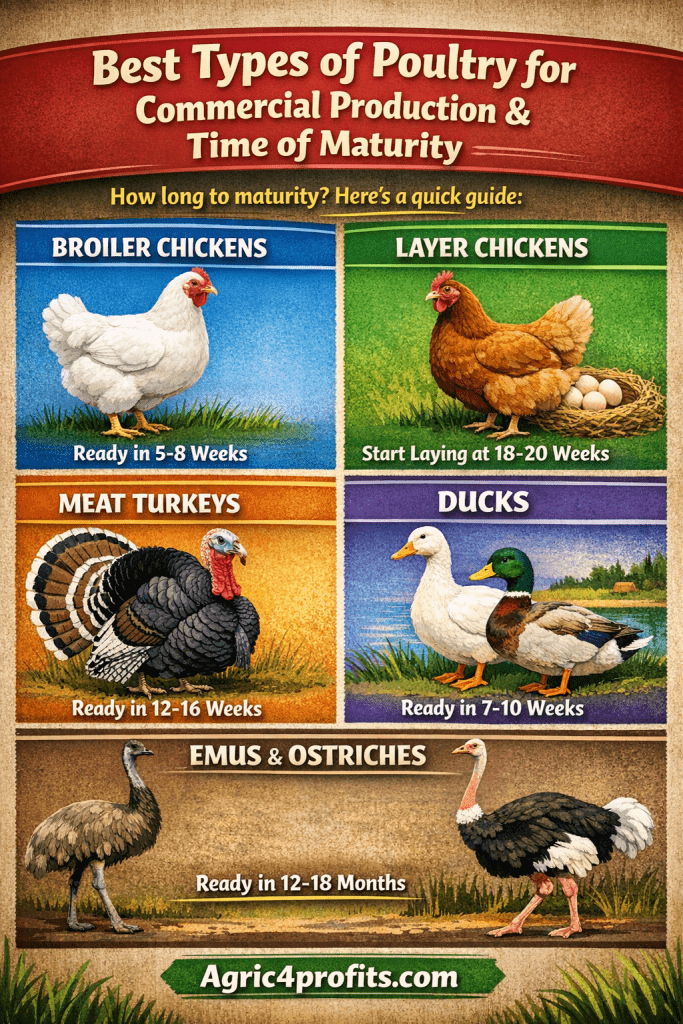
| Aspect | Details |
|---|---|
| Fastest Maturity | Quail (6-8 weeks) and Broiler chickens (5-7 weeks) reach market weight quickest |
| Best for Beginners | Broiler chickens and layer chickens due to established markets and available support |
| Highest Profit Potential | Turkeys during holidays, specialty ducks, and geese command premium prices |
| Most Efficient Feed Conversion | Broiler chickens at 1.6-1.9:1 feed conversion ratio |
| Lowest Initial Investment | Quail and broiler chickens require minimal starting capital |
| Best Year-Round Demand | Broiler chickens and eggs have consistent market demand |
| Longest Maturity | Geese (12-14 weeks for market weight, 2-3 years for full maturity) |
| Egg Production Leaders | Layer chickens (250-320 eggs/year) and quail (250-300 eggs/year) |
| Key Success Factors | Market research, climate suitability, capital availability, management skills |
| Main Challenges | Disease management, feed costs, market access, regulatory compliance |
Frequently Asked Questions About Best Types of Poultry for Commercial Production and Time of Maturity
1. Which poultry type is most profitable for beginners?
Broiler chickens offer the best starting point for most beginners. They reach market weight in 5-7 weeks, have established markets everywhere, and require relatively low initial investment. You can start with a small flock and scale up as you gain experience.
2. How long does it take to start making money from layer chickens?
Layer chickens start producing eggs at 18-20 weeks old. This means you’ll feed and care for them for about 4-5 months before seeing any income. Once they start laying, they’ll produce for 72-78 weeks, giving you a steady daily income from egg sales.
3. Are turkeys more profitable than chickens?
Turkeys can be more profitable per bird, especially during holiday seasons when prices peak. However, they take 14-22 weeks to reach market weight (compared to 5-7 weeks for broilers) and require more feed, space, and management. The longer production cycle and higher costs mean more risk.
4. What’s the best poultry for small spaces?
Quail are ideal for limited space. You can raise hundreds of quail in the same area needed for a few dozen chickens. They reach maturity in 6-8 weeks and produce both meat and eggs. However, the market for quail products is more limited than for chicken.
5. Which poultry species is most disease resistant?
Ducks and guinea fowl generally resist disease better than chickens and turkeys. Ducks are hardy and adapt well to various conditions. Guinea fowl rarely get sick and can handle both hot and cold climates. However, both have smaller, less established markets than chickens.
6. Can I raise multiple poultry types together?
It’s possible but not recommended for commercial operations. Different species have different nutritional needs, health vulnerabilities, and management requirements. Mixing species increases disease transmission risk and complicates management. Most successful farms specialize in one type.
7. What factors should I consider for my climate?
Hot climates stress chickens and turkeys, while ducks and geese tolerate heat better. Cold climates require heated housing for most species but guineas are quite hardy. Also consider humidity, rainfall, and seasonal temperature swings when choosing your poultry type and housing design.
8. How much space do I need per bird?
Space requirements vary by species and production system. Broilers need about 1-1.5 square feet per bird in intensive systems. Layers need 1.5-2 square feet. Turkeys need 3-5 square feet. Ducks need 2-4 square feet plus water access. Free-range systems require much more space.
9. What are feed conversion ratios and why do they matter?
Feed conversion ratio (FCR) measures how many pounds of feed produce one pound of meat or eggs. Broiler chickens have the best FCR at 1.6-1.9:1. Since feed is your biggest cost, better FCR means more profit. Turkeys have FCR around 2.5-3.0:1, which is less efficient.
10. Should I focus on meat or egg production?
This depends on your market, capital, and patience. Meat production (broilers) gives faster returns with birds ready in 5-7 weeks. Egg production requires waiting 18-20 weeks but provides a steady daily income afterward. Research your local market demand and prices for both before deciding.
Do you have any questions, suggestions, or contributions? If so, please feel free to use the comment box below to share your thoughts. We also encourage you to kindly share this information with others who might benefit from it. Since we can’t reach everyone at once, we truly appreciate your help in spreading the word. Thank you very much for your support and for sharing!