


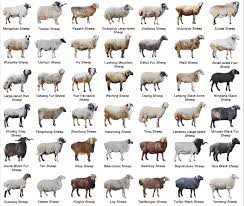
There are about four main breeds of sheep. These are the West Africa Dwarf, Yankasa, Uda and Balami. All are hairy types. The West Africa Dwarf sheep is a small, short-legged animal found in the humid zone. Animals vary in coat color but black predominates.
The males have horns while females are hornless. It is the smallest of the breeds, with a mature body weight of 18 to 25 kg. Because the breeds thrive in areas that are heavily infested with tsetse fly, it is considered to be tolerant to trypanosomiasis.
The Yankasa sheep is the most numerous and is found throughout the Guinea and Sudan savanna zones. It has a predominantly white coat colour, with black patches around the eyes, ears, muzzle (nose and mouth area) and hooves.
Mature rams have curved horns and heavy, hairy white mane. The females are hornless. It is a fine-looking breed, hardy and of medium body size. The adults reach weights of 30 to 40kg. It adapts well to intensive production and has a relatively high growth rate.
The Uda sheep is a large, long-legged breed with a convex facial profile, found in the Sudan savanna zone, especially in the North-western part of Nigeria. It has a characteristic pied coat colour pattern of an entirely black or brown head and fore quarters and white hind-quarters.
The ears are large, long and droopy. Mature males have horns white females are normally hornless. The breed is particularly abated to extensive grazing and is renowned for its trekking ability. Mature animals weigh 35 to 45kg.
🌿 Go Organic on Your Farm: Instead of harmful chemical pesticides and fertilisers, try our organic farming products — including neem oil spray, bio-pesticides, natural plant treatments, organic seeds and seedlings, suckers, and many more organic products that are safe for your health, your family, your soil and your harvest. Shop Now →
Read Also: Major Production Constraints of Cattle Production
The Balami sheep is the biggest of the sheep breeds and is found mainly in the drier Sudan and Sahel Savanna zones. It has an all-white coat. Mature weights of 40 to 50 kg are common.
Experience has shown that the different breeds of sheep are adapted and perform best in their specific ecological zones. Because of the variations in the amount of rainfall, temperature and relative humidity, all of which indirectly affect performance, farmers are advised to raise those breeds that predominate in their ecological zones.
Thus, while the Yankasa and Uda are suitable for the Guinea and Sudan zone. The West African Dwarf and Yankasa breeds should be raised in the humid Forest and Derived Savanna zones.
🔧 Free Farm Tool Available: Use our free Agric4Profits Farm Tools to calculate your farm profits, formulate feeds, identify pests and diseases on both your crops and animal farms, plan your planting and harvesting season, including many more farm tasks to get free expert advice and recommendations — completely free, no registration required. Access Free Tools →
Stocking and Production Practices for Sheep
1. Procuring Foundation Stock for Breeding
Ideally, foundation-breeding stock should be purchased from reputable sheep breeding farms or government Livestock investigation and Breeding Centers LIBC so as to be certain of their purity, high genetic quality and freedom from diseases.
Unfortunately, such sources are too few at present and where they exist, the number of breeding animal available for sale is limited. This leaves the open market as the main source of breeder stock for farmers.
In purchasing animals from the market, major consideration must be given to the animal’s health, age and physical appearance. The behavior and posture of an animal are reflections of its health status. Age can be determined from the number and size of teeth. Therefore, the farmer is advised to:
a. Buy animals that are free from obvious diseases such as catarrh, diarrhea and skin diseases. Also ensure that, animals are free of ectoparasites such as fleas and ticks on their bodies.
b. Avoid animals with physical defects such as lameness. Walk the animal around to find out, blindness and malformations.
💬 Have a Farming Question? Join thousands of farmers across Africa on the Agric4Profits Community — ask questions, share experiences and connect with agricultural experts. It is completely free. Ask Your Question Now →
c. A lean or stunted animal should be avoided. Buy only alert, fine-looking and active animals with bright eyes and fine coat.
d. Ewes (female sheep) should be between 1.5 and 3 years of age.
e. A -1.5 to 2 year-old sheep has two broad (big) central teeth, a -2 to 2.5 year-old has 4, while those aged about 3 years have 6 big teeth.
f. Buy in small batches from many markets in different localities so as to have animals that are as unrelated as possible and to have genetic variety in your foundation stock.
Initial Health Precautions
A number of health precautions should be taken before introducing newly purchased animals into your farm of flock. These precautionary measures are aimed at preventing the introduction of diseases into the farm and also to improve the chances of survival of your newly purchase stock.
It is good husbandry practice to have an isolated area away from your main flock where newly purchased stock can be quarantined for a month before introduction into the main flock. Adequate feed, water and shelter should be provided in the quarantine area.
Recommended treatment for a one month quarantine period are as follows:
• 1st day: Give prophylactic antibiotic treatment for 3 days
• 4th day: Give broad spectrum anthelmintics and coccidiostat treatments. Coccidiostat treatment should continue for 7 days.
📖 Want to Go Deeper on This Topic?
Our expert agricultural ebooks cover poultry, fish farming, different crops production, snail farming, organic farming, mushrooms, sheep, cattle, flowers, pig farming, goat farming, agribusiness, etc. in practical step-by-step detail — written by agricultural professionals for African farmers.
Browse All Farming Ebooks →• 7th Day: Give tick-bath against ectoparasites.
• 28th day: Repeat treatment with anthelmintics and also repeat the tick-bath. Trim overgrown hooves
• 30th day: Animals can leave quarantine to join the main flock
In the humid zones of Southern Nigeria where PPR (pests des petit ruminants, a disease of sheep and goats also known as “kata”) may be a problem, the following vaccination schedule should be included in the quarantine procedures outlined above:
Recommended treatment for a one month quarantine period are as follows:
• 1st Day: Give prophylactic treatment with hyper-immune PPR antiserum (raised in cattle) subcutaneously (4 ml for full-grown adult).
• 10th day: Give TCRV vaccination against PPR (one cattle dose) subcutaneously in the neck region above the shoulder. Of course initially, when starting a sheep farm you will certainly require assistance from a veterinarian or trained personnel to carry out these procedures but except for the vaccination you will be able to carry them out routinely yourself from then on.
Read Also: Strategies for Improving Cattle Production
🌱 Take Your Farming Further With Agric4Profits
Based on what you just read, here are free resources and products from Agric4Profits that can help your farm right now:
- 🛒 Visit Our Marketplace — Organic neem oil, bio-pesticides, seeds and farming products
- 📚 Read Premium Content — Advanced guides for serious and profitable farming
- 🎓 Join Our Free Academy — Structured free training for farmers across Africa
- 🔧 Use Our Free Farm Tools — Profit calculators, feed formulation, pest identifier and more
- 💬 Join Our Farming Community — Connect with farmers across all 54 African countries
- ❓ Ask a Farming Question — Get answers from experienced farmers and agricultural experts
Please cite this content in academic work, research, or publications.