


Belonging to the family: Mycosphaerellaceae . This is a fungus disease that affects crops like eggplant, hot pepper, sweet pepper, carrots, okro, Sugar beet, beet root, roses, shrubs. This fungus symptoms can occur primarily on foliage, petiole and stem lesions develop when conditions are highly favorable. It can be stored in crop residues and spread by wind, insects , water etc.
Life Cycle of Cercospora leaf spot
Cercospora leaf spot
can be caused by many different Cercospora fungal pathogen species
depending on the plant type infected. For example, Cercospora
beticola infects sugar beets whereas Cercospora rosicola infects rose
plants.
This is considered a
foliar disease and can be especially devastating to sugar beet crops
in North Dakota and Minnesota. This disease is sometimes misdiagnosed
as black spot. Infection will begin at the bottom of the plant and
will work up toward leaves with new growth.
This happens when the
fungal spores germinate and enter through natural openings of leaves
when conditions are optimal. If leaves do not have high moisture
levels on their outside tissue for at least 11 hours, new spores are
unlikely to enter the plant.
While infection is
most commonly found on leaves, sometimes stems, bracts, or fruit can
also be affected. Once spores infect a plant, it will take 5 to 21
days for symptoms to appear. This fungus has the ability to
overwinter in plant debris that remains in a field after harvest.
🌿 Go Organic on Your Farm: Instead of harmful chemical pesticides and fertilisers, try our organic farming products — including neem oil spray, bio-pesticides, natural plant treatments, organic seeds and seedlings, suckers, and many more organic products that are safe for your health, your family, your soil and your harvest. Shop Now →
Symptoms and Damage
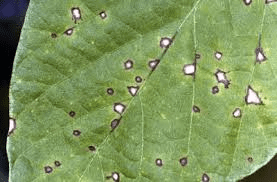
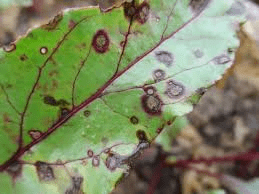
One of the most common symptoms of this Cercospora leaf spot disease attack on crops is when you notice round spots with a light grey center and a deep brown margin surrounded by a yellow ring. The leaves later turns yellow then wilt and fall. On stems, elongated spots can be seen as they appear.
Identification and Habitat of Cercospora leaf spot
🔧 Free Farm Tool Available: Use our free Agric4Profits Farm Tools to calculate your farm profits, formulate feeds, identify pests and diseases on both your crops and animal farms, plan your planting and harvesting season, including many more farm tasks to get free expert advice and recommendations — completely free, no registration required. Access Free Tools →
Identification
As the name suggests,
this disease causes spots on foliage. The circular blemishes
typically have an average diameter of 3 millimeters that is between
brown and reddish-purple in color, bordering a gray center.
However, if spots have
just developed, the gray center will not yet be visible. When this
fungus experiences favorable conditions, it may progress through 4 or
5 cycles in one season.
Each progressive cycle
is often more severe than the previous one, with spots sometimes
growing to have a diameter of 10 millimeters. As these spots kill the
plant cells, leaves will begin to fall from the plant, causing
defoliation.
A plant’s yield will
be reduced from the limited photosynthetic capacity and can also
result in more juice impurities and less sucrose extraction for sugar
beets.
💬 Have a Farming Question? Join thousands of farmers across Africa on the Agric4Profits Community — ask questions, share experiences and connect with agricultural experts. It is completely free. Ask Your Question Now →
Habitat
Cercospora leaf spot
favors weather that is wet, warm, and humid; often most prevalent
following canopy closure. During the day this fungus thrives when
temperatures are between 80 and 90 degrees Fahrenheit and at night
when temperatures exceed 60 degrees Fahrenheit.
The disease will not
develop well if temperatures reach 93 degrees or higher. Humidity
levels are preferred between 90 and 100 percent. More susceptible
conditions for Cercospora involve areas near waterways, plants close
to other fields that were infected in the past, and those near
shelter-belts.
Management and Control Methods
Cultural
Control
Since infection grows
worse with time, early control is essential for effective management
of this disease. In order to do this, scout fields frequently to
catch any infection early, especially in highly susceptible areas.
Also, whenever possible keep vulnerable plants away from areas that
are most commonly affected by this disease.
For example, plant
sugar beets no closer than 100 yards from other previously infected
areas. Practice fall tillage to bury infected plant debris that could
be a possible overwintering site for Cercospora spores. Rotate crops,
giving sugar beets a 2 year break in-between and replacing them with
a crop type that is less susceptible.
It is important to
note that having satisfactory control is often dependent on using an
integrated management system that includes the use of both cultural
and chemical methods.
Chemical
Control
📖 Want to Go Deeper on This Topic?
Our expert agricultural ebooks cover poultry, fish farming, different crops production, snail farming, organic farming, mushrooms, sheep, cattle, flowers, pig farming, goat farming, agribusiness, etc. in practical step-by-step detail — written by agricultural professionals for African farmers.
Browse All Farming Ebooks →Fungicides should be
applied once first symptoms appear. Most often, additional
applications will be needed to continue effective control, especially
when conditions are favorable for this fungus; however, if using
Topsin with a protectant (e.g., Supertin), this application should
only be used once per season.
Other fungicides with
the following active ingredients have also shown to be effective for
the control of Cercospora: copper oxychloride, sulfur, maneb,
mancozeb, chlorothalonil, propiconazole, and neem oil. Always be sure
to carefully read the fungicides label for cautions and proper
application before use.
In order to avoid this
fungi building a resistance to a certain chemical, ensure the same
fungicide is not being used back-to-back. Additionally, if only one
application type is being used annually, do not use the same type of
application.
High spray pressure is
best, often 100 psi, and also high water volume. Using both of these
methods can create more effective control. On average, fungicides can
provide protection for 2 weeks. Also, treatment methods in place for
powdery mildew and black spot have also helped in the management of
Cercospora.
Damage Prevention
Some
of the ways by which these fungus disease can be managed or prevented
is through the following measures:
- Always
use healthy seeds. - Remove
all crop residues, weeds and infested plants. - Avoid
overhead watering otherwise water early in the morning. - Apply
fungicides on the foliage in case of early symptoms. - Implement
crop rotation by alternating with plants such as sorghum, corn or
fodder plants.
Read Also: Basic things you should know about Poultry Farming
Read Also: 28 Best Energy-Boosting Foods and Drinks
Frequently Asked Questions
We will update this section soon.
🌱 Take Your Farming Further With Agric4Profits
Based on what you just read, here are free resources and products from Agric4Profits that can help your farm right now:
- 🛒 Visit Our Marketplace — Organic neem oil, bio-pesticides, seeds and farming products
- 📚 Read Premium Content — Advanced guides for serious and profitable farming
- 🎓 Join Our Free Academy — Structured free training for farmers across Africa
- 🔧 Use Our Free Farm Tools — Profit calculators, feed formulation, pest identifier and more
- 💬 Join Our Farming Community — Connect with farmers across all 54 African countries
- ❓ Ask a Farming Question — Get answers from experienced farmers and agricultural experts
Please cite this content in academic work, research, or publications.