


Meat, a vital food source, encompasses the edible portion of animals, plants, or seafood containing essential nutrients: water, fat, protein, carbohydrate, vitamins, and minerals. Producing meat from animals is costlier compared to other protein sources, with protein being the primary and most expensive nutrient in meat.
Concept and Categories of Meat
1. Definition of Meat
Meat refers to the flesh of animals consumed as food. In tropical regions, meat primarily comes from sheep, cattle, goats, pigs, deer, antelope, rabbits, squirrels, rats, elephants, camels, and other mammalian animals, whether domesticated or wild.
It also includes poultry such as chicken, turkey, ducks, guinea fowl, geese, and meat from other avian and reptilian animals, as well as crayfish, crabs, lobsters, snails, other mollusks, and insects. Meat can also be defined as the edible portion of animal tissues, encompassing all processed or manufactured products derived from these tissues.
Meat consumption correlates with societal affluence, with developed countries consuming more meat than less developed ones. Producing meat is resource-intensive, requiring 7–10 kg of plant food to produce 1 kg of beef, 4–6 kg for 1 kg of pork, and 2–3 kg for 1 kg of chicken.
This inefficiency makes meat production less sustainable compared to plant-based nutrition, compelling less affluent societies to rely more on plant-derived foods.
2. Categories of Meat
The following are the primary categories of meat:
i. Red Meat: The most consumed category, characterized by dark pigmentation. Common examples include beef, goat, lamb, mutton, and pork.
ii. White or Lightly Pigmented Meat: Includes poultry meat from domestic birds such as chickens, turkeys, ducks, geese, and guinea fowl.
iii. Seafood: Encompasses fish, lobsters, oysters, crabs, and other aquatic organisms.
iv. Game and Lesser-Known Meat Sources: Includes flesh from non-domesticated (wild or game) animals and unconventional sources like tortoises, snails, grasshoppers, termites, beetles, insect larvae, crickets, and low-flying birds.
Read Also: Layers or Broilers which One is More Profitable in Poultry Farming? Find Out!
Chilling Practices for Meat Preservation
1. Importance of Chilling Meat
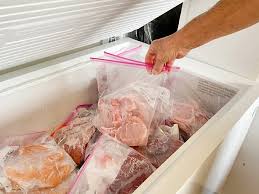
Chilled meat must be kept cold until sold or cooked. If the cold chain is disrupted, condensation forms, and microbes grow rapidly. Rules for chilling include avoiding overloading, ensuring space for air circulation, minimizing door openings, and maintaining the highest hygiene standards during handling.
The ideal storage temperature for fresh meat is just above its freezing point, approximately 1°C, or –3°C for bacon due to salt content. The International Institute of Refrigeration provides the following expected storage life for various meats at –1°C:
Types of Meat and Storage Periods at –1°C
| Type of Meat | Expected Storage Life (at –1°C) |
|---|---|
| Beef | Up to 3 weeks (4–5 with strict hygiene) |
| Veal | 1–3 weeks |
| Lamb | 10–15 days |
| Pork | 1–2 weeks |
| Edible Offal | 7 days |
| Rabbit | 5 days |
| Bacon | 4 weeks (at –3°C) |
Under commercial conditions, maintaining meat at 0°C to 1°C is challenging, resulting in shorter storage times. High relative humidity (above 90%) further reduces storage life. Meat should be refrigerated immediately upon receipt.
Any parts showing mold growth or bacterial slime must be trimmed off and destroyed. Hands must be washed thoroughly after handling such trimmings, and knives sterilized in boiling water. Refrigerators should be cleaned thoroughly after discovering contaminated meat and regularly maintained.
Large carcasses or quarters should not be cut into smaller portions, as this exposes more surface area for bacterial growth. Freshly cut surfaces are moist, fostering bacterial proliferation compared to desiccated outer surfaces of stored cuts.
An accurate thermometer must be placed in the refrigerator and checked regularly to ensure temperatures remain within 0°C to 1°C.
Read Also: Guide On How To Increase Goats Milk
2. Guidelines for Chilling and Handling Meat
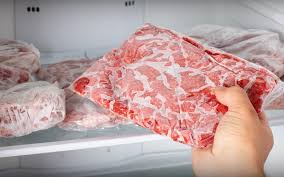
Chilled meat is typically stored for sale in refrigerated display cabinets, either unwrapped or portioned and packaged for self-service. Fan-assisted convection cabinets maintain lower temperatures better than natural convection types, as they are less affected by drafts. Cabinets should be stacked to ensure good airflow around all meat.
Unwrapped cooked and raw meat must not be stored or displayed together. Separate refrigerators and display cabinets prevent cross-contamination, as raw meat exudate on cooked meat causes explosive bacterial growth.
Simple packaging with plastic foil, popular due to affordable films, provides hygienic protection for portioned meat in self-service retail.
Packaging aims to maintain the bright red color of fresh meat, caused by myoglobin binding oxygen to form oxymyoglobin. Wrapping films must have high oxygen permeability to sustain this color and low moisture permeability to prevent desiccation.
Over time, the cut surface browns as myoglobin forms metmyoglobin, typically within three days, depending on temperature, bacterial load, and other conditions.
Retail packaging often involves placing meat portions in plastic trays and overwrapping with clear plastic film. Plastic trays are more hygienic than cardboard. Portions should align with local demand, with only a day’s sales cut at a time to minimize contamination from airborne microorganisms.
High hygiene standards are critical during cutting and packaging. Bacteria on large meat pieces primarily colonize outer surfaces, but cutting spreads them to freshly cut, moist surfaces, where they multiply rapidly. All surfaces and tools in cutting and packaging rooms must be thoroughly cleaned.
Packaging materials should be stored hygienically, protected from dust, insects, or vermin. Personnel involved in cutting and packaging must prioritize personal hygiene, as they are the primary source of food-poisoning pathogens, which thrive in packaged environments due to moist surfaces and high relative humidity.
Low temperatures during display are essential to retard bacterial growth. Overwrapping increases meat temperature due to trapped air acting as an insulator, and light-generated heat warms the upper surface. Meat must be thoroughly cooled before packaging to maintain low temperatures during display.
Minced meat has a shorter shelf life than cuts, as mincing spreads surface bacteria throughout. Mincers must be kept scrupulously clean, and minced meat packs well-chilled. Only small quantities should be prepared at a time.
Cooked meats, with lower bacterial counts, are vulnerable to airborne microorganisms, making packaging particularly beneficial. Bacteria introduced during cutting and packaging, especially food-poisoning types from poor hygiene, face little competition.
If high hygiene standards cannot be maintained, pasteurizing treatment after packaging is necessary, though it may not eliminate Bacillus or Clostridium spp. if introduced.
Do you have any questions, suggestions, or contributions? If so, please feel free to use the comment box below to share your thoughts. We also encourage you to kindly share this information with others who might benefit from it. Since we can’t reach everyone at once, we truly appreciate your help in spreading the word. Thank you so much for your support and for sharing!