


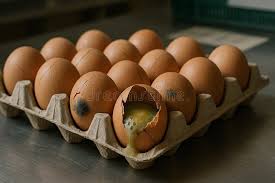
Most freshly laid eggs are sterile inside, but the shells soon become contaminated by fecal matter from the hen, the cage or nest, wash water if the eggs are washed, handling, or the material in which the eggs are packed.
The total number of microorganisms per shell of a hen’s egg has been reported to range from 10² to 10⁷, with a mean of about 10⁵. The types of microorganisms recovered from the shell are diverse. Salmonella species may be present on the shell or in the egg as laid, build up during processing, and appear in significant numbers in frozen or dried eggs.
Read Also: All You Need To Know About Animal Shelters
Factors Influencing Eggshell Contamination
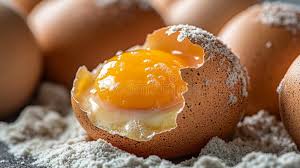
The spoilage of eggs is related to eggshell contamination and the ability of some bacteria to penetrate the egg. The type and level of eggshell contamination are related to the hygienic conditions in which hens are reared, the breeding environment, breeding practices, housing system, geographical area, and season.
Contamination may also occur during egg transport or packaging on farms or in conditioning centers, either through the environment or from one egg to another.
Even though the microflora of the eggshell surface varies, the spoilage flora of the egg content tends to be less diversified, highlighting that intrinsic egg barriers strongly influence the invasiveness of spoilage bacteria.
The cuticle, shell, and shell membranes are barriers preventing the penetration of microorganisms from the surface into the egg content. Nevertheless, the cuticle, which is resistant to water and microorganism penetration, may crack rapidly over time or during egg manipulation.
The effectiveness of this protective coating is therefore limited. The shell, a calcified proteinic layer, represents a physical barrier but is rather ineffective because microorganisms can transfer through the pores, particularly if condensed water is present on the eggshell.
The presence of eggshell cracks or micro-cracks increases the risk of contamination. The manipulation of eggs, especially in conditioning centers, increases the risk of egg cracking.
The external and internal shell membranes represent effective filters composed of antibacterial glycoprotein fibers, which may play a role in protection against penetration.
In addition to these physical barriers, egg white, similar to an intracellular fluid, is an important line of defense against invading bacteria because it represents an unfavorable environment for microbial development (poor nutrient, alkaline pH, high viscosity, and heterogeneity)
Contains several molecules expressing antimicrobial activities, such as lysozyme, ovotransferrin, proteinase inhibitors (cystatin, ovomucoid, and ovoinhibitor), and vitamin-binding proteins (riboflavin-binding protein, avidin, and thiamine-binding proteins). The integrity of egg barriers is essential to prevent microbial penetration and proliferation.
Read Also: All You Need To Know About Sweet William Flowers
Types of Egg Spoilage
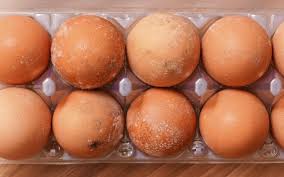
Some egg defects are obvious from their general appearance, others are shown by candling with transmitted light, and some show up only in a broken egg.
1. Defects in Fresh Eggs
Fresh eggs may exhibit cracks, leaks, loss of bloom or gloss, or stained or dirty spots on the exterior, as well as “meat spots,” general bloodiness, or translucent spots in the yolk when candled.
2. Changes During Egg Storage
The changes that take place in eggs while they are held or stored may be divided into those due to non-microbial causes and those caused by microorganisms.
3. Non-Microbial Changes in Eggs
Untreated eggs lose moisture during storage and hence lose weight. The amount of shrinkage is shown to the candler by the size of the air space or air cell at the blunt end of the egg, a large cell indicating much shrinkage.
The physical state of the egg’s contents changes, as shown by candling or by breaking out the egg.
The albumin (egg white) becomes thinner and more watery as the egg ages, and the yolk membrane becomes weaker. When an old egg is broken onto a flat dish, the thinness of the white is more evident, and the weakness of the yolk membrane permits the yolk to flatten out or even break. By contrast, a broken fresh egg shows a thick white and a yolk that stands up strongly in the form of a hemisphere.
During storage, the alkalinity of the egg white increases from a normal pH of about 7.6 to about 9.5. Any marked growth of chick embryos in fertilized eggs also serves to condemn the eggs. The poorer the egg, the more the yolk moves and approaches the shell when twirled during candling.
4. Microbial Changes Leading to Spoilage
To cause spoilage of an undamaged shell egg, the causal organisms must:
- Contaminate the shell.
- Penetrate the pores of the shell to the shell membranes (usually the shell must be moist for this to occur).
- Grow through the shell membranes to reach the white (or the yolk if it touches the membrane).
- Grow in the egg white, despite the unfavorable conditions there, to reach the yolk, where they can grow readily and complete spoilage of the egg.
In general, more spoilage of eggs is caused by bacteria than by molds, and the types of bacterial spoilage, or “rots,” of eggs go by different names. The primary ones are:
i. Green Rots: Caused primarily by Pseudomonas fluorescens, a bacterium that grows at 0°C. The rot is named because of the bright-green color of the white during early stages of development. This stage is noted with difficulty in candling but shows up clearly when the egg is broken. Odor is lacking or is fruity or “sweetish.” The contents of eggs so rotted fluoresce strongly under ultraviolet light.
ii. Colorless Rots: These may be caused by Pseudomonas, Acinetobacter, Alcaligenes, certain coliform bacteria, or other types of bacteria. These rots are detected readily by candling, as the yolk usually is involved, except in very early stages, and disintegrates or shows a white incrustation. The odor varies from scarcely detectable to fruity to “highly offensive.”
iii. Black Rots: The eggs are almost opaque to the candling lamp because the yolks become blackened and then break down, giving the entire egg contents a muddy-brown color. The odor is putrid, with hydrogen sulfide evident, and gas pressure may develop in the egg. Species of Proteus most commonly cause these rots, although some species of Pseudomonas and Aeromonas can also cause black rots. Proteus melanovogenes causes an especially black coloration in the yolk and a dark color in the white. The development of black rot and red rot usually means the egg has been held at temperatures higher than those ordinarily used for storage.
iv. Pink Rots: These occur less often and are caused by strains of Pseudomonas. They resemble colorless rots, except for a pinkish precipitate on the yolk and a pink color in the white.
v. Red Rots: Caused by species of Serratia, these are mild in odor and not offensive.
5. Fungal Spoilage of Eggs
The spoilage of eggs by fungi goes through stages of mold growth that give the defects their names:
i. Pin Spot Molding: Very early mold growth is termed pin-spot molding because of the small, compact colonies of molds appearing on the shell and usually just inside it. The color of these pin spots varies with the kind of mold. Penicillium species cause yellow, blue, or green spots inside the shell, Cladosporium species give dark-green or black spots, and species of Sporotrichum produce pink spots.
ii. Superficial Fungal Spoilage: In storage atmospheres of high humidity, a variety of molds may cause spoilage, first in the form of fuzz or “whiskers” covering the shell and later as more luxuriant growth. When eggs are stored at near-freezing temperatures, the temperatures are high enough for slow mycelial growth of some molds but too low for sporulation, while other molds may produce asexual spores. Molds causing spoilage of eggs include species of Penicillium, Cladosporium, Sporotrichum, Mucor, Thamnidium, Botrytis, Alternaria, and other genera.
iii. Fungal Rotting: The final stage of spoilage by molds is fungal rotting, after the mycelium of the mold has grown through the pores or cracks in the egg. Jellying of the white may result, and colored rots may be produced, e.g., fungal red rot by Sporotrichum and a black color by Cladosporium, the cause of black spot of eggs as well as other foods. The hyphae of the mold may weaken the yolk membrane enough to cause its rupture, after which the growth of the mold is stimulated greatly by the food released from the yolk.
6. Off-Flavors in Eggs
Off-flavors sometimes develop in eggs. Mustiness may be caused by bacteria such as Achromobacter perolens, Pseudomonas graveolens, and P. mucidolens. The growth of Streptomyces on straw or elsewhere near the egg may produce musty or earthy flavors absorbed by the egg. Molds growing on the shell also give musty odors and tastes.
A hay odor is caused by Enterobacter cloacae. Fishy flavors are produced by certain strains of Escherichia coli. The “cabbage-water” flavor may appear before rotting is obvious. Off-flavors, such as the “cold-storage taste,” may be absorbed from packing materials.
Frequently Asked Questions (FAQs)
- What causes the contamination of eggshells?
Eggshells become contaminated by fecal matter from hens, cages or nests, wash water, handling, or packing materials. The level and type of contamination depend on hygienic conditions, breeding environment, housing systems, geographical area, and season. - How do bacteria penetrate eggs to cause spoilage?
Bacteria contaminate the shell, penetrate its pores (often when moist), grow through the shell membranes to reach the egg white, and then proliferate in the yolk, where conditions are favorable for growth, leading to spoilage. - What are the main types of bacterial spoilage in eggs?
The primary types are green rots (caused by Pseudomonas fluorescens), colorless rots (caused by various bacteria like Pseudomonas or Acinetobacter), black rots (caused by Proteus species), pink rots (caused by Pseudomonas), and red rots (caused by Serratia). - How do molds contribute to egg spoilage?
Molds cause spoilage through stages like pin spot molding (small mold colonies on the shell), superficial fungal spoilage (fuzz or whiskers on the shell), and fungal rotting (mycelium growth through pores or cracks, leading to jellying or colored rots). - What are the natural barriers in eggs that prevent microbial penetration?
Eggs have a cuticle, shell, shell membranes, and egg white, which contains antimicrobial molecules like lysozyme, ovotransferrin, and proteinase inhibitors. These barriers limit microbial penetration, though cracks or moisture can reduce their effectiveness. - Why do eggs develop off-flavors during storage?
Off-flavors, such as mustiness, hay, fishy, or “cabbage-water” flavors, can result from bacteria (Achromobacter, Pseudomonas, E. coli), molds, or Streptomyces growth on nearby materials. Packing materials may also contribute to flavors like the “cold-storage taste.” - How can egg spoilage be detected?
Spoilage can be detected through general appearance (cracks, stains), candling (yolk movement, air cell size, or rot indicators), or breaking the egg to observe changes in the white or yolk, such as thinning, discoloration, or off-odors. - What non-microbial changes occur in eggs during storage?
Non-microbial changes include moisture loss (leading to weight loss and a larger air cell), thinning of the egg white, weakening of the yolk membrane, increased alkalinity of the white (pH 7.6 to 9.5), and yolk movement closer to the shell.
Do you have any questions, suggestions, or contributions? If so, please feel free to use the comment box below to share your thoughts. We also encourage you to kindly share this information with others who might benefit from it. Since we can’t reach everyone at once, we truly appreciate your help in spreading the word. Thank you so much for your support and for sharing!