


Cheese is an established curd of milk solids produced by casein coagulation and entrapment of milk fat in the coagulum. The water content is greatly reduced in comparison with milk, by the separation and removal of whey from the curd.
With the exception of some fresh cheeses, the curd is textured, salted, shaped, and pressed into moulds before storage and curing or ripening.
Cheese-making is based on the application of lactic acid bacteria (LAB) in the form of defined or undefined starter cultures that are expected to cause a rapid acidification of milk through the production of lactic acid.
With the consequent decrease in pH, thus affecting a number of aspects of the cheese manufacturing process and ultimately cheese composition and quality. The basic operations in the production of cheese are outlined in this article.
Read Also: Complete Guide on Sheep and Goats Production
Milk Standardization and Pasteurization
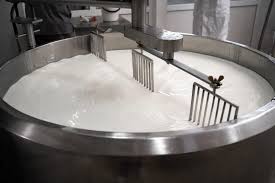
Milk is often standardized before cheese-making to optimize the protein-to-fat ratio to produce a high-quality cheese with a high yield. Cheese may be made from raw milk, pasteurized milk, or milk that has undergone a sub-pasteurization (thermisation) treatment.
Pasteurization destroys the vegetative cells of pathogens as well as many spoilage organisms and some of the enzymes naturally present in the milk.
Cooling, Coagulum Formation, and Curd Formation
1. Cooling: Milk is cooled after pasteurization or heat treatment to 90°F (32°C) to bring it to the temperature needed for the starter bacteria to grow. If raw milk is used, the milk must be heated to 90°F (32°C).
2. Coagulum Formation (Inoculation with Starter Culture and Non-Starter Bacteria): If pasteurized, milk is cooled to 30°C. Standardized milk is inoculated with starter culture and non-starter bacteria.
3. Coagulum Formation (Addition of Starter and Rennet): A coagulant is normally added to the acidified milk for cheddar cheese approximately 30–45 minutes after adding the starter, but in other cheeses, acidification may be allowed to proceed further.
Enzymic coagulation by rennet made from the stomach of young calves is employed. Recently, however, concerns about shortages of ruminal rennet and increasing demand for vegetarian cheeses have generated interest in microbial rennet.
This may consist of acid proteases produced by moulds such as Mucor miehei, or chymosin. Rennet, in combination with acid from the starter, causes coagulation of the milk curd by precipitating casein as an aqueous gel.
The curd is then allowed to set for a time depending on the cheese variety. For most hard or semi-hard cheeses, this would be approximately one hour.
3. Curd Cutting (pH 5.0–5.2): The curd is cut to facilitate whey expulsion.
4. Scalding (Gradual Increase in Temperature): The curd is heated to 39–40°C.
5. Stirring: The curd is stirred to promote whey separation.
Texturing, Salting/Brining, and Ripening
1. Texturing: The curd mats are cut into sections and piled on top of each other and flipped periodically. This step is called cheddaring.
Cheddaring helps to expel more whey, allows the fermentation to continue until a pH of 5.1 to 5.5 is reached, and allows the mats to “knit” together and form a tighter matted structure. The curd mats are then milled (cut) into smaller pieces.
2. Salting/Brining: In the manufacture of cheddar, salt is added to the milled curd before pressing (dry salting) at a concentration of 1.5–2% w/w. In other varieties, such as Gouda and Camembert, the moulded cheese is immersed in a concentrated brine.
Some blue cheeses are salted by rubbing dry salt into the surface of the moulded cheese. Salting inhibits the growth of the starter culture and other microorganisms, contributes to the flavour, and affects texture.
3. Ripening: All but fresh cheeses require some degree of ripening for the full development of flavour and texture. During ripening, further moisture loss occurs, and a complex combination of microbial and enzymic reactions take place, involving milk enzymes, the coagulant, and proteases and peptidases from the starter culture and non-starter organisms, which remain viable although their growth is inhibited.
The acidification of milk is the key step in the making of cheese. Acidification is essential for the development of both flavour and texture, promotes coagulation, and the reduction in pH inhibits the growth of pathogens and spoilage organisms.
Most cheese is now produced using a carefully selected starter, which gives predictable and desirable results. Lactococcus lactis, Streptococcus thermophilus, Lactobacillus helveticus, and Lactobacillus delbrueckii are the primary species of starter bacteria used in cheese manufacture.
Properties of Cheese
Cheese can be broadly categorized as acid or rennet cheese, and natural or process cheese. Acid cheeses are made by adding acid to the milk to cause the proteins to coagulate.
Fresh cheeses such as cream cheese or queso fresco are made by direct acidification. Most types of cheese, such as cheddar or Swiss, use rennet (an enzyme) in addition to the starter cultures to coagulate the milk.
The term “natural cheese” is an industry term referring to cheese that is made directly from milk. Process cheese is made using natural cheese plus other ingredients that are cooked together to change the textural and/or melting properties and increase shelf life.
Overview of Yoghurt Processing
Yoghurt is the food produced by culturing one or more of the optional dairy ingredients with a characterizing bacterial culture that contains the lactic acid-producing bacteria, Lactobacillus bulgaricus and Streptococcus thermophilus.
There are two major types of yoghurt: set and stirred yoghurt. Set yoghurt (which includes fruit-on-the-bottom) is formed in retail pots as lactic acid bacteria ferment lactose into lactic acid, giving a continuous gel structure in the consumer container.
In stirred yoghurt, the acid gel formed during incubation in large fermentation tanks is disrupted by agitation (stirring), and the stirred product is usually pumped through a screen which gives the product a smooth and viscous texture. The main manufacturing procedures of these two types of yoghurts are described in this article.
Read Also: Small Ruminants: Sheep and Goats Classification
Milk Standardization, Homogenization, and Heat Treatment
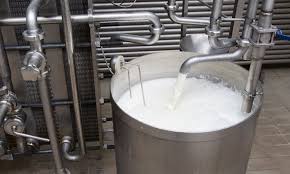
Milk is often mixed with skim milk and cream to standardize (or adjust) the fat content to the desired level.
1. Homogenization: Homogenization of the milk base is an important processing step for yoghurts containing fat. Milk is typically homogenized using pressures of 10–20 and 5 MPa first and second stage pressures, respectively, and at a temperature range between 55 and 65°C.
Homogenization results in milk fat globules being disrupted into smaller fat globules, and the surface area of homogenized fat globules greatly increases. The use of homogenization prevents fat separation (creaming) during fermentation or storage, reduces whey separation, increases whiteness, and enhances the consistency of yoghurts.
2. Heat Treatment: Heating of milk is an important processing variable for the preparation of yoghurt since it greatly influences the physical properties and microstructure of yoghurt. In yoghurt manufacture, milk is heated prior to culture addition.
The temperature/time combinations for the batch heat treatments that are commonly used in the yoghurt industry include 85°C for 30 min or 90–95°C for 5 min. However, very high temperature short time (100°C to 130°C for 4 to 16 s) or ultra-heat temperature (UHT) (140°C for 4 to 16 s) are also sometimes used.
The heat treatment of milk is also used to destroy unwanted microorganisms, which provides less competition for the starter culture. Yoghurt starter cultures are sensitive to oxygen, so heat treatment helps to remove dissolved oxygen, assisting starter growth.
Fermentation and Cooling
1. Fermentation: After heat treatment, the milk base is cooled to the incubation temperature used for the growth of the starter culture. An optimum temperature of the thermophilic lactic acid bacteria, i.e., Streptococcus subsp. thermophilus and Lactobacillus delbrueckii subsp. bulgaricus, is around 40–45°C.
Bacterial fermentation converts lactose into lactic acid, which reduces the pH of milk. During acidification of milk, the pH decreases from 6.7 to ≤4.6. Gelation occurs at pH 5.2 to 5.4 for milk that was given a high heat treatment.
2. Cooling: When yoghurts have reached the desired pH (e.g., ~4.6), yoghurts are partially cooled (~20°C) before fruit or flavouring ingredients are added. Yoghurt products are often blast chilled to <10°C (e.g., 5°C) in the refrigerated cold store to reduce further acid development.
In the production of set yoghurt, yoghurts are directly transferred to a cold store or blast chilled in cooling tunnels. For stirred yoghurts, cooling is first performed by agitation in the jacketed fermentation vat, and the product is sheared and smoothed by devices like back-pressure valves, high shear devices, or sieves.
Properties of Yoghurt
Yoghurt is a fermented milk product that contains the characteristic bacterial cultures Lactobacillus bulgaricus and Streptococcus thermophilus.
All yoghurt must contain at least 8.25% solids not fat. Full-fat yoghurt must contain not less than 3.25% milk fat, low-fat yoghurt not more than 2% milk fat, and non-fat yoghurt less than 0.5% milk.
The physical and sensory properties of yoghurt gels are greatly influenced by the total solids content of the yoghurt milk, especially the protein content. Increased yoghurt viscosity is observed when the total solids content of milk is increased.
Overview of Cream Processing
Cream may be defined as that portion of milk which is rich in milk fat or that portion of milk into which fat has been gathered and which contains a large portion of milk fat, or when milk fat is concentrated into a fraction of the original milk.
1. Chemical Composition of Cream
| Constituents | Percentage |
|---|---|
| Water | 45.45–68.2% |
| Fat | 25–60% |
| Protein | 1.69–2.54% |
| Lactose | 2.47–3.71% |
| Ash | 0.37–0.56% |
| Total Solids | 31.8–54.55% |
| Solids Not Fat | 4.55–6.80% |
2. Production of Cream
When milk, which may be considered to be a mixture of fat (as cream) and skim milk, is subjected to either gravity or a centrifugal force, the two components, viz. cream and skim milk, by virtue of their differing densities, stratify from one another.
The centrifugal method is used commercially to separate cream from milk. The remaining component of milk after separation of cream is called skim milk.
Do you have any questions, suggestions, or contributions? If so, please feel free to use the comment box below to share your thoughts. We also encourage you to kindly share this information with others who might benefit from it. Since we can’t reach everyone at once, we truly appreciate your help in spreading the word. Thank you so much for your support and for sharing!