


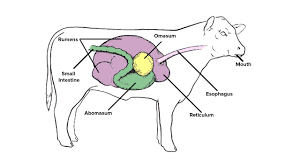
In this article, the digestion process in ruminant animals will be studied. Ruminants have a digestive system that is significantly different from monogastric animals.
Understanding the ruminant digestion process is essential, as it forms the basis for later sections that discuss feed materials and the feeding practices for sheep, goats, and cattle.
Digestion in Ruminant Animals

The rumen consists of pillars, and rhythmic contractions of these pillars cause the rumen to contract and expand, resulting in a mixing of its contents. The rumen contents have a liquid part at the bottom and a dense floating “raft” of fibrous materials.
These fibrous materials are the ones the ruminant chews further (regurgitates). The act of regurgitation reduces the particle size of these fibrous materials, increasing the surface area for attack by microorganisms in the rumen and reticulum.
Carbohydrate Digestion in the Rumen
Fungi are the first microorganisms to attack food in the rumen, secreting enzymes that break down surrounding fibers, reducing the physical strength of food particles and allowing bacteria and protozoa to enter.
The rumen is an anaerobic (oxygen-free) environment where protozoa and bacteria secrete enzymes that break down the beta-linkages in forages and other fibrous feed materials, producing pyruvic acid (pyruvate).
This is further oxidized to produce volatile fatty acids (VFA). The major fatty acids produced in the rumen are acetic acid, propionic acid, and butyric acid, along with minor ones like valeric and iso-butyric acids, which come from microbial protein metabolism.
VFAs are absorbed through the rumen wall. It is important to note that the energy produced during anaerobic fermentation is lower than that produced during aerobic fermentation, where the end products are carbon dioxide and water.
Read Also: How to Market your Matured Fishes for Profit
Protein Digestion in the Rumen

Some of the proteins consumed by ruminants may escape microbial fermentation in the rumen and pass unchanged into the abomasum. These proteins can be digested by normal enzymatic processes in the abomasum, playing a crucial role in ruminant nutrition.
These proteins are referred to as “Bypass Protein” or “Rumen Escape Protein.” The fraction of dietary protein that is degraded in the rumen is known as Rumen Degradable Protein (RDP). The end products of RDP digestion include simple amino acids, ammonia, and some urea.
Digestion leaves the reticulo-rumen through the reticulo-omasal orifice and moves into the omasum. The omasum’s main role is to absorb a large volume of water that comes with the digesta.
Digestion in the Hind-Gut
Once the digesta enters the abomasum, it undergoes a series of changes due to enzyme action, similar to what occurs in the simple stomach of monogastric animals.
Digestion in Young Ruminants

Ruminants are not born with a fully functional rumen. At birth, the rumen and reticulum together make up about 30% of the total stomach volume. By the age of two months, this increases to about 70%, and in a mature cow, the rumen and reticulum together account for 85% of the total volume. The abomasum, on the other hand, decreases from 70% to 7% of the total stomach volume.
In young ruminants feeding solely on their mother’s milk, foregut digestion does not occur. Instead, milk passes directly from the esophagus to the abomasum through the esophageal groove, formed as a reflex action initiated by suckling.
This prevents milk from undergoing microbial fermentation, preserving its nutritional quality. As the young ruminant matures and begins to consume grasses and other solid feeds, the rumen develops, and the ability to close the esophageal groove is lost.
Read Also: Introduction and Feasibility Study on Fish Farming
Advantages of the Ruminant Digestion Process

The microbial population in the rumen has a significant impact on nutrient metabolism. Microorganisms allow for the effective utilization of fibrous materials, particularly cellulose, through the action of protozoa and bacteria, which break down cellulose’s beta-linkages.
Microorganisms can also synthesize essential nutrients, such as using non-protein nitrogen (NPN) to synthesize cellular proteins, reducing the need for high-quality protein in the diet. Furthermore, rumen microorganisms can produce all B-complex vitamins, except for vitamins A, D, and E.
Disadvantages of the Ruminant Digestion Process
A major disadvantage of the ruminant digestion process is that most dietary proteins are degraded to ammonia and then to microbial protein, which is sometimes of lower quality than the original dietary protein, resulting in wastage.
Simple sugars, such as glucose and starches, are completely broken down to volatile fatty acids, which are used less efficiently for energy than the original carbohydrates. Additionally, up to 4-10% of the energy consumed is lost as methane and hydrogen gases, which cannot be utilized by the animal.
In conclusion, the digestion process in ruminant animals is a complex activity that involves the breakdown of fibrous materials by microorganisms in the rumen, working symbiotically with the animal. As a result, ruminants do not require all nutrients to be supplied through feed, as some can be synthesized through microbial action in the rumen.
Do you have any questions, suggestions, or contributions? If so, please feel free to use the comment box below to share your thoughts. We also encourage you to kindly share this information with others who might benefit from it. Since we can’t reach everyone at once, we truly appreciate your help in spreading the word. Thank you so much for your support and for sharing!
Read Also: How to Make an Avocado Tree Bear Fruit
Frequently Asked Questions
We will update this section soon.