


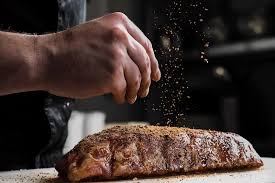
Specific equipment is employed during the meat cutting operation. The pattern of cutting an animal carcass depends on the animal being processed, as the composition of animals differs. This article details the equipment, techniques, and processes for cutting various meats in agricultural settings.
Essential Meat-Cutting Equipment
The specifications for meat cutting equipment must be strictly adhered to in order to avoid problems in meat processing. The equipment includes:
- Solid cutting table, preferably made of non-corrosive material (stainless steel, aluminum, or galvanized material) with a hard plastic top. If wood must be used instead of plastic, only tight wooden tops/cutters should be used.
- Oil or water sharpening stone
- Sharpening steel
- Knives
- Boning: 20 cm straight
- Steak: 30 cm curved
- Meat saw, hand or electric
- Totes, bins, and meat trucks (plastic or other non-corrosive material)
- Wrapping table
- Paper or plastic foil/bags for meat wrapping
- Tool holder
- Metal mask/safety gloves
- Boning aprons/safety aprons
- Hand wash-basin
- Knife sterilizer
Read Also: Economic Importance, Uses, and By-Products of Watermelon Shoots
Techniques for Cutting Different Meats
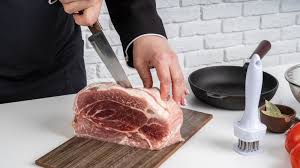
The pattern of cutting an animal carcass depends on the animal being processed, as the composition of animals differs.
1. Beef Cutting Methods
Four essential points when cutting beef or any other meat animal carcass are:
- Cut across the grain of meat when possible.
- Use sharp knives and saws for speed and good workmanship.
- Keep the cutting table orderly and have a place for everything.
- Be clean and sanitary in all operations.
There are different ways to cut the fore- and hindquarters of beef depending on its use, the wishes of consumers, and the quality of the carcass. Poor quality meat is normally used for further processing, while higher-quality and thicker-fleshed carcasses are used as fresh meat in the form of steaks and roasts.
a. Halving the Beef Carcass
Halving is done immediately after the animal has been dressed, and every effort should be made to divide the carcass into equal sides through the center of the backbone.
b. Quartering the Beef Carcass
Quartering or ribbing down is the division of a side between the twelfth and thirteenth ribs into fore- and hindquarters. One rib is usually left on the hindquarter to hold the shape of the loin and to make it easier to cut steaks. Dividing between the twelfth and thirteenth ribs splits the carcass almost in quarters, usually with slightly heavier forequarters. Make this cut straight and neat.
Locate the exact place between the ribs on the inside of the carcass and make the cut about 5 cm from the midline at the flank. The flank part should be left attached until the quarter is ready to be carried to the cutting table. Then saw the backbone, making the cut even with the knife to produce smooth and attractive appearances to the small end of the loin.
Make this cut from the inside. The large muscle exposed when this cut is made is the “eye of beef” in which most of the quality characteristics of the meat can be seen, including color, marbling, firmness, and texture.
High-quality beef will have a bright cherry-red color, some intramuscular fat or marbling, be firm to the touch, and fine in texture. When the person carrying the meat has a firm grip on the forequarter, the small strip of flesh holding the quarters together should be cut.
With some practice and experience, one can learn to carry a forequarter easily by holding below the shank so that the full weight of the quarter is on the carrier’s shoulder when it is cut down. By taking a step forward as the cut is being made, it is easier to have the quarter drop with the right proportion of weight on the shoulder.
The right forequarter should be carried on the left shoulder and the left forequarter on the right shoulder. When placing the forequarter on the cutting table, always have the inside up.
c. Bone-In Cutting Method
By far the easiest way to merchandise meat is to have some basic information relative to the bone and muscle structure of the carcass and to utilize an electric saw to cut up the whole carcass. This is now being done to a large extent by meat packers who cut out what is commonly referred to as a wholesale or primal cut, such as a whole chuck (shoulder), rib, loin, or round of beef.
The cut may or may not be trimmed of some bone and fat and then vacuum-packaged and shipped to a retail store. The vacuum-packaging provides an anaerobic atmosphere, and the refrigerated shelf-life of the product may be extended as much as two or three months.
The store personnel need have only the slightest knowledge of meat cutting. The primal is positioned correctly and run across the saw in a prescribed fashion, the saw dust is scraped off, and the consumer-sized cut packaged for retail sale.
Common wholesale or primal cuts of beef from the forequarter are the square-cut chuck, shank, brisket, plate, and rib, and from the hindquarter the flank, loin, and round.
The kidney knob, consisting of kidney and fat, is removed from the loin. Since the hindquarter contains a higher proportion of tender cuts, it is usually in greater demand and returns higher prices.
i. Forequarter Processing
The first cut to make is between the fifth and sixth ribs counting from the neck back. This cut is made parallel with the ribs and produces a cross-cut chuck consisting of a square-cut chuck (also called chuck and blade), foreshank, and brisket.
Next, the foreshank and brisket are removed by cutting through the first sternal cartilage (the first soft segment of the breastbone), and making the cut almost parallel with the backbone of the carcass.
ii. Foreshank Processing
The foreshank is separated from the brisket by following the natural connective tissue seam between the muscles with a knife. The foreshank can then be sawn into small pieces to be used for soup stock or the lean may be removed and used for ground meat.
iii. Brisket Preparation
The brisket, boned and made into a roll, can be used either as a pot roast or can be cured (corned).
iv. Square-Cut Chuck Processing
This wholesale cut contains the first five ribs of the forequarter and may be sawn into steaks or roasts. Several cuts are usually made across the bottom or shank end of the chuck, resulting in arm steaks or roasts. The chuck is then turned, and cuts are made parallel with the ribs, resulting in blade steaks and roasts.
If the carcass is of high quality and thickly fleshed, steaks cut from the rib end of the chuck or across the arm bone will be highly desirable. Blade cuts to be used as roasts should contain two or three ribs and should be trimmed as for standing rib roasts, although for convenience in carving, all bones may be removed.
The portions nearest the neck usually have more connective tissue and are recommended for simmering rather than for steaks and roasts.
v. Neck Processing
Only the neck remains to be processed. It is usually severed at a point where it enlarges to meet the shoulder. The neck contains a large amount of bone and connective tissue and is generally used for simmering, corning, or grinding. All bloody portions should be trimmed off before other cutting is done.
vi. Short Plate Processing
The cut to divide the short plate from the rib is made 18-25 cm from the inside edge of and parallel with the chine or backbone. This division varies according to the thickness of the carcass. With a thick carcass, the cut may be made further down the ribs, and with a thin carcass nearer the spinal column.
The plate may be used for different purposes, but it is commonly used for stews or further processing. Short ribs, which are suited for broiling, are also cut from the upper portion of the plate, usually about 5-8 cm in length.
If the plate is to be used for corning, all of the ribs should be removed. If used for stews, the ribs can be left in, and the plate sawn crosswise into small pieces. The plate can also be boned, and the meat used for ground meat or sausage products. Before cutting the plate in any way, remove the tough membrane lining the inner portion below where the ribs join the breastbone.
vii. Rib Processing
The rib cut is made up of the rear seven ribs in the forequarter. This is the most valuable piece of meat from the forequarter because it is the tenderest and has the least amount of bone. It has a large bundle of muscle fiber that runs parallel to the backbone.
There are several different ways to prepare the rib cut for cooking as a roast. It may also be used for steaks. It may be prepared as a bone-in, folded, or rolled roast. If prepared as a bone-in roast, the superior spinous processes of the vertebrae or featherbones are loosened from the meat and then cut off with a saw.
In making this cut, keep the knife as close to the bone as possible to avoid removing the thin lining that surrounds the bundle of muscle fiber next to the bone. With the saw, cut across the ribs at intervals of about 8 cm, just deep enough to cut through the ribs. Also remove the yellow connective tissue or ligament found between the outer covering and the layer of muscle.
The only difference between a bone-in and a folded rib roast is that a small 5-cm piece of rib is removed so that the thin end of the cut may be folded and skewered to the heavy portion. This simply makes a neater, more compact package.
viii. Hindquarter Processing
Place the hindquarter on the cutting table with the inside of the carcass up because the first cut made is to remove the kidney knob from the inside of the loin.
ix. Kidney Knob Removal
Begin removing the kidney fat at the lower end and loosen it with a knife where it is attached to the loin, leaving a thin covering on the inside of the loin and being careful not to cut into the tender loin muscle.
x. Flank Processing
Remove the flank next by cutting into the scrotum or udder, following the round muscle and cutting close enough so little of the lean meat is taken from in front of the stifle joint. Continue cutting along and below the outer portion of the line of the kidney fat, or in a straight line to leave 10 cm of the thirteenth rib in the flank.
This cut may vary with the thickness of the carcass and is lowest in thick or heavy carcasses. The tough membrane covering the inside of the flank must be removed by cutting off a thin strip on the lower side and then peeling off the membrane.
A small piece of lean meat on the inside of the end portion of the flank, weighing 1.2-1.4 kg, is known as the flank steak. This heavy bundle of muscle fibers is dry and, if used for steak, is often scored on both sides, marinated, or sliced thin to make it more tender and desirable as a steak. The entire defatted flank may be used for stew or ground beef or rolled around stuffing and pot-roasted.
xi. Round Processing
The round and loin are divided at about the fourth sacral joint in the spinal column to almost parallel with the back end of the round, or to about 5 cm in front of the stifle joint. The aim is to cut the tip of the ball-and-socket bone in the hip joint, cutting off a piece about 2.5 cm in diameter.
The round includes the rump, round cushion (consisting of knuckle piece and inside round muscle or topside), outside round muscle (also called bottom round muscle or silverside), and hind shank. Remove the rump by cutting just below the exposed pelvic or aitchbone. The rump usually has a large amount of bone.
The most desirable piece of rump is cut from the upper portion and is composed of eye and bottom round muscles. The removal of bone and tying the rump means that it requires less oven space and is easier to carve. Round steak is cut in comparatively thin slices from the full round after removal of the rump. The choicest round steaks are cut from the center section.
The remaining portion is made up of the hind shank and the piece called the heel of the round. The heel of round is used as a pot roast and is removed by cutting close to the bone and tearing away as much meat as possible from the backside. The shank can be sawn into pieces to be used for soup stock.
xii. Loin Processing
The loin is usually completely sawn into steaks beginning at the large end. Sirloin steaks are cut first, and the first three or four are known as wedge or round bone sirloin steaks. These are the least desirable pieces of the sirloin. The last sirloin is cut where the hip-bone is separated from the spinal column, and the steak cut there is known as the hip- or pin-bone sirloin steak.
The small portion of the loin known as the short loin is the source of T-bone steaks. This area contains the two most tender muscles in the whole carcass, namely, the loin eye muscle above the bone and the tenderloin muscle below the bone.
T-bone steaks are cut to about 10 cm from the end of the short loin. This tip portion can either be used as a roast or be cut into rib steaks. Rib steak from the short loin is identified by the piece of the thirteenth rib remaining on it. When beef is to be cured and dried, pieces should be taken from either the chuck or the round.
If the round is used, remove the rump and follow the procedure for muscle boning. If taken from the chuck, use the heavy piece commonly known as shoulder clod.
xiii. Muscle-Boning Method
One excellent approach to cutting up meat animal carcasses, which is becoming more popular and utilized by large meat processors, is the procedure commonly referred to as “muscle-boning.” While this procedure is particularly adaptable to large carcasses such as beef, it can be successfully used on carcasses or cuts of any size.
Muscle-boning is also popular among hunters who do not have meat saws but who want to cut up a whole carcass with a knife while removing the bone that would otherwise fill valuable freezer space.
Any animal carcass with a complete and thick layer of subcutaneous or cover fat would have to have most of the fat removed in order to expose the muscles. Once the fat is removed, a boning knife can be used to separate each large individual muscle or group of muscles.
This is done along the seams of connective tissue that encases each muscle. Once separated, the muscle mass is then cut from the bone, thus the term “muscle-boning.”
The advantages of this procedure are numerous; however, the principal reasons for using it are to obtain small-sized portions for sale or preparation; to permit each muscle or muscle combination to be treated or prepared according to its individual characteristics of size, tenderness, flavor, or fiber orientation; and to remove much of the bone and fat that would otherwise take up packaging and storage space.
xiv. Muscle-Boning Directions for Beef
Initially for muscle-boning, the side of beef is divided into fore- and hindquarters as described for the bone-in method. Also, both the fore- and hindquarters are placed on the cutting table with the inside up. One muscle-boning method is as follows:
a Forequarter Muscle-Boning
The forequarter is sawn into square-cut chuck, foreshank, brisket, rib, and plate as in the bone-in method.
b. Foreshank Muscle-Boning
The foreshank has attached to it, behind the elbow joint, a relatively large, thick piece of muscle. This is usually cut out by following the connective tissue seams and produces a fairly large triangular-shaped cut correctly identified as boneless arm roast.
The remainder of the foreshank can be sawn into soup bones or can be separated into bone and soft tissue with a knife. The soft tissue is composed of muscle, fat, and a large amount of connective tissue, which is best utilized as ground meat.
c. Brisket Muscle-Boning
The ribs and sternum are lifted from the inside of the brisket, and the excess fat is removed. The brisket can either be rolled or tied to be used as a pot roast or it can be cured.
d. Square-Cut Chuck Muscle-Boning
The neck is sawn from the chuck and trimmed of bone, fat, and the large prescapular lymph gland. The boneless neck can be utilized as a pot roast; however, it is more often cut into cubes for stew or ground meat.
From the large remaining portion of the chuck, the ribs and feather bones (superior spinous processes) are removed with a knife, and the heavy, yellow connective tissue or elastin is removed from the top of the cut.
With a knife, the thick portion is then separated into outside and inside portions by following the inside or smooth side of the blade-bone, which is then lifted from the outside piece along with what remains of the arm bone.
The inside portion, which contains some of the rib eye muscle, is often rolled and tied to be used as a pot roast. There is a part of the outside chuck, a muscle that somewhat resembles the tenderloin muscle in size and shape but not in tenderness, which is often cut into steaks known as chuck fillets.
e. Rib Muscle-Boning
The rib is prepared by first sawing across the rib bones to facilitate the removal of both the backbone and the ribs with the knife. Another procedure often used to bone out a rib is carefully with a sharp knife to loosen the small strip of meat found between the ribs.
The ribs are then loosened by cutting close to the bone and removed by striking with a blunt instrument. After removing all bones and the heavy yellow connective tissue, the meat may be rolled into a tight bundle with the thin portion on the outside and tied tightly.
Preparing ribs in this way makes for convenient carving and requires less cooking and storage space. About 25 percent of the initial rib weight is lost when the bones are removed. The boneless rib may also be sliced into boneless rib steaks.
f. Plate Muscle-Boning
After the heavy connective tissue lining is peeled from the inside of the plate, the bones are removed, and the lean meat cubed for stew or prepared for grinding in a way similar to the trimming of the brisket.
g. Hindquarter Muscle-Boning
As a first step, the kidney and accompanying fat are removed from the hindquarter carefully with a knife so as not to cut into the tenderloin muscle. The hindquarter is then separated into flank, round, and loin as described in the bone-in method.
h. Flank Muscle-Boning
Remove the flank by cutting into the scrotum or udder, following the round muscle and cutting close enough so that little lean meat is taken from the front of the stifle joint. Continue cutting along and below the outer portion of the line of the kidney fat in a straight line and saw through the thirteenth rib. Again, the flank steak is removed as described in the bone-in method.
i. Round Muscle-Boning
The round and loin are separated with a saw as described in the bone-in method. The pelvic bone is removed from the round, and the muscle sections of the round are exposed.
Muscle-boning the round means that the large muscle masses of the round are separated from each other by following the natural connective tissue seams. In front of the stifle joint, the tip or knuckle piece is removed, then the topside or inside round muscle, and then the remaining silverside or bottom round muscles.
The latter is often divided, and the eye of the round removed separately. All of the separated muscles may then be used as roasts or sliced into steaks. Muscle-boning is particularly useful when beef is prepared for roasting for large groups, such as pit barbecuing.
j. Hind Shank Muscle-Boning
The hind shank, somewhat like the foreshank, has a large muscle group attached to it that can be removed and utilized as a pot roast. This cut is sometimes referred to as the “duck” of beef.
k. Loin Muscle-Boning
The tenderloin muscle is carefully cut from the inside of the loin and usually cut into individual steaks. The remainder of the loin is then sawn just in front of the hip-bone into the short loin and sirloin sections.
The bone is removed from the sirloin, which is a somewhat complicated procedure because the pelvic bone is fused with the backbone. The short loin is boned, and the muscle that is known as boneless top loin is usually cut into boneless top loin steaks.
l. On-the-Rail Boning Method
This is a modification of the muscle-boning method. Typical for on-the-rail boning is the hanging position of the hindquarter or the entire beef side during the boning procedure. The removal of the different meat cuts from the hanging carcass is considerably facilitated.
Beef cuts can easily be pulled downwards under their own weight after being freed along their natural connective tissue seams. Special hooks with handles used by the operators are an additional aid for the correct fixation of the cuts during boning.
On-the-rail boning is the most hygienic way of meat cutting, as contamination by hands of operators, tools, cutting-boards, etc., is less than with other methods. The technique is also suitable for smaller operations. Final trimming of the meat cuts takes place on cutting tables as usual.
When meat cuts are produced by muscle-boning, it is often difficult to identify them, primarily because traditionally the size and shape of the accompanying bone has been used as the major means of identification. Also, the traditional shape of muscle in a cut of meat is often determined because of its attachment to bone.
Many conventional cuts of meat combine muscles because of their association, size, and proximity to bone or general location. The basic principle of merchandising meat is to separate the tender from the less tender and to sell each according to its palatability characteristics and its possible method of preparation. Muscle-boning facilitates this type of merchandising.
2. Pork and Lamb Carcass Cutting
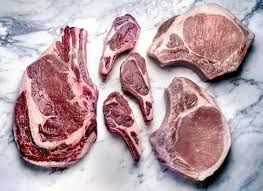
a. Pork Cutting Techniques
Halving is done immediately after the animal has been dressed, and every effort should be made to saw the carcass into equal sides through the center of the backbone. The side to be cut should be laid on the cutting table with the inside up. The primal cuts of pork are ham, fore-end or forequarter, loin, and belly.
i. Hind Foot Removal
The hind foot is removed by sawing through the hock joint at a right angle to the long axis of the leg.
ii. Ham Processing
The ham may be removed in several ways to make either long-cut or short-cut hams. One procedure (short-cut) is to locate the division between the second and third (or the third and fourth) sacral vertebrae and saw perpendicularly to the long axis of the ham.
After the bone has been severed with the saw, the knife is used to complete the removal of the ham. The ham is further trimmed by removal of the tail bone on one side and the flank on the other side. Commonly, a skinned ham is produced by removal of three-fourths of the skin and fat from the rump end.
For the production of special cured dried hams, the skin is left on. In order to obtain a long-cut ham, the division is made between the last two (fifth and sixth) lumbar vertebrae.
The long cut is composed of a rump or chump portion and a leg portion comprising center section and shank portion. Nowadays, more processors are removing the bones, thus fabricating a boneless rump (chump) and a boneless ham.
The ham is commonly merchandised in smaller portions (topside, silverside, thick flank, shank) and the internal fat deposits before further preparation of the thick flank, e.g., for diced pork or steaks.
iii. Forefoot Removal
The forefoot is removed by sawing through the junction between the foreshank and the forefoot bone at a right angle to the length of the foot. This foot contains some muscle and is therefore more desirable than the hind foot for food.
iv. Fore-End Processing
Considerable variation exists as to where the fore-end is removed. Generally, one to three ribs are left on the pork fore-end. Locate the division between the third and fourth ribs from the head end and saw perpendicularly to the length of the backbone.
The fore-end is trimmed of the hock, which is cut off about halfway up the leg, and about two-thirds of the skin and fat is removed from the butt or top end. Additionally, the neckbone (all cervical and three thoracic vertebrae) and the jowl or cheek meat are removed.
The jowl is removed by a straight cut parallel to the cut that separates the fore-end from the side just behind the site where the ear was removed. The fore-end may be divided into two cuts (spare-rib, also called blade Boston, and hand, also called arm picnic) by sawing just below the exposed lower end of the blade-bone parallel to the top of the shoulder.
The spare-rib can be sliced into steaks or used as a roast. It can easily be made into a boneless cut by removing the corner of the blade-bone. Besides this method, some other ways of cutting and boning the pork fore-end exist.
In order to obtain boneless cuts (shoulder and neck-end) from the fore-end, the following technique is recommended. Seam the shoulder carefully from the rest of the side, leaving the rind and associated fat behind.
Release the under-blade steak and remove the blade-bone (scapula) and the shoulder-bone (humerus). Separate the main muscle block from the smaller group. The smaller group, after trimming the fat off, can be used for dicing. The main shoulder block should be trimmed of excessive connective tissue.
It can be separated further into the blade and feather muscles and the main shoulder muscle. These can then be sliced into a number of boneless steaks. The group of muscles on either side of the spinous processes of the neck bone and the two or three following segments of the backbone is called the neck-end.
The neck-end is loosened from the backbone and, after trimming of excessive rind, fat, and any adhering ragged edges, it can be cut into attractive steaks.
v. Loin Processing
The middle or center section of the pork side is divided into loin and belly by a straight cut from the edge of the tenderloin muscle on the ham end through a point on the front rib tight against the protruding edge of the split backbone.
The fat back (skin and excess fat) is removed from the loin so that a complete fat cover about 0.5 cm thick remains. Starting along the backbone side at the shoulder end, cut and lift the fat over the curve of the loin muscles without cutting into the lean.
The loin can be roasted whole, cut into smaller roasts, or cut into chops. Shoulder, rib, loin, and sirloin chops are made from the loin. Chops for broiling or frying should be cut 1.3-1.9 cm thick. Thicker chops may be made, and a pocket cut into them for stuffing.
vi. Belly Processing
Separate the spare-ribs from the belly by cutting closely underneath the ribs, beginning at the flank end. Prepare the bacon side from the belly by removing any thin or ragged pieces of lean. Turn the belly over and remove the lower edge with a straight cut just inside of the teat line. Trim the flank edge of the belly to square the whole piece to prepare it for curing.
b. Lamb Cutting Techniques
This procedure, as described, may also be followed for the processing of deer, goats, sheep, or other animal carcasses of similar size.
i. Cooling the Lamb Carcass
All lamb carcasses should be promptly chilled and kept at a low temperature (-2°C to 2°C) until cut and utilized. Do not permit lamb carcasses to freeze within a day after slaughter, or the meat may toughen. Lamb carcasses can be cut into retail cuts after they have been chilled for 24 to 48 hours.
ii. Lamb Carcass Preparation
Lamb carcasses are generally not split into halves after dressing because they are not thick enough in any location to create cooling problems. Begin cutting the lamb carcass by removing the thin cuts, i.e., flank, breast, and foreleg. Lay the carcass on the cutting table and mark one side from the cod or udder fat in front of the hind leg to the elbow joint.
After removing the thin cuts from both sides, remove the kidneys, kidney fat, and diaphragm. Next, the carcass is turned over, and the neck removed either in thin slices to be braised or in one piece to be added to stew or to be boned and ground.
The trimmed carcass can then be separated into four primal cuts, each with different characteristics. A cut between the fifth and sixth rib removes the shoulder.
Another cut between the twelfth and thirteenth (last) rib separates the rib from the loin. The loin and legs are separated just in front of the hip bones by cutting through the back where the curve of the leg muscles blends into the loin.
iii. Leg Processing
Split the legs through the center of the backbone. Trim off the flank and cod or udder fat. Utilize the saw and knife to remove the backbone from the leg. The leg may be further trimmed by cutting through the knee-joint, which is located about halfway between where the muscles of the shank end and the muscles of the lower leg begin.
Work the knife and cut through the joint. Several sirloin chops may be cut from the loin end of the leg. Legs may either be prepared with the bone in or the bones completely removed and the leg rolled and tied.
iv. Loin Processing
The loin is usually split through the middle of the backbone, and chops are cut perpendicularly to the backbone. Lamb chops are cut about 2.5 cm thick. Double or “English” chops are made from a loin that has not been split. Remove the fell or connective tissue covering before cooking chops.
v. Rib Processing
The rib of lamb is prepared by sawing through the ribs on both sides of the backbone. The main portion of the backbone is then removed with a knife. Rib chops are easily made by cutting between the ribs. Remove the fell before cooking the chops. The breast portion may be barbecued in one piece or made into riblets by cutting between the ribs.
vi. Shoulder Processing
After splitting through the backbone, the shoulder may be roasted as is, made into chops, or boned and rolled into a roast. Arm chops should be made first by cutting parallel to the surface where the foreleg and breast were removed. Blade chops are made by cutting between ribs and sawing through the blade- and backbones.
To prepare a boneless shoulder, first remove the ribs and backbone by cutting closely underneath the ribs, backbone, and neck vertebrae. Next, from the rear surface, cut along the inside of the blade-bone to expose it and the arm bone.
Cut along the edges of the bones and remove them. Roll the meat and tie it securely with clean twine. The boneless shoulder may also be made into a pocket roast and stuffed with ground lamb or other dressing. The edges of the pocket roast are stitched together.
vii. Shanks Processing
Both the fore- and hind shanks, when removed, can be barbecued, cut into pieces for stew, or boned and the meat ground.
viii. Lean Trimmings Processing
Lean trimmings of lamb in chunks are suitable for stews or to be marinated and used for special roasts. Other lean trimmings can be ground and used as one would prepare ground veal or beef.
Read Also: Economic Importance, Uses, and By-Products of Watermelon Axils
c. Sheep Carcass Preparation
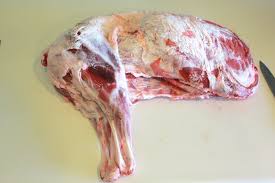
Sheep can carry large volumes of dirt into the slaughterhouse. It is impossible to avoid contamination of sheep and lamb carcasses when the fleece is heavily soiled. The fleece or hair must never touch the skinned surface; neither must the operator touch the skinned surface with the hand that was in contact with the fleece.
i. Combined Horizontal/Vertical Skinning Method
The animal is turned on its back, and cuts are made from the knuckles down the forelegs. The neck, cheeks, and shoulders are skinned. The throat is opened up, and the gullet (food-pipe) is tied off. The skin on the hind legs is cut from the knuckles down to the tail root.
The legs are skinned, and the sheep is hoisted by a gambrel inserted into the Achilles tendons. A rip is made down the midline, and skinning proceeds over the flanks using special knives or the fists.
The pelt is then pulled down over the backbone to the head. If the head is for human consumption, it must be skinned, or it will be contaminated with blood, dirt, and hairs.
ii. Moving Cradle and Rail Skinning System
The hanging carcass is lowered onto a horizontal conveyor made up of a series of horizontal steel plates, bowed slightly and divided into sets large enough to cradle a single animal.
Two operators usually work together on each lamb, performing the legging operations and opening the skin to the stage where it can be pulled off the back. When the gambrel is inserted into the hind legs, it is hoisted onto a dressing rail.
iii. Vertical Skinning Method
At sticking, the animal is shackled by one hind-leg and left to bleed. Dressing commences with the free leg, which is skinned, and the foot removed. A gambrel is inserted into this leg and hung on a runner on a dressing rail. The second leg is freed from the shackle, skinned, and dressed, then hooked onto the other end of the gambrel.
The skin is opened down the midline and cleared from the rump. A spreader frame (a bar U-shaped at each end) spreads the front legs to simplify work on the neck, breast, and flanks.
The front toes are held in each end of the frame, which is then slung up onto a separate traveling hook. The animal is therefore suspended by all four legs, belly uppermost. Skinning continues as in the combined horizontal/vertical method.
To clear the shoulders and flanks, the forelegs are freed from the spreader, and the feet removed, the animal returning to a vertical position. The skin can now be completely pulled off, including the head if this is for consumption, though this takes some work with the knife. In both methods, after fleece removal, the vent and food-pipe are cleaned and tied off.
d. Evisceration Processes
With all species, care must be taken in all operations not to puncture the viscera. All viscera must be identified with the carcass until the veterinary inspection has been passed. After inspection, the viscera should be chilled on racks, etc., for better air circulation.
i. Cattle Evisceration
The brisket is sawn down the middle. In the combined horizontal/vertical system, this is done with the animal resting on the cradle. The carcass is then raised to the half-hoist position, and when hide removal is complete, the abdominal cavity is cut carefully along the middle line.
The carcass is then fully hoisted to hang clear of the floor so that the viscera fall out under their own weight. They are separated into thoracic viscera, paunch, and intestines for inspection and cleaning.
If any of the stomachs or intestines is to be saved for human consumption, ties are made at the esophagus/stomach, stomach/duodenum boundaries, the esophagus and rectum having been tied off during hide removal. This prevents cross-contamination between the paunch and the intestines.
ii. Small Ruminants Evisceration
A small cut is made in the abdominal cavity wall just above the brisket, and the fingers of the other hand are inserted to lift the body wall away from the viscera as the cut is continued to within about 5 cm of the cod fat or udder.
The omentum is withdrawn, the rectum (tied off) loosened, and the viscera freed and taken out. The food-pipe (tied off) is pulled up through the diaphragm. The breastbone is split down the middle, taking care not to puncture the thoracic organs, which are then removed.
Loosen and tie off the rectum. Pigs are cut along the middle line through the skin and body wall from the crotch to the neck. Cut through the pelvis and remove the bladder and sexual organs. In males, the foreskin must not be punctured, as the contents are a serious source of contamination.
All these organs are considered inedible. Remove the abdominal and thoracic viscera intact. Avoid contact with the floor or standing platform. The kidneys are usually removed.
Do you have any questions, suggestions, or contributions? If so, please feel free to use the comment box below to share your thoughts. We also encourage you to kindly share this information with others who might benefit from it. Since we can’t reach everyone at once, we truly appreciate your help in spreading the word. Thank you so much for your support and for sharing!