



Fatty acids are organic acids produced by the hydrolysis of neutral fats and oils (i.e., lipids). Essential fatty acids, like essential amino acids, cannot be synthesized by the body and must be obtained through the diet.
Essential fatty acids include linoleic acid (LA) (of the omega-6 family) and alpha-linolenic acid (ALA) (of the omega-3 family). These two fatty acids are parent compounds for other biologically active long-chain polyunsaturated fatty acids (LCPUFAs).
Linoleic acid can be converted to gamma-linolenic acid (GLA) and arachidonic acid (AA). Alpha-linolenic acid can be converted to docosahexaenoic acid (DHA) and eicosapentaenoic acid (EPA).
These fatty acids are necessary for proper growth, maintenance, and functioning of the body. The LCPUFAs are major essential components of membrane phospholipids.
Read Also: How to Extract and Package Snail Slime (Snail filtrate) for Commercial Use
Importance of Essential Fatty Acids in Nutrition

It was first suggested that certain fats are essential for life as early as 1929 (Mead, 1982). Although the body can synthesize most fats de novo, certain fatty acids are required as dietary precursors to more critical functional fatty acids.
It was later recognized that two specific fatty acids, linoleic acid (LA) and alpha-linolenic acid (ALA), cannot be synthesized de novo due to the position of certain double bonds close to the methyl end of the molecule.
The twenty-carbon fatty acids of the omega-6 and omega-3 families [arachidonic acid (ARA) and eicosapentaenoic acid (EPA), respectively] are the precursors for a family of circulating bioactive molecules called eicosanoids.
1. Deficiency Symptoms of Essential Fatty Acids
Without these two fatty acids in the diet, animals develop symptoms such as dry, scaly skin, excessive water consumption, reduced growth, infertility, and other issues, now recognized as classic symptoms of essential fatty acid (EFA) deficiency.
It is now understood that the symptoms associated with deficiency are not necessarily due to the absence of LA or ALA, but rather to the resulting absence of the products of LA and ALA metabolism—the long-chain polyunsaturated fatty acids (LC-PUFAs).
2. Addressing Lack of Essential Fatty Acids
Similar to classic vitamin deficiencies, essential fatty acid deficiency can be overcome by only a small amount of dietary LA and ALA, and there are few reported cases of essential fatty acid deficiency in humans.
However, optimal body function (beyond absolute function) is highly dependent on the amount and ratio of these EFAs and their metabolites. This ratio has been drastically affected by changes in dietary patterns over the years.
2. Fortification of Agricultural Food Products
It is appropriate to consider fortifying foodstuffs with certain dietary fats, like food additives, to provide an optimal ratio of EFAs to maximize health and longevity. This rationale has driven the development of new types of food products referred to as “functional foods.”
Chemical Composition of Essential Fatty Acids
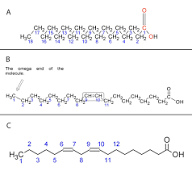
The most biologically relevant fatty acids are straight-chain hydrocarbons (12–22 carbons in length) with a terminal carboxyl group. They are synthesized through enzymatic steps that result in the successive elongation of precursor molecules by two-carbon increments and can be fully saturated or desaturated by the insertion of one to six double bonds at specific locations in the hydrocarbon chain.
All fatty acids with multiple double bonds have the double bonds interrupted by a methylene group, and all double bonds are in the cis configuration.
The position of the double bond is indicated by the number of carbon atoms from the functional (acid) group (e.g., oleic acid has a single cis double bond at the ∆9 position).
The standard biochemical nomenclature describes the fatty acid in terms of the length of its carbon chain, followed by the number of double bonds, and then the position of those double bonds.
Oleic acid is, therefore, referred to as C18:1(∆9), or a fatty acid with 18 carbons and one double bond at the 9 position, as shown in Figure 1.
1. Nutritional Nomenclature of Essential Fatty Acids
Nutritionists use a nomenclature that classifies families of fatty acids based on the position of the double bond closest to the methyl end of the molecule. For example, linoleic acid is chemically described as C18:2(∆9,12), but also as an omega-6 (or n-6) fatty acid since the double bond closest to the methyl end is six carbons away from the terminal methyl group.
This nomenclature is functionally useful because different fatty acid families have significantly different physiological and biochemical effects in the body.
The other essential fatty acid, alpha-linolenic acid, is chemically described as C18:3(∆9,12,15) and is nutritionally part of the omega-3 (n-3) family of fatty acids. The scientific and common names for the principal fatty acids in biology are provided in Table 1.
Common and scientific names of essential fatty acids and their chemical notations
| Common Name | Scientific Name | Chemical Notation |
|---|---|---|
| Omega-6 Family | ||
| Linoleic acid (LA) | Octadecadienoic acid | C18:2(Δ9,12) |
| Gamma-linolenic acid (GLA) | Octadecatrienoic acid | C18:3(Δ6,9,12) |
| Dihomo-gamma-linolenic acid | Eicosatetraenoic acid | C20:3(Δ8,11,14) |
| Arachidonic acid (ARA) | Eicosatetraenoic acid | C20:4(Δ5,8,11,14) |
| Osbond acid | Docosapentaenoic acid | C22:5(Δ4,7,10,13,16) |
| Omega-3 Family | ||
| Linolenic acid | Octadecatrienoic acid | C18:3(Δ9,12,15) |
| Stearidonic acid | Octadecatetraenoic acid | C18:4(Δ6,9,12,15) |
| Timnodonic acid | Eicosapentaenoic acid (EPA) | C20:5(Δ5,8,11,14,17) |
| Cervonic acid | Docosahexaenoic acid (DHA) | C22:6(Δ4,7,10,13,16,19) |
Read Also: The Health Benefits of Using Accent Seasoning on your Cooking
Biological Functions of Essential Fatty Acids in Agriculture
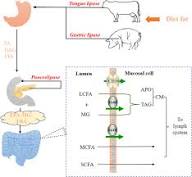
Essential fatty acids serve as structural entities, acting as membrane protein boundary lipids. They influence the performance of membrane-bound proteins. Twenty-carbon metabolites of EFAs play significant roles as circulating eicosanoids, directly affecting biological responses associated with immune function, including:
- Inflammatory response
- Induction of macrophages
- Production of antibodies in response to challenges
Generally, omega-6 eicosanoids are considered pro-inflammatory and up-regulators of typical immunological responses. EFAs are required to ensure normal development of the central nervous system in infants.
Dietary DHA supplementation has been shown to improve the EFA status and visual function of patients with visual dysfunction related to DHA deficiency.
1. Essential Fatty Acids and Cardiovascular Health
The potential role of essential fatty acids, particularly omega-3 fatty acids, in cardiovascular function has been studied extensively for the last 40 years.
Since the first observation by Dyerberg and Bang (1979) that indigenous Arctic populations consuming large amounts of omega-3 fatty acids (from fish and marine mammals) had a low incidence of cardiovascular disease, numerous clinical studies have assessed the effects of fish diets or fish oil pills on cardiovascular outcomes.
Most studies conclude that fish oil supplementation reduces triglycerides and improves the HDL/LDL ratio.
Applications of Essential Fatty Acids in Food Production
Certain LC-PUFAs are unique in requiring only small quantities relative to total dietary calories to achieve their functions. The omega-3 and omega-6 families may be present in different proportions in the diet, leading to an imbalance.
This imbalance has been linked to an increased incidence of chronic diseases. The human diet has changed drastically over the last 100 years. Modern agricultural processes have made seed oils (corn, soybean, palm, etc.) inexpensive, significantly increasing their presence in diets.
As these oils are omega-6 dominant, the proportion of omega-6 to omega-3 EFAs has risen to about 15:1, deviating from the ratio to which humans evolved.
To address this, increasing omega-3 EFAs or decreasing omega-6 EFAs in the diet is essential. Supplementing dietary calories with small amounts of omega-3 LC-PUFAs is a practical approach.
Commercial Sources of Essential Fatty Acids
| Fatty Acid | Commercial Sources | Levels |
|---|---|---|
| Omega-6 | ||
| LA | Vegetable oils: Corn, soy, canola | 59, 50, 30 |
| GLA | Specialty plant oils: Primrose, borage, black currant seed | 9, 22, 17 |
| ARA | Single-cell oils: Mortierella; Animal: Egg yolk | 18, 8 |
| Omega-3 | ||
| LNA | Vegetable oils: Soy, canola, flax (linseed) | 9, 7, 58 |
| EPA | Animal (fish): Menhaden, salmon, tuna | 10, 12, 6 |
| DHA | Animal (fish): Menhaden, salmon, tuna; Animal: Egg yolk; Single-cell oils: Crypthecodinium, Schizochytrium | 13, 4, 17, 2, 47, 25 |
1. Fortified Agricultural Food Products
Various foods, particularly in Japan and Southeast Asia, have been supplemented with omega-3 EFAs. Initially specialty foods, they are now mainstream, including fast and convenience foods. Companies in Japan market specialty drink products enriched with DHA at low levels.
Cookies and biscuits have also been produced, though disguising the taste of fish oil, a primary source of EPA and DHA, remains challenging.
A common issue with PUFA-enriched products is shelf-life, as PUFAs are highly susceptible to oxidation. Refrigerated dairy products are ideal candidates for supplementation, and packaging with low oxygen permeability materials and “flavor seals” helps prevent oxidation and off-flavors.
Regulatory Status of Essential Fatty Acids in Food
Essential fatty acids as food additives are generally recognized as safe (GRAS) due to their historical presence in the diet, exempting them from premarket approval requirements.
An exception is their use in infant formulas, which may require additional regulatory consideration. Enrichment of food products with supplemental PUFAs (omega-6 or omega-3) generally does not require prior approval.
Toxicological Considerations in Agricultural Applications
Essential fatty acids are nutrients present in human diets on an evolutionary timescale and are found in high levels in certain tissues. Under normal dietary circumstances, PUFAs are nontoxic.
However, as they are obtained from various sources, toxicological testing remains critical due to potential “co-travelers” in these sources.
Do you have any questions, suggestions, or contributions? If so, please feel free to use the comment box below to share your thoughts. We also encourage you to kindly share this information with others who might benefit from it. Since we can’t reach everyone at once, we truly appreciate your help in spreading the word. Thank you so much for your support and for sharing!