



The processing industries are a part of our environment and are often major generators of waste. Since the existing environment within which they operate is the only one we have, and shared by the consumers and operators of the sectors of the economy, there is the need, therefore, to ensure the preservation of the environment in as natural and ecologically balanced a state as possible for the use of all.
The food industries should be aware of the content of the waste they generate with the view of making them environment-friendly. In this article, we shall examine food process contaminants, industrial effluents, and noise pollution.
Read Also: Agricultural Tillage Practices
Food Processing Contaminants

The development of food processing technology which includes frying, toasting, roasting, evaporation, smoking, sterilization, pasteurization, irradiation, pickling, freezing, and canning expanded the potential of food supplies greatly in the modern era.
For example, smoke treatment made a year-round supply of fish possible, and canned foods could be sent anyplace in the world.
However, the chemical changes in food components, including amino acids, proteins, sugars, carbohydrates, vitamins, and lipids, caused by high-heat treatment have raised questions about the usual consequence of reducing nutritive values and even the formation of some toxic chemicals such as polycyclic aromatic hydrocarbons (PAHs), amino acid or protein pyrolysates, and N-nitrosamines.
Among the many reactions occurring in processed foods, the Maillard Reaction plays the most important role in the formation of various chemicals (including toxic ones).
1. Polycyclic Aromatic Hydrocarbons (PAHs)
Polycyclic aromatic hydrocarbons occur widely in the environment. The typical PAHs are shown in Figure 1. One of the most abundant food sources of PAHs is vegetable oil.
2. Benzo[a]pyrene
The most commonly known carcinogenic PAH is benzo[a]pyrene (BP), which is widely distributed in various foods.
i. Toxicity: For over 200 years, carcinogenic effects have been ascribed to PAHs. In 1775, Percival Pott, an English physician, made the association between the high incidence of scrotal cancer in chimney sweeps and their continual contact with chimney soot.
The research on the toxicity of PAHs, however, progressed somewhat slowly. In 1932, benzo[a]pyrene (BP) was isolated from coal tar and found to be highly carcinogenic in experimental animals.
3. Maillard Reaction Products
The summary of the Maillard reaction is shown in Figure 2. Many chemicals form from this reaction in addition to the brown pigments and polymers.
Because of the large variety of constituents, a mixture obtained from a Maillard reaction shows many different chemical and biological properties: brown colour, characteristic roasted or smoky odours, pro- and anti-oxidants, and mutagens and carcinogens, or perhaps anti-mutagens and anti-carcinogens.
4. Amino Acid Pyrolystates
In the late 1970s, mutagenicity of pyrolysates obtained from various foods was reported that could not be accounted for by PAHs formed on the charred surface of certain foods such as broiled fish and beef.
The mutagenic principles of the tryptophan pyrolysates were later identified as nitrogen-containing heterocyclic compounds.
A group of polycyclic aromatic amines is produced primarily during the cooking of protein-rich foods. The early work on the isolation and production of these substances was based on their mutagenicity.
5. N-Nitrosamines
N-nitrosamines have been an issue due to nitrite, which was added to prevent the growth of Clostridium botulinum in processed meat.
6. Food Irradiation
The use of ionizing radiation to preserve food falls into this category.
Gamma radiation is most often used for food irradiation. Gamma rays are a form of electromagnetic radiation produced by such radioactive elements as Cobalt-60 and Cesium-137. Such sources emit radiation with energies of up to 10 million electron volts (MeV).
This is sufficient to penetrate deep into foods, but is far below the range required to produce radioactivity in the target material. Since there is no direct contact between the source and the target, there is no mechanism that can produce radioactivity in irradiated foods.
Ionizing radiation can sterilize foods, control microbial spoilage, control insect infestations, and inhibit undesired sprouting.
Food irradiation has the potential to substantially reduce postharvest applications of pesticides to prevent spoilage due to insects and fungi. Irradiation can be used to destroy Salmonella in cases where heat treatment is not possible, for example, in frozen chicken.
Despite the potential of food irradiation as a preserving technique, it is widely misunderstood and controversial. Some opposition arises from apparent confusion between “irradiated” and “radioactive”.
Gamma irradiation of foods is in some ways analogous to sterilization of medical equipment with ultraviolet light. Both of these processes can kill a wide range of microorganisms by radiation.
Some other critics have raised questions about the toxicity of chemicals that may be produced during irradiation. The energies used are sufficient to produce free radicals, which can combine with each other or form new bonds to other compounds that may be present.
However, it is important to remember that heat treatments commonly used in food processing are likely to produce a higher degree of chemical modification than is irradiation.
Industrial Wastewater Pollutants in Agriculture
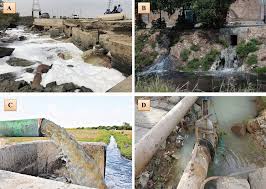
Increase in industrialization has led to an increase in the production of industrial waste. These industrial wastes cause major environmental havoc by polluting the water, air, and soil.
The quality and quantity of wastewater generated depend on the type of industry: it can contain non-biodegradable waste such as heavy metals, pesticides, plastic, etc., and biodegradable compounds such as paper, leather, wool, etc.
Industrial wastewater can be toxic, reactive, carcinogenic, or ignitable. Therefore, without proper treatment and management strategies, the discharging of the waste into water bodies can pose dreadful environmental and health effects.
1. Sources of Industrial Wastewater
Several waterborne pathogens proliferate in wastewater and produce toxins, affecting the earth’s ecosystem and human health. The toxins in industrial wastewater cause acute poisoning, immune system suppression, and reproductive failure.
According to the WHO, around 80% of diseases are waterborne. To address the environmental and health issues created by industrial wastewater, it is absolutely necessary to obliterate its toxicity by adequate treatment with physical, chemical, and biological means so that it can be recycled for water conservation.
2. Types of Wastewater
In general, wastewater has been categorized into two broad types: sewage wastewater and non-sewage wastewater. Sewage wastewater includes discharge from domestic activities.
The wastewater produced from places like houses, schools, hospitals, hotels, restaurants, public toilets, etc., containing body wastes (urine and faeces) comes under sewage wastewater.
All the other types of wastewater produced from commercial activities, such as that generated from factories and industrial plants, are termed non-sewage wastewater.
The non-sewage wastewater also includes stormwater and rainwater generated after rainfall or flood events. Day-to-day human activities are majorly water-dependent, which makes wastewater management and treatment very important.
3. Possible Pollutants from Industrial Wastewater
Water with dissolved and suspended substances discharged from various industrial processes, such as the water released during manufacturing, cleaning, and other commercial activities, is termed industrial wastewater.
The nature of the contaminants present in industrial wastewater depends on the type of the factory and the industry. Examples of industries that produce wastewater are the mining industry, steel/iron production plants, industrial laundries, power plants, oil and gas fracking plants, metal finishers, and the food/beverage industry.
The various contaminants commonly found in industrial water outlets are chemicals, heavy metals, oils, pesticides, silt, pharmaceuticals, and other industrial by-products.
In general, it is difficult to treat industrial wastewater, as individual examination of the setups and specific treatment plants are required on an industry-based level. Therefore, to deal with this, on-site filter presses are installed to treat the effluent wastewater.
Read Also: Maggot Feeding: Can You Feed Fishes with Maggots?
Noise Pollution in Agricultural Settings

Noise is playing an ever-increasing role in our lives and seems a regrettable but ultimately avoidable corollary of current technology. The trend toward the use of more automated equipment, sports and pleasure craft, high-wattage stereo, larger construction machinery, and the increasing numbers of ground vehicles and aircraft has created a gradual acceptance of noise as a natural by-product of progress.
Noise pollution is thus another environmental pollutant to be formally recognized as a genuine threat to human health and the quality of life. The fundamental insight we have gained is that noise may be considered a contaminant of the atmosphere just as definitely as a particulate or a gaseous contaminant.
There is evidence that, at a minimum, noise can impair efficiency, adversely affect health, and increase accident rates. At sufficiently high levels, noise can damage hearing immediately, and even at lower levels, there may be a progressive impairment of hearing.
This article is descriptive. It deals with the sources, characteristics, and effects of noise, describes methods for the measurement and analysis of noise, and lists some of the guidelines that are used to control the problem.
1. Characteristics of Noise
Noise levels in general have increased over the years, and some authorities hold that average noise levels in cities have increased at about 1 dB per year for the last 30 years.
The sound pressure level represents the magnitude of a noise source and is one of the characteristics that can assess whether a given noise is considered to be annoying.
There are other characteristics, both intrinsic to the noise and its context, that dictate whether people will consider it to be annoying:
- Frequency content or bandwidth
- Duration
- Presence of pure tones or transients
- Intermittency
- Time of day
- Location (or activity)
2. Sources of Noise Pollution
Basically, noise sources can be grouped into three types: transportation, industrial, and residential.
i. Transportation Sources: Transportation sources of noise are comprised principally of automotive and aircraft noises; motorcycles, scooters, and snowmobiles should also be considered. A main contributor to transportation noise is automotive traffic.
ii. Industrial Sources: Some industrial operations and equipment are significant noise sources. Principal examples are machinery or machine tools, pneumatic equipment, high-speed rotating or stamping operations, and duct, fan, and blower systems.
Typical noise levels for operating personnel may be quite high. Community exposure to such noises would, of course, depend on the proximity to the noise sources, and ambient noise levels in residential areas could be affected.
iii. Residential Sources: Residential sources, both indoor and outdoor, may not seem so significant at first. However, when one considers air conditioners, lawn mowers, power saws, dishwashers, kitchen and laundry appliances, television, stereos, pets, and children, the overall severity of these sources cannot be ignored.
Furthermore, the simple increase in the numbers of tools, cars, gadgets, and appliances used by modern industrial societies can create a substantial noise burden.
3. Effects of Noise Pollution
Effects of noise include physiological and annoyance types.
i. Physiological Effect: There is evidence indicating that exposure to noise of sufficient intensity and duration can permanently damage the inner ear, with resulting permanent hearing loss. Loss of sleep from noise can increase tension and irritability; even during sleep, noise can lessen or diminish the relaxation that the body derives from sleep.
ii. Annoyance Effect: In the annoyance category, noise can interfere with speech communication and the perception of other auditory signals; the performance of complicated tasks can be affected by noise.
Noise can adversely affect mood, disturb relaxation, and reduce the opportunity for privacy. In all of the above ways, noise can detract from the enjoyment of our environment and can affect the quality of human life.
4. Control of Noise Pollution
There are essentially three approaches to noise reduction and control.
i. Source Control: Source control can be achieved by careful consideration of noise control during the design of new products.
ii. Rerouting or Relocating Noise Sources: When the desired amount of noise reduction cannot always be achieved by good acoustic design at the noise source, the next best solution is the modification or alteration of the noise path between the source and the receiver.
Rerouting or relocating noise sources is an example of path modification and is best applied in the planning stage of highways and airports.
iii. Shielding: Another method of path modification is to interpose barriers between the source and receiver. Such a “shielding” is useful in attenuating highway noise levels imposed on nearby areas.
Do you have any questions, suggestions, or contributions? If so, please feel free to use the comment box below to share your thoughts. We also encourage you to kindly share this information with others who might benefit from it. Since we can’t reach everyone at once, we truly appreciate your help in spreading the word. Thank you so much for your support and for sharing!