



Food safety is a scientific discipline handling preparation and storage of food in ways that prevent foodborne illness. These include a number of routines that should be followed to avoid potentially severe health hazards.
For a restaurant, sanitation focuses on wholesome food and beverages that are prepared and served in an environment that is free of disease-causing organisms and other harmful contaminants.
At one time or another, a flu caused by a foodborne illness may have been experienced. Most foodborne illnesses contracted at restaurants go unreported because people often incorrectly assume that it is just a touch of flu, without realizing that almost everyone who ate that particular dish at the same restaurant got the same flu.
Role of Health Department Inspections in Food Safety
Health department inspections are incredibly important to the life and reputation of any food service operation in the food service industry. From time to time, the National Food and Drug Administration Control (NAFDAC) pays unexpected visits to various locations or factories where food service operations or production are being carried out.
Some time ago, a team of NAFDAC staff paid an unexpected visit to a bakery and discovered that the dough for the bread was being kneaded on a very filthy table, in a very filthy environment by a group of young men who wore only trousers with no shirts on.
Some of the men had open sores on their bodies and were sweating profusely. The sweat from their bodies dropped freely onto the dough they were kneading for the bread. This scenario was televised on one of the local TV stations.
The NAFDAC agents subsequently sealed off the bakery immediately. To avoid inspection problems, onsite management and staff should treat food safety as the top priority.
Implementing good safety practices ultimately depends upon higher management, which controls the amount of money available for training and equipment updates. Food safety competes for funding with many other corporate programs.
Read Also: Pincushion Flowers (Scabiosa Spp): Complete Growing and Care Guide
Common Food Safety Problems Identified by Research

In an executive research conducted by Eastern Research Group, Inc. (ERG) under contract to the US Food and Drug Administration (similar to Nigeria’s NAFDAC), titled Good Manufacturing Practices (GMPs) for the 21st Century Food Processing, in 2009, the group came up with definitions of food safety problems, which include the following:
1. Contamination of Raw Materials
This is the adulteration of food ingredients with pathogens and foreign objects so that the product is no longer wholesome and safe to eat. The problem encompasses those instances where the incoming raw material or ingredient arrives contaminated.
Contamination can also be caused by the use of non-potable water to wash food ingredients, inadequate cooling, i.e., not using the proper temperature during storage or processing of food ingredients.
2. Biofilms in Food Processing
This is a slimy layer formed by bacteria on a surface, which provides an environment for pathogens to proliferate. Food contamination can result when biofilms detach from their substrate and enter food products or ingredients.
3. Contamination During Processing
This is the adulteration of a product during processing with pathogens, chemicals, allergens, or foreign objects so that it is no longer wholesome and safe, therefore potentially rendering the finished product unsafe to eat.
Contamination during processing can also be caused by an inadequate glass clean-up policy (i.e., the cleaning up of glass containers, providing shielding in the event of glass breakage during production, and the proper cleanup of glass in production areas).
4. Condensate on Pipes and Other Equipment
When cold pipes come in contact with humid air in a food processing plant, condensate will form, which can drip and contaminate food.
5. Difficult-to-Clean Equipment
When food production and packaging equipment is not designed and installed in such a way as to produce a wholesome product, for example, if the equipment is difficult to access for cleaning or the equipment is not operating properly.
6. Inadequate Cooling Practices
This is when the proper temperature is not used during storage or processing of food ingredients or food products, especially refrigerated or frozen foods.
7. Stagnant Water Due to Dead-Ends in Plumbing
When plumbing connections do not have a drain into other areas, this will result in sitting water that can contaminate food.
8. Poor Employee Hygiene Practices
Employee hygiene is considered poor if it could result in unsafe food or increases the likelihood of unsafe food prepared to be served to people or food manufactured at the plant. This could be attributed to inadequate employee hygiene policies and procedures, lack of monitoring and compliance verification, and other causes.
9. Poor Pest Control Measures
This has to do with the absence of a detailed pest management policy and program that is documented and conducted under the supervision of a licensed pest control contractor.
10. Poor Equipment and Plant Sanitation
Plant and equipment sanitation is considered poor if it could result in unsafe food or increase the likelihood of unsafe food manufactured at the plant. This could be attributable to lack of adequate sanitation procedures, ineffective application of sanitation policies, inadequate or lack of monitoring and verification of cleanliness.
Food Safety Training and Education
Management and employees in the food industry should undergo training at regular intervals and be provided with information and educational materials for food safety. To ensure food safety, management has the responsibility and duty of demonstrating knowledge of foodborne disease prevention and implementing healthy catering services.
The management’s primary responsibility is to provide safe food to consumers by:
- Complying with the National, State, and Local food codes of the National Food and Drug Administration Control.
- Minimizing liability issues.
- Dealing with crises, such as food recalls, food illness outbreaks, equipment breakdowns, and other emergencies.
- Ensuring personnel follow appropriate food safety and hygiene practices.
- Being a certified food handler.
- Providing a safe place to work.
- Keeping equipment in good operating order.
- Publishing rules for food safety.
- Training employees in proper food safety principles.
Food safety is achieved in a food service establishment when both employees and management properly perform their duties. Additional examples of management’s responsibility are as follows:
- Management shall be in charge of the supervision of the food service establishment or designate an individual to be in charge (a manager or supervisor) who has the responsibility and duty of ensuring that personnel follow appropriate food safety and hygiene practices.
- Management or the person in charge shall require food service personnel (applicants to whom a conditional offer of employment is made and current food service employees) to report information about their health and activities as they relate to diseases that are transmissible through food.
Read Also: Economic Importance, Uses, and By-Products of Mushroom Gills
Hygienic Practices for Food Service Workers
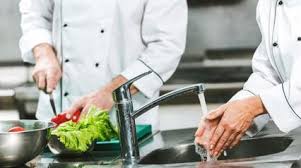
Management should ensure good hygienic practices so that food is not contaminated with bacteria, foreign objects, or chemicals. It is important that all food service workers maintain a high standard of personal hygiene and cleanliness.
Some hygienic practices that every food service worker should follow include:
- Frequent hand-washing.
- Personal hygiene.
- Hair restraint.
- Wearing appropriate attire (clean clothes, aprons, closed-toe shoes) and limited jewelry.
- Keeping fingernails trimmed, filed, and maintained.
- Abstaining from smoking, chewing gum, and other unhygienic practices in food handling areas and covering all wounds on hands and arms.
All food handlers and servers shall be free of communicable diseases. If an employee or volunteer is believed to be ill or a carrier of a communicable disease, they shall be restricted from performing food preparation and service activities.
The employee must obtain clearance from a physician to certify that they are fit to return to work. All food handlers and servers shall wear clean, washable clothing, closed-toed protective footwear, and hair nets, caps, or other suitable hair coverings to prevent contamination of foods, beverages, or utensils.
All food handlers and servers are prohibited from using tobacco in any form while preparing, handling, or serving food or beverages. Tobacco shall not be used in any form in any room or space used primarily for the preparation or storage of food. No smoking signs should be posted and maintained in such rooms or places.
All food handlers and servers shall thoroughly wash their hands prior to beginning work, after using the toilet, and every time hands are soiled. Hand-washing facilities in good repair and equipped with hot and cold running water shall be provided for employees within or adjacent to the food preparation area.
A permanently installed detergent or soap dispenser and single-use paper towels or hot air blowers shall be provided at or adjacent to all hand-washing facilities. Legible signs shall be posted in each toilet room directing employees that they shall wash hands with soap before returning to work.
Do you have any questions, suggestions, or contributions? If so, please feel free to use the comment box below to share your thoughts. We also encourage you to kindly share this information with others who might benefit from it. Since we can’t reach everyone at once, we truly appreciate your help in spreading the word. Thank you so much for your support and for sharing!