



Public Group
Active 8 months, 2 weeks ago
Group Type By Country
Group Leadership
- Group Administrators
-

Guinea-Bissau Farmers Community
Land preparation techniques in Guinea-Bissau
- This topic is empty.
- AuthorPosts
- February 24, 2026 at 4:22 pm #738717

 Agric4ProfitsModerator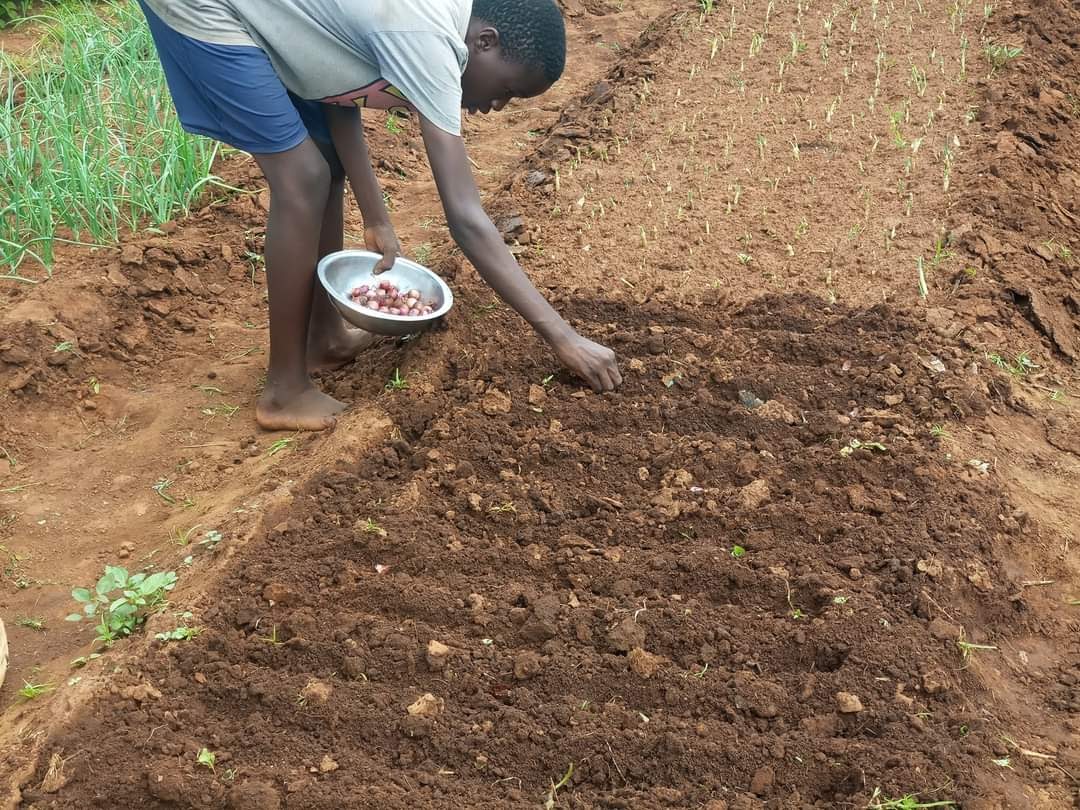
Land preparation is one of the most crucial steps in agriculture. It lays the foundation for healthy crop growth, high yields, and sustainable farming. In Guinea-Bissau, the majority of farmers are smallholders relying on manual labor and traditional tools. Proper land preparation helps improve soil structure, enhance water retention, control weeds, manage pests, and create suitable seedbeds.
The agricultural landscape of Guinea-Bissau is diverse, with uplands, lowlands, and coastal plains. Each type of land requires specific preparation techniques to optimize crop performance. Farmers cultivate both food crops, such as rice, maize, cassava, and millet, and cash crops, particularly cashew nuts, groundnuts, and palm oil. The preparation method varies according to soil type, crop selection, climate conditions, and labor availability.
Women play a significant role in land preparation, particularly in small-scale food crop farming. They participate in clearing plots, hand tilling, weeding, and making planting holes. Their involvement ensures timely planting, which is critical in regions with short rainy seasons.
Modern agricultural programs in Guinea-Bissau encourage improved land preparation practices to increase productivity. Techniques such as mechanized plowing, contour farming, and conservation agriculture are introduced alongside traditional methods to enhance soil fertility, reduce erosion, and optimize water use. Combining traditional knowledge with modern innovations helps farmers adapt to climate variability and maximize yields.
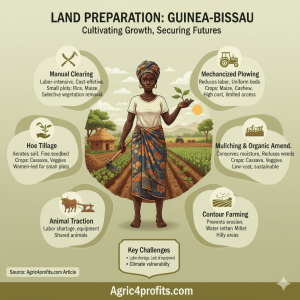
This article explores six major land preparation techniques practiced in Guinea-Bissau, highlighting their methods, benefits, challenges, and crop suitability. Tables are included to summarize key practices and recommendations for farmers.
1. Manual Clearing
Manual clearing is the most common method used by smallholder farmers, especially in upland areas and forest margins. Farmers use machetes, hoes, and axes to remove shrubs, weeds, and trees. This technique requires intensive labor but is cost-effective for households with limited financial resources.
Manual clearing also allows selective removal of unwanted vegetation, leaving useful trees or shrubs that improve soil fertility. Women often take the lead in this process for small plots. While effective, manual clearing is time-consuming and can delay planting if labor is insufficient.
Tool Used Purpose Crops Suitable Machete Cut shrubs and grass Rice, maize, millet Hoe Clear small weeds Cassava, groundnuts Axe Cut larger trees Cashew, palm trees Manual clearing is particularly suited for small plots, lowland rice paddies, and areas with dense vegetation.
Read Also: Climate-smart farming practices in Guinea-Bissau
2. Hoe Tillage
Hoe tillage involves loosening and turning the soil using hand hoes. It improves aeration, breaks compacted soil, and creates a fine seedbed for sowing. Hoe tillage is widely used for maize, millet, cassava, and vegetables.
Women often perform hoe tillage for household gardens and small plots. It is labor-intensive but provides control over depth and spacing, ensuring uniform germination. Combined with organic manure, this method enhances soil fertility and supports sustainable crop production.
Crop Type Depth of Hoeing (cm) Benefits Maize 10-15 Better root penetration Millet 8-12 Uniform seed germination Cassava 15-20 Improves soil aeration Vegetables 5-10 Easier planting, weed control Hoe tillage is particularly suitable for smallholders who lack access to mechanized equipment.
3. Plowing with Animal Traction
Animal-drawn plows are increasingly used in Guinea-Bissau to prepare larger plots. Oxen or donkeys pull plows to turn the soil, creating furrows for sowing seeds. This method is more efficient than manual tillage and reduces labor time.
Plowing improves soil aeration, facilitates water infiltration, and incorporates crop residues and organic matter into the soil. It is particularly useful for maize, groundnuts, and millet cultivation.
Tool/Animal Area Covered per Day (ha) Crop Suitability Ox-drawn plow 0.5-1.0 Maize, millet Donkey plow 0.3-0.5 Groundnuts, cassava Challenges include access to animals, equipment maintenance, and cost. Farmers often share animals communally to overcome these limitations.
4. Mechanized Plowing
Mechanized plowing involves using tractors or motorized tillers to prepare large agricultural areas efficiently. Though limited in Guinea-Bissau due to high costs, mechanization is gradually introduced through government programs and NGOs.
Mechanized plowing significantly reduces labor and prepares uniform seedbeds, which improves crop yields. It is ideal for upland rice, maize, and cashew plantations. Combining mechanized plowing with contour farming helps reduce soil erosion in sloping areas.
Equipment Area Covered (ha/day) Crop Suitability Tractor 2-5 Rice, maize Motorized tiller 0.5-1.5 Vegetables, cassava Constraints include equipment cost, fuel availability, and operator skills. Government support and cooperative ownership can improve accessibility.
5. Mulching and Organic Amendments
Mulching involves covering the soil with plant residues, straw, or organic matter before or after land preparation. This method helps conserve moisture, reduce weed growth, and improve soil fertility.
Farmers, especially women, apply mulch on cassava, sweet potato, maize, and vegetable plots. Organic amendments such as compost or animal manure are incorporated during tillage to enhance nutrient content and soil structure.
Crop Type Mulching Material Benefit Cassava Crop residues Moisture retention Maize Straw Weed suppression Vegetables Compost Soil fertility improvement Mulching is low-cost, environmentally friendly, and highly suitable for smallholder farms.

6. Contour Farming and Terracing
In hilly and sloped areas, contour farming and terracing prevent soil erosion, improve water retention, and maintain soil fertility. Farmers dig furrows along the contour lines or create small terraces for crops like maize, millet, and vegetables.
Technique Crop Suitability Benefits Contour farming Maize, millet Reduces runoff, prevents erosion Terracing Vegetables, maize Retains water, maintains fertility These techniques are particularly useful in regions prone to heavy rainfall or soil erosion, ensuring long-term productivity.
Frequently Asked Questions
What is land preparation in agriculture
It is the process of preparing soil for planting to optimize crop growth and yield.Why is it important in Guinea-Bissau
Proper land preparation improves soil fertility, water retention, weed control, and crop performance.Who is involved in land preparation
Both men and women participate, with women often leading small-scale plots and home gardens.What tools are commonly used
Machetes, hoes, axes, animal-drawn plows, and tractors.Which crops require intensive land preparation
Rice, maize, cassava, millet, and vegetables benefit from thorough soil preparation.What is the role of organic amendments
Compost, manure, and crop residues enhance soil fertility and structure.How does mechanization help
It reduces labor, prepares uniform seedbeds, and allows cultivation of larger areas.What challenges do farmers face
Labor shortage, lack of equipment, high costs, and limited technical knowledge.
Personal Thoughts
Effective land preparation is fundamental for agricultural productivity in Guinea-Bissau. Combining traditional methods with modern practices such as mechanized plowing, mulching, and contour farming can help farmers maximize yields while conserving soil and water. Supporting women farmers with training, tools, and access to cooperative equipment is crucial for sustainable agriculture. By investing in proper land preparation, Guinea-Bissau can enhance food security, reduce labor intensity, and promote climate-resilient farming.
- AuthorPosts
- You must be logged in to reply to this topic.