


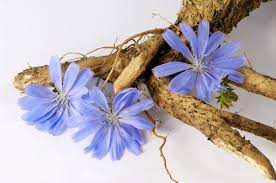
The chicory roots (Cichorium Intybus) has been grown since ancient Egypt and has been around for a while. Since the 19th century, it has also been a well-liked addition to coffee in France, where it was frequently roasted and ground.
A perennial herbaceous plant belonging to the dandelion family with brilliant blue blooms is the source of chicory root. Endive and icons are just two of the many types grown for salad greens, but crushed chicory root is also used in baking or substituted for coffee.
Because of its fibrous makeup, chicory root, which has a slight woody texture, is not digested in the small intestine but rather keeps its shape as it moves to the colon or large intestine.
The coffee and chicory mixture is said to have originated in Holland and expanded throughout the rest of Europe in the 1800s. Traditional uses for chicory root include making tea or adding it to medicines to cure conditions like jaundice, enlarged liver, gout, and rheumatism.
Coffee replaced chicory as the preferred beverage in America, and New Orleans rose to become the country’s second-largest coffee importer. However, because of the Union naval blockades preventing cargo from reaching the port, Louisianans began to think of using chicory root in their coffee during the American Civil War.
In reality, chicory root was frequently employed during coffee shortages, even in prisons, to help stretch the supply of coffee. Later, coffee was also replaced with acorns and beets. Chicory, on the other hand, had a more similar flavor profile, which made it a much better and more affordable complement.
Whatever the case, every Louisianan will tell you that it’s not only one of the best and tastiest traditions, but also a must-have when traveling there. It has become a crucial part of New Orleans’ heritage and is known as the chicory in a café au lait, which is chicory coffee with heated milk.
Chicory has a stiff, grooved, and generally hairless stem while it is in flower. It has a 1.5 m (5 ft) maximum height.
The stalked, lanceolate, and unlobed leaves are between 7.5 and 32 centimeters (3-12+12 inches) long (tiniest near the top), and between 2 and 8 centimeters (34 to 3+14 in) broad.
The 3-5 cm (1+1/4-2 in) wide flower heads are often light blue or purple, though they have sporadically been identified as white or pink.
The inner row of involucral bracts is longer and more upright than the outer row, which is shorter and spreading. From March through October, it blooms. The seed’s tip features tiny scales.
Read Also: 7 Health Benefits of Dill Weed (Anethum Graveolens)
7 Health Benefits Of Chicory Roots (Cichorium Intybus)

1. Reduces Stress
One of the key components of coffee is caffeine, and even very small levels of it can be found in decaffeinated varieties. Reducing your coffee intake can significantly reduce the levels of adrenaline and cortisol, both of which are released under stressful conditions and can increase stress.
According to a 2006 study that appeared in Pharmacology Biochemistry and Behavior, stress and routine coffee usage significantly increased cortisol levels. Chicory is a wonderful alternative to lower your coffee intake and regulate your cortisol levels because it doesn’t contain any caffeine.
2. Anti-inflammatory
Plant polyphenols, which are organic substances with the capacity to aid in the prevention of inflammation, are abundant in chicory.
Taking caffeine-free chicory coffee for a week significantly improved red blood cell deformability, which measures the body’s capacity to adapt to inflammation by returning cells to their initial state, according to a study done at the University of Pécs Medical School in Hungary.
Therefore, it can be said that chicory can lessen inflammation, which is quite significant. Why? Since inflammation is the basis of the majority of diseases, lowering inflammation can help prevent the onset of many chronic health disorders.
Chicory root may help with symptoms of autoimmune illnesses like Hashimoto’s disease, a thyroid ailment that produces symptoms including weight gain and exhaustion, even if further research is needed to assess its impact on thyroid health.
3. Protects the Liver
According to certain studies, chicory root extract can aid in the prevention of free radical production and potential liver damage. A review found that using chicory extract to alleviate oxidative stress and prevent cell damage could improve the health of the liver.
These remarkable findings show that chicory extract is a potent natural antioxidant and efficient free radical scavenger. As a result, it may strengthen the body’s immune system while also detoxifying the liver.
4. May Prevents Diabetes
Starting with food, there are several natural approaches to control and treat diabetes. If you have diabetes, adding chicory to your diet may help you avoid or manage this prevalent condition.
47 healthy adults participated in a study that was published in the Journal of Traditional and Complementary Medicine to assess the effects of roasted chicory extract.
Due to its high fiber content, chicory root extract has been shown to improve levels of adiponectin, a protein that controls blood sugar levels as well as the breakdown of fatty acids. This finding raises the possibility that chicory root extract may be able to prevent or delay the early onset of diabetes.
5. Prevents Osteoarthritis
It’s interesting to note that a clinical trial from the Department of Internal Medicine at the University of Texas Southwestern Medical Center’s Rheumatic Diseases Division revealed that chicory root extracts may have anti-inflammatory qualities that could help treat osteoarthritis.
18 adults over 50 with hip or knee osteoarthritis participated in the study and received chicory treatment for a month. Chicory’s capacity to assist in the treatment of severe joint discomfort is demonstrated by the fact that, of the 18 patients who finished treatment, at least 13 patients displayed a 20% improvement in reaction to pain and stiffness.
6. Aids Gut Health
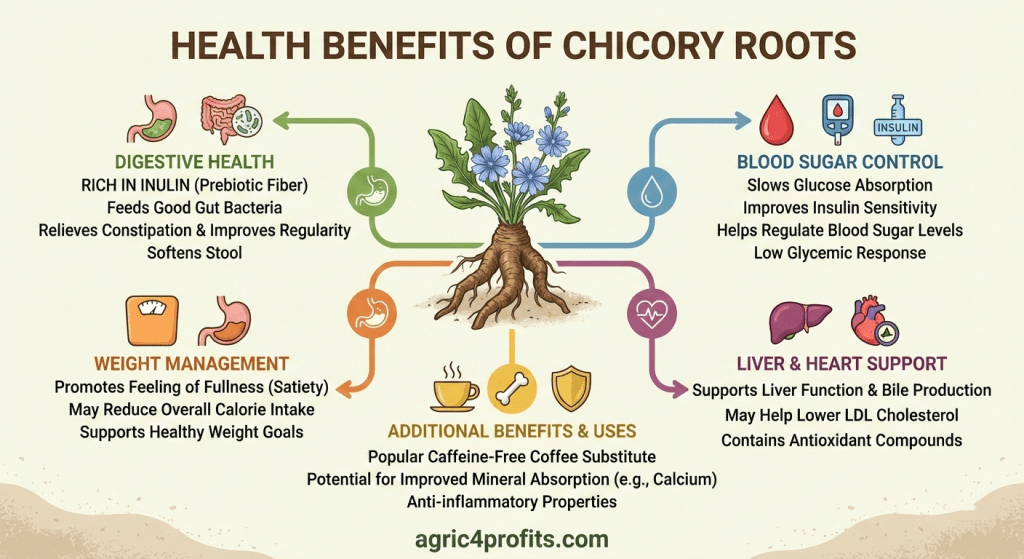
Inulin, a prebiotic, is found in the chicory root. One of the best food sources of prebiotics is fresh chicory roots, which provide roughly 68 grams of inulin per 100 grams.
Prebiotics can support the development of good bacteria in the stomach. For this reason, inulin, or chicory root fiber, is frequently found in probiotic supplements.
In addition to improving digestive health, fostering the growth of beneficial gut bacteria may also improve immunological performance, maximize nutritional absorption, and reduce inflammation.
7. Relieves Constipation
Because of its high inulin concentration, chicory root fiber has been demonstrated to ease constipation. For instance, a study that was published in the International Journal of Food Sciences and Nutrition looked at the effects of chicory ingestion every day for 28 days on older persons who had constipation.
Volunteers in the inulin group reported improved satisfaction about digestion and fewer defecation issues during the supplementation, the study found. In an aged population with constipation, daily supplementation with 15 grams of inulin improves the quality of life.
Read Also: 10 Health Benefits Cayenne Pepper (Capsicum annuum)
Nutritional value of Chicory Roots (Cichorium intybus)

1. Inulin (prebiotic dietary fiber): High content (up to 68% dry weight), a soluble fructan that acts as a low-calorie fiber promoting gut health.
It supports satiety, blood sugar control, and mineral absorption without contributing to calories.
2. Potassium: Abundant mineral aiding fluid balance, nerve function, and blood pressure regulation.
It enhances the root’s diuretic and cardiovascular supportive role.
3. Calcium: Essential for bone health and muscle function, present in notable amounts.
This contributes to traditional claims for skeletal support.
4. Magnesium: Involved in energy metabolism, muscle relaxation, and enzyme activity.
It bolsters metabolic and relaxation benefits.
5. Vitamin C: Antioxidant vitamin supporting immunity and collagen production.
It aids in combating oxidative stress.
6. Vitamin K: Key for blood clotting and bone mineralization.
This supports bone and vascular health.
7. B vitamins (e.g., folate, B1, B2): Aid in energy production, red blood cell formation, and metabolic processes.
They add to overall nutritional support.
8. Iron: Trace mineral for oxygen transport and energy.
It helps prevent deficiency-related issues.
9. Manganese: Cofactor in antioxidant enzymes and bone development.
It enhances protection against oxidative damage.
10. Polyphenols (e.g., caffeic acid, chicoric acid): Bioactive antioxidants with anti-inflammatory properties.
They contribute to the root’s protective and therapeutic phytochemical profile.
Chicory roots are low in calories and fat, primarily valued for high inulin fiber and trace minerals/vitamins rather than macronutrients, making them ideal as a functional food or supplement over a staple.
Scientific Evidence and Case Studies on Chicory Roots (Cichorium intybus)
1. Nishimura et al. (2015): Effects of roasted chicory root extract (containing inulin-type fructans) on blood glucose, lipid metabolism, and fecal properties in healthy adults.
Ingestion improved adiponectin levels, tended to enhance fecal properties (e.g., defecation rhythm), with no major lipid changes but potential metabolic syndrome counteraction.
2. Farhangi et al. (2016): Randomized placebo-controlled trial on oligofructose-enriched chicory inulin in type 2 diabetes patients.
It reduced fasting glucose, HbA1c, liver enzymes (AST, ALP), blood pressure, and hematologic risks, while increasing serum calcium.
3. Puhlmann & de Vos (2020): Review revisiting fiber-rich chicory taproots, emphasizing inulin as a prebiotic.
It supports GI health, appetite stimulation, stool regularity (EFSA-approved claim at 12 g/day), with safety in traditional use per EMA.
4. Nwafor et al. (2017): Chemical composition and nutritive benefits review, highlighting inulin, minerals, phenolics.
It notes prebiotic stimulation of beneficial bacteria (lactobacilli, bifidobacteria), immune support, and mineral absorption.
5. Street et al. (2013): Comprehensive review of traditional uses, phytochemistry, pharmacology.
It documents antioxidant, anti-inflammatory, hepatoprotective, hypoglycemic, and antimicrobial effects from compounds like sesquiterpene lactones and polyphenols.
6. Wu et al. (2018): Chicory polysaccharides attenuated high-fat diet-induced non-alcoholic fatty liver disease via AMPK activation in models.
It showed liver protection through metabolic pathway modulation.
7. Landmann et al. (2014): Chicoric acid reduced acute alcohol-induced hepatic steatosis in mice.
It demonstrated hepatoprotective antioxidant effects.
8. Azpiroz et al. (2017): Chicory-derived inulin on abdominal sensations and bowel motor function.
It stabilized GI function via prebiotic mechanisms, improving tolerance.
Studies strongly support inulin’s prebiotic effects on digestion, gut microbiota, stool regularity, and metabolic benefits (e.g., glucose/lipid control, liver health), with promising antioxidant/anti-inflammatory actions from phenolics, though more large-scale human trials are needed for broader claims like anticancer or anxiolytic.
Summary of Chicory Roots (Cichorium intybus)
| Aspect | Details |
|---|---|
| Plant Description | Perennial herbaceous plant with deep fleshy taproot, lance-shaped leaves, bright blue flowers; roots creamy-white inside, used medicinally/culinarily. |
| Key Compounds | Inulin (prebiotic fiber), caffeic/chicoric/chlorogenic acids, sesquiterpene lactones, polyphenols, vitamins (C, K, B), minerals (potassium, calcium, magnesium). |
| Traditional Uses | Digestive aid, liver detox, coffee substitute (roasted/ground roots), jaundice treatment, wound healing, tonic, appetite stimulant in ancient Egypt/Greece/Rome. |
| Health Benefits Listed | 23 benefits including digestive aid, prebiotic, weight management, anti-inflammatory, blood sugar regulation, liver/heart/bone/skin/immune support, antioxidant, anti-bacterial/cancer/diuretic, eye health, mood enhancement, joint health, anti-ulcer. |
| Scientific Backing | Strong for prebiotic/digestive effects (inulin), metabolic improvements (glucose/lipids/liver), antioxidant/anti-inflammatory; preliminary for others like anticancer/anxiolytic. |
| Precautions | GI distress (gas/diarrhea) from excess inulin, allergies, blood sugar/pressure effects, interactions with meds, caution in pregnancy/nursing; consult professional. |
Frequently Asked Questions About Chicory Roots (Cichorium intybus)
1. What are chicory roots mainly used for?
Primarily as a prebiotic fiber source (inulin), coffee substitute (roasted/ground), digestive aid, and in supplements for gut, metabolic, and liver health.
2. Does chicory root contain caffeine?
No, it’s caffeine-free and often used as a natural coffee alternative.
3. How does inulin in chicory roots benefit gut health?
It acts as a prebiotic, feeding beneficial bacteria like bifidobacteria, improving microbiota balance, stool regularity, and reducing constipation.
4. Can chicory roots help with blood sugar control?
Yes, studies show it may lower fasting glucose and improve insulin sensitivity, beneficial for diabetes management.
5. Is chicory root safe for daily use?
Generally yes in moderation (e.g., 10-30 g/day inulin equivalent), but excess can cause bloating/gas; start low and consult a doctor if you have GI issues.
6. What are the main active compounds in chicory roots?
Inulin (fiber), phenolic acids (chicoric, chlorogenic), sesquiterpene lactones, polyphenols, vitamins, and minerals.
7. Does chicory root support liver health?
Yes, animal and some human studies indicate hepatoprotective effects, reducing steatosis and enzyme levels via antioxidants and metabolic pathways.
8. Can chicory roots aid weight management?
Inulin promotes satiety and may support appetite control/weight loss efforts, per some research.
9. Are there side effects of chicory roots?
Possible gas, bloating, diarrhea from high fiber; rare allergies or interactions with diabetes/blood pressure meds.
10. Is chicory root the same as chicory leaves or endive?
No, roots focus on inulin/coffee substitute; leaves (bitter greens) or witloof (forced chicons) are used differently for salads/cooking.
Do you have any questions, suggestions, or contributions? If so, please feel free to use the comment box below to share your thoughts. We also encourage you to kindly share this information with others who might benefit from it. Since we can’t reach everyone at once, we truly appreciate your help in spreading the word. Thank you very much for your support and for sharing!
Disclaimer: This article is for educational and informational purposes only. The health benefits described are based on scientific research and traditional knowledge. They ayre not a substitute for professional medical advice, diagnosis, or treatment. Always consult a healthcare professional before using any herb or natural remedy for medical purposes.
Read Also: What are The Challenges and Rewards of A Career in Agriculture?