


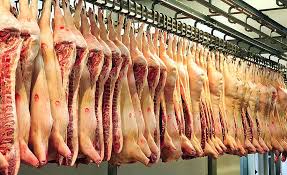
Stress in its many forms, such as deprivation of water or food, rough handling, exhaustion due to transporting or trekking over long distances, and mixing of animals reared separately resulting in fighting, is unacceptable from an animal welfare viewpoint and should be avoided because of its deleterious effects on meat quality.
The most serious consequence of stress is death, which is not uncommon among pigs transported in poorly ventilated, overcrowded trucks in hot weather. From loading on the farm to the stunning pen, animals must be treated kindly, and lorries, lairages, and equipment for livestock handling must be designed to facilitate humane treatment.
Stress immediately prior to slaughter, such as fighting or rough handling in the lairage, causes stored glycogen (sugar) to be released into the bloodstream. After slaughter, this is broken down in the muscles, producing lactic acid.
This high level of acidity causes a partial breakdown of the muscle structure, resulting in pale, soft, and exudative (PSE) meat. This condition is mostly found in pigs. Long-term stress before slaughter, such as prolonged fighting during transport and/or lairage, leads to exhaustion.
The sugars are used up, so less is available to be broken down, and less lactic acid is produced. The reduced acidity leads to an abnormal muscle condition known as dark, firm, and dry (DFD) in pigs or dark cutting in beef. The condition is rarer in lambs. Such meat has a high pH (above 6.0) and spoils quickly as the low acidity favors rapid bacterial growth.
Preventing Stress in Animals
To avoid stress, animals not reared together must not be mixed during transport and in the lairage. Load and unload using shallow stepped ramps to avoid stumbles. Trucks should be neither over- nor under-loaded. Overloading causes stress and bruising due to crushing.
Under-loading results in animals being thrown around and falling more than necessary. Drivers should not corner at excessive speed and must accelerate and decelerate gently.
The lairage should have small pens. Corridors must curve and not bend sharply so that stock can see a way forward. Stock must not be slaughtered in sight of other stock. Plenty of clean water must be available. The lairage must be well-lit and ventilated.
Do not hold stock in lairage for more than a day. Only fit, healthy stock may be slaughtered for human consumption. Fasting before slaughter reduces the volume of gut contents and hence bacteria, thereby reducing the risk of contamination of the carcass during dressing.
It is usually sufficient for animals to receive their last feed on the day before slaughter. Stock should rest after arrival at the slaughterhouse. However, long periods in the lairage can lead to DFD if animals are restless and fighting or mounting.
Animals should be as clean as possible at slaughter. Producers should wash their animals before leaving the farm. Trucks used for transport must be washed after each load, and the lairage at the slaughterhouse should be kept clear of fecal matter and frequently washed.
Read Also: Sheep and Goat Housing Complete Guide
Slaughtering Appliances and Stunning Principles
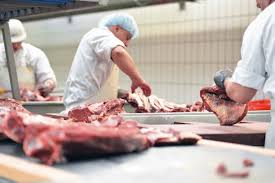
1. Slaughtering Appliances
Slaughtering appliances, particularly for smaller-scale operations, need not be elaborate or expensive. The amount of equipment depends on the slaughtering procedures employed. If possible, all equipment should be made of stainless steel or plastic, be rust-resistant, and easily cleaned and sanitized.
Equipment that does not come into contact with meat (e.g., overhead rails, working platforms, knocking pen) is usually made of galvanized steel. Basic equipment needed for the slaughtering operation includes:
- Stunning gun, electrical head tongs, or simple stunning equipment for direct blow
- Knives: sticking (15 cm, sharpened on both sides), skinning (15 cm, curved)
- A sharpening steel
- Oil or water sharpening stone
- Scabbard and belt for holding knives
- Meat saw (hand or electric) and cleaver
- Block and tackle or chain hoist strong enough to hold the weight of the animal to be slaughtered
- Pritch, chocks, or skinning rack (dressing cradle)
- A strong beam, tripod, or track 2.4 to 3.4 m from the floor
- Spreader gambrel or metal pipe
- Several buckets
- Working platforms
- Scalding barrel or tank
- Pot, barrel, or system for boiling water
- Bell scrapers
- Solid scraping table or platform
- Thermometer registering up to 70°C
- Hog or hay hook
- Torch or flame for singeing
The last seven items indicate additional equipment required when hogs are scalded and scraped rather than skinned. Useful additional equipment includes:
- Knocking pen
- Bleeding hooks (for vertical bleeding)
- Blood-catching trough
- Wash trough (tripe)
i. Sanitation of Hands and Tools
Means should be available to thoroughly clean all equipment coming into contact with carcasses or meat. Implement sterilizers are stainless-steel boxes holding hot (82°C) water, shaped to suit particular equipment such as knives, cleavers, and saws.
Knife sterilizers should be placed in positions where every operator who uses a knife has immediate access. Handles, as well as blades, must be sterilized. Each operator should have at least two knives, one to use while the other sterilizes.
Failure to sterilize all knives and equipment regularly will result in carcass contamination. Bacteria will be transferred from the hide to the carcass and from carcass to carcass.
2. Types of Stunning
Most countries have legislation requiring that animals are rendered unconscious (stunned) by humane methods prior to bleeding. Exceptions are made for religions that require ritual slaughter without prior stunning, provided the slaughter method is humane.
Stunning also makes sticking (throat-slitting) less hazardous for the operator. The animal must be unconscious long enough for sticking to be carried out and for brain death to result from the lack of blood supply.
i. Direct Blow to Skull: Using a club or poleaxe, the blow must be delivered with precision and force to immediately smash the skull, causing instantaneous unconsciousness. In cattle, the aiming point is the middle of the forehead in line with the ears, where the skull is thinnest.
Horses have thinner skulls and are easier to stun by this method. In sheep and goats, the brain is more easily reached from the back of the neck. Pigs have a well-developed frontal cavity, so the blow should be aimed slightly above the eyes.
ii. Slaughtering Mask: A bolt held in the correct position by the mask is driven into the animal’s brain by a hammer blow. The device is usually fitted with a spring that returns the bolt to its original position.
iii. Free Bullet: A bullet fired from a pistol into the skull is effective but unsafe. This method has been used on horses and cattle.
iv. Captive-Bolt Pistols: Fitted with a blank cartridge, these are effective on cattle and sheep but not pigs, whose skulls are thicker. After firing, the bolt returns to its original position in the pistol. The bolt may or may not penetrate the skull.
With penetrating types, the brain becomes contaminated with hair, dirt, and bone fragments. If brains are to be saved as edible tissue, a non-penetrating type with a mushroom-shaped head should be used.
v. Electrical Stunning: An electric current of high frequency but relatively low voltage (60-80 V) is passed through the brain for a few seconds to produce unconsciousness. If applied correctly, a deep state of unconsciousness is achieved. Strict safety rules must be observed.
Head tongs are suitable for pigs and sheep but not for cattle. Electrodes must be accurately placed, avoiding areas where the skull is thick. Electrical contact is impeded by hair and caked mud.
Water or brine improves contact, but the head must not be completely wet to avoid a short-circuit path bypassing the brain. Electrodes must be applied with strong pressure.
vi. Carbon Dioxide Stunning: Used only in large pig abattoirs, pigs are induced into a chamber and exposed to a concentration of 85 percent CO2 for about 45 seconds. Although effective for anesthetizing sheep, it is impractical due to large amounts of CO2 collecting in the wool and affecting operators on the killing line.
Bleeding Methods
1. Concept of Bleeding
Bleeding usually follows stunning. The objectives of bleeding are to kill the animal with minimal damage to the carcass and to remove as much blood as possible, as blood is an ideal medium for bacterial growth. Sticking, severing the major arteries of the neck, should immediately follow stunning. Care must be taken not to puncture the chest cavity, or it will fill with blood.
i. Cattle: Insert the sticking knife carefully just above the breastbone at a 45° angle pointed toward the head. Ensure the carotid arteries and jugular veins are severed in one movement.
ii. Sheep: Draw the knife across the jugular furrow close to the head, severing both carotid arteries. Alternatively, the knife may be inserted through the side of the neck, though this requires more skill.
iii. Pigs: As for cattle, but do not cut too far, or a pocket of blood will collect at the shoulder. To reduce contamination by scalding tank water, the cut should be as small as possible.
2. Bleeding on a Rail
The most hygienic system of bleeding and dressing is to shackle the animal immediately after stunning, then hoist it onto a moving rail. The animal is stuck while being hoisted to minimize the delay after stunning. Bleeding continues until the blood flow is negligible, when carcass dressing should begin without further delay.
Blood for human use must be collected with special equipment to avoid contamination from the wound, the gullet, or the knife. A hollow knife directs blood away from the wound into a covered stainless-steel container without touching the skin or hide.
The knife may be connected to a hose to reduce the risk of contamination. The hose may be connected to a pump to speed blood flow. Between 40 and 60 percent of the total blood volume will be removed, though this will be reduced if sticking is delayed.
To prevent coagulation, a citric acid solution (one part citric acid to two parts water) is added at a rate of up to 0.2 percent of the blood volume. The main sources of contamination during sticking and bleeding include the knife, the wound, and the food pipe.
The knife should be changed after each operation and returned to a sterilizer. Cutting the hide of sheep and cattle and opening it out to make a clean entry for the sticking knife reduces contamination from the wound. If the food pipe is pierced, semi-digested food may be regurgitated, contaminating the blood and neck wound.
3. Horizontal Bleeding
Horizontal bleeding is claimed to give faster bleeding rates and greater blood recovery. This may be due to certain organs and blood vessels being put under pressure when animals are hoisted, thus trapping blood and restricting flow.
Bleeding on the floor is very unhygienic. The operation should take place on a specially designed, easily cleaned stainless-steel table that should be cleaned frequently. If blood is to be saved, it must not come into contact with the table before reaching the collecting vessel.
4. Bleeding Without Stunning
The Jewish and Muslim religions forbid the consumption of meat killed by any method other than bleeding. Since it is difficult to guarantee that all animals will recover consciousness after being stunned by any particular method, stunning is not generally allowed. Some communities accept low-voltage electrical stunning.
Because animals are fully conscious at the time of sticking, ritual slaughter may be less humane than sticking after stunning. To reduce suffering, operators must be highly skilled to make a successful gash cut, severing all veins and arteries quickly at the first attempt.
Different communities have regulations regarding the animal’s orientation at sticking, some favoring a position lying on its side, others insisting it lie on its back. The animal should not be hoisted until unconsciousness due to lack of blood supply to the brain is complete.
Read Also: Guide On How To Increase Goats Milk
Hair Removal Procedures

1. Scalding and Dehairing of Pigs
Scalding in water at around 60°C for about six minutes loosens the hair in the follicle. Too low a temperature, and the hair will not be loosened; too high a temperature, and the skin will be cooked, making hair removal difficult.
The simplest equipment consists of a tank into which the pig is lowered by a hoist. The water is heated by oil, gas, electricity, or an open steam pipe. To check the effectiveness of the scald, rub the skin with the thumb to see if hair comes away easily.
Some machines have thermostatic controls and timers. To reduce contamination, scalding water should be changed frequently, pigs should be as clean as possible at sticking, and bleeding should be fully completed before immersion.
In large factories, pigs are transported through scalding tanks with rotating bars or through long scalding tanks stretching from the sticking point to the dehairing point in the time required for an effective scald.
Dehairing is done with a specially formed scraper (bell scraper or knife). If the scald is effective, all hair can be removed by this manual method. Another method is to dip the pig in a bath containing hot resin adhesive. The pig is removed from the bath, and the resin is allowed to set partially, then peeled off, pulling the hair from the root.
This is less labor-intensive than scraping and produces a very clean skin. After use, the adhesive is melted again, strained to remove the hair, and returned to the tank.
Another method combines dehairing and scalding in one operation using a tank with rotating rubber-tipped paddles, which are started after closing the lid.
As the hair is loosened by the scalding water, it is removed by the rubbing effect of the paddles against the skin. Singeing removes any remaining hairs, shrinks and sets the skin, decreases the number of adhering microorganisms, and leaves an attractive clean appearance.
It may be done with a handheld gas torch. Automated systems transport the pig into a furnace and leave it long enough for an effective singe. After singeing, black deposits and singed hairs are scraped off, and the carcass is thoroughly cleaned before evisceration begins.
2. Skinning Cattle
The outer side of the hide must never touch the skinned surface of the carcass. Operators must not touch the skinned surface with the hand that was in contact with the skin.
a Combined Horizontal/Vertical Methods
i. Head: After bleeding, while the animal is still hanging from the shackling chain, the horns are removed, and the head is skinned. The head is detached by cutting through the neck muscles and the occipital joint. Hang the head on a hook. Lower the carcass on its back into the dressing cradle.
ii. Legs: Skin and remove the legs at the carpal (foreleg) and tarsal (hind leg) joints. The forelegs should not be skinned or removed before the carcass is lowered onto the dressing cradle, or the cut surfaces will be contaminated. The hooves may be left attached to the hide.
iii. Flaying: Cut the skin along the middle line from the sticking wound to the tail. Using long, firm strokes and keeping the knife up to prevent knife cuts on the carcass, skin the brisket and flanks, working backward toward the round. Skin udders without puncturing the glandular tissue and remove them, leaving the supramammary glands intact and attached to the carcass.
At this point, raise the carcass to the half-hoist position, with the shoulders resting on the cradle and the rump at a good working height. Clear the skin carefully from around the vent (anus), avoiding puncturing it, and cut the abdominal wall carefully around the rectum.
Tie off with twine to seal it. Skin the tail, avoiding contamination of the skinned surface with the hide. Raise the carcass free of the floor and finish flaying.
b. Vertical Methods
High-throughput plants have overhead rails that convey the carcass from the sticking point to the chills. Hide removal is carried out on the hanging carcass. The operations are as in the combined horizontal/vertical method, but as it is not possible to reach the hide from ground level, more than one operator is needed.
A single operator may work with a hydraulic platform that is raised and lowered as required. Automatic hide pullers are used in high-throughput slaughterhouses.
Some types pull the hide down from the hind, others from the shoulders upward toward the rump. Automation of hide removal reduces contamination since there is less handling of the carcass and less use of knives.
Moving overhead rails also improve hygiene by reducing carcass contact with operators, equipment such as dressing cradles, and with each other, since carcasses are evenly spaced.
Do you have any questions, suggestions, or contributions? If so, please feel free to use the comment box below to share your thoughts. We also encourage you to kindly share this information with others who might benefit from it. Since we can’t reach everyone at once, we truly appreciate your help in spreading the word. Thank you so much for your support and for sharing!