


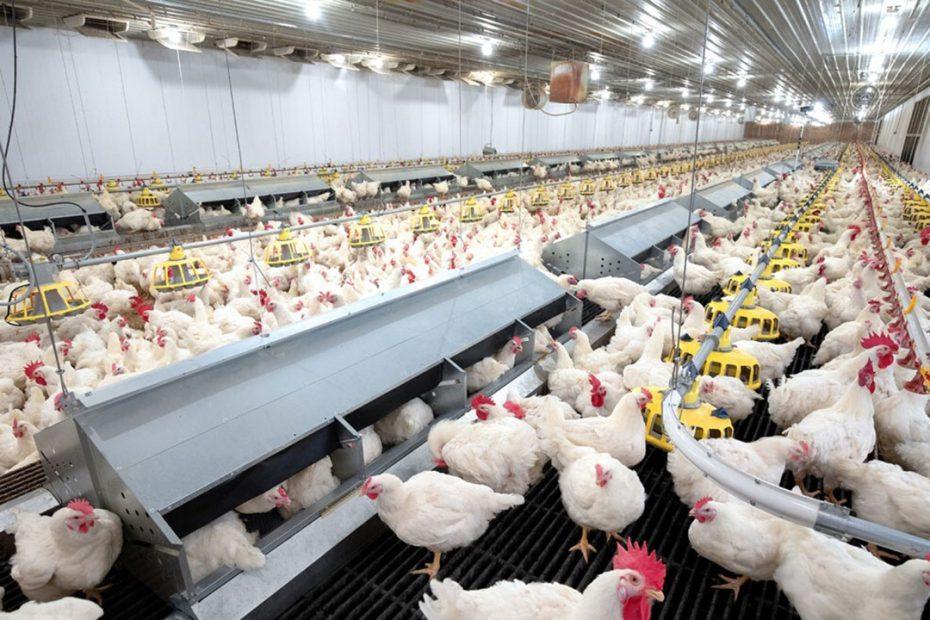
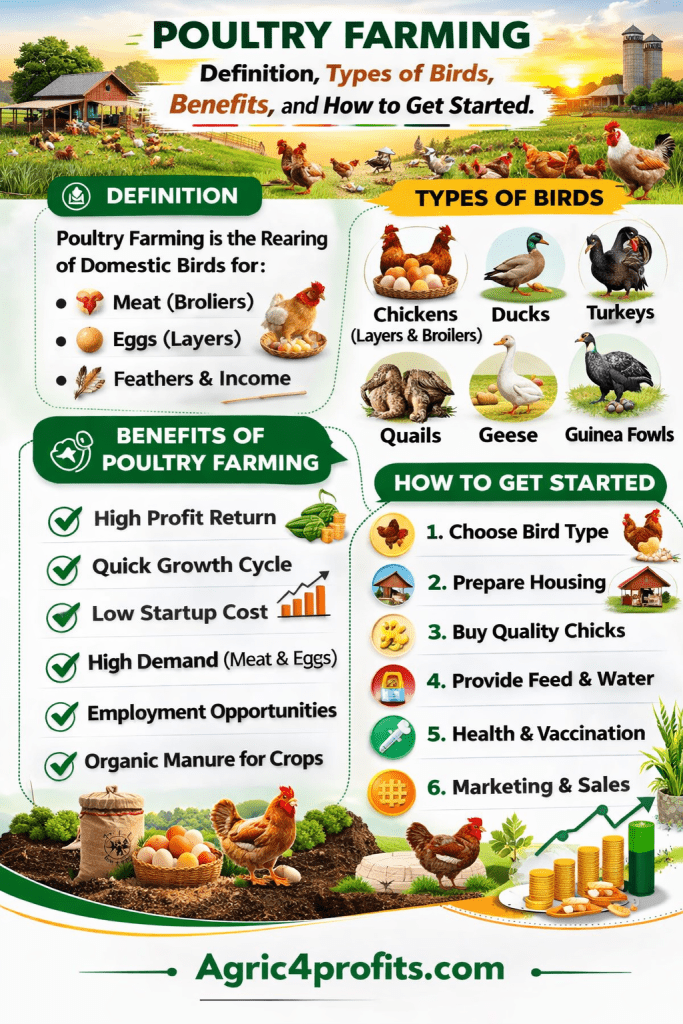
Poultry farming covers a much wider range of birds than most people realize. When most people hear the term poultry, they think of chickens. In reality, poultry farming includes chickens, turkeys, ducks, geese, guinea fowl, pigeons, peacocks, peafowl, ostriches, quails, and other game birds. It applies to these birds whether they are raised alive or dressed, meaning killed and prepared for sale.
At its core, poultry farming is the process of raising domesticated birds for meat, eggs, or both. It is one of the most accessible agricultural businesses available, requiring less capital than most other livestock enterprises while offering consistent, year-round returns.
1. Types of Poultry Birds and How They Are Classified
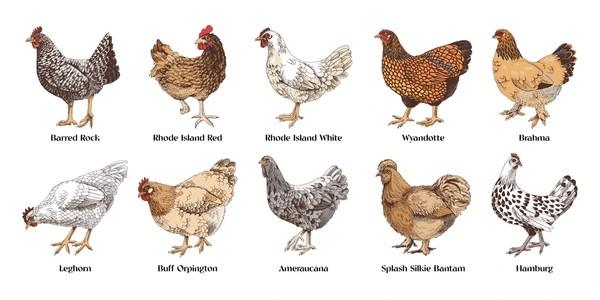
Poultry birds are broadly classified based on utility, economic value, or purpose. The main categories are meat type, egg type, dual purpose, game, and ornamental birds.
The domestic fowl, known scientifically as Gallus domesticus, originated in South East Asia and has been selectively bred over centuries for size, colour, conformation, and egg-laying ability. It is distinguished from other birds by the presence of a comb, a feather coat, no teeth, and legs with spurs. Chickens have high breathing and pulse rates, with body temperatures ranging from 105°F to 109°F, which is higher than most other domestic animals.
A. Commercial Classification
The three types of birds most commonly raised commercially are:
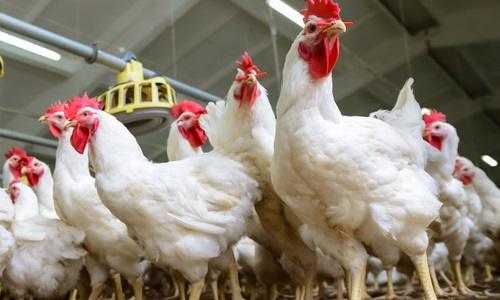
i. Broilers: Raised for meat production. Broilers can be male or female and are bred specifically for rapid weight gain. They are ready for market at around 12 weeks from hatch.
ii. Cockerels: Male birds raised for meat production. They grow more slowly than broilers, taking up to 24 weeks to reach market weight, but they are more resilient and better able to handle difficult conditions.
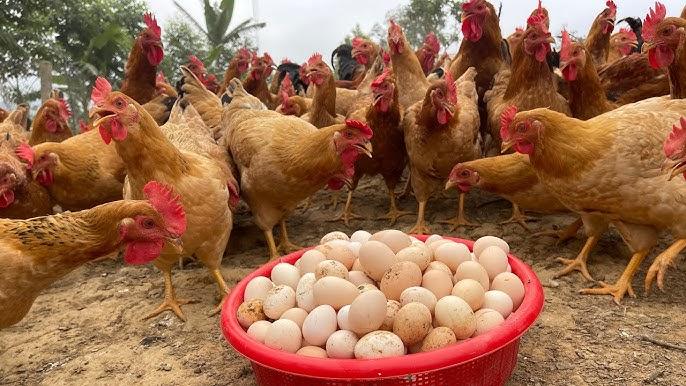
iii. Pullets or Layers: Female birds raised primarily for egg production but also sold for meat. Layers begin producing eggs at around 18 weeks and continue laying throughout their productive life.
B. Scientific Classification
Birds admitted to a recognized standard based on distinct type and colour patterns are called standard breeds. Poultry breeds are further classified into four levels:
i. Class: A group of breeds developed in a particular geographical region, such as Asia, England, or America.
ii. Breed: A group of birds sharing the same body shape, weight, and common characteristics.
iii. Variety: A subdivision of a breed distinguished by colour pattern, comb type, or feather pattern. The Leghorn breed, for example, includes varieties such as the Single Comb White Leghorn and the Rose Comb White Leghorn.
iv. Strain: A further subdivision within a variety, usually referring to birds that have been selectively bred for specific performance traits within a commercial or research program.
Read Also: Different Breeds of Poultry Birds and Their Uses
2. Benefits of Poultry Farming
Poultry farming offers a range of practical benefits that make it attractive to both small-scale and commercial farmers:
i. It requires less capital investment compared to raising other types of livestock, making it accessible to farmers at different financial levels.
ii. It offers rapid returns on investment. Production cycles are short and income can begin within weeks of starting.
iii. It is a year-round source of income, not seasonal. Eggs and poultry meat are in consistent demand throughout the year.
iv. Poultry droppings are nitrogen-rich and make excellent organic fertilizer, adding value beyond just meat and eggs.
v. Feathers from poultry birds are used in making pillows, decorative items, and other products, providing an additional income stream.
vi. It creates both full-time and part-time employment, making it a viable livelihood option for farmers and their families.
Read More: Classification of Feed Ingredients in Poultry Feed Production
3. Requirements for Starting Poultry Farming
Getting started in poultry farming requires careful planning. Two of the most important decisions you will make at the start are choosing your area of specialization and selecting the type of bird you want to raise.
A. Selecting Your Area of Specialization
Poultry farming is a broad industry with several distinct sectors. Many people assume it simply means raising chickens, but the business encompasses far more than that. The main sectors within the poultry industry include:
i. Chicken breeding
ii. Meat production
iii. Poultry feed production
iv. Poultry market and consultancy
v. Egg production
Choosing a specific sector to focus on helps you direct your resources, build expertise, and manage your operation more effectively. Trying to operate across too many sectors at once without sufficient capital and experience spreads you too thin.
B. Selecting the Right Bird
Different birds suit different production goals. The main species raised in poultry farming include domestic fowl, turkey, geese, duck, peacock, and guinea fowl. For most farmers entering the business, the decision comes down to which type of chicken to raise.
Broilers are the right choice if your primary goal is fast meat production with a short turnaround cycle. Layers are better suited if you want a continuous income stream from eggs over a longer period, with the added option of selling the birds for meat at the end of their laying life. Understanding your market, your resources, and your management capacity will help you decide which direction makes the most sense for your situation.
Summary on Poultry Farming: Definition, Types, Benefits, and Getting Started
| Topic | Key Points |
|---|---|
| What is Poultry Farming | Raising domesticated birds including chickens, turkeys, ducks, geese, guinea fowl, and others for meat, eggs, or both. |
| Main Commercial Birds | Broilers for meat, cockerels for slower meat production, pullets or layers for eggs and meat. |
| Classification Levels | Class by region, breed by body type, variety by colour or comb, strain by selective breeding for performance. |
| Benefits | Low capital, rapid returns, year-round income, fertilizer from droppings, feathers as by-product, employment creation. |
| Key Sectors | Chicken breeding, meat production, feed production, egg production, consultancy and marketing. |
| Bird Selection | Choose based on production goal. Broilers for fast meat, layers for consistent egg income and eventual meat sales. |
Frequently Asked Questions About Poultry Farming
1. What is poultry farming?
Poultry farming is the practice of raising domesticated birds for the purpose of producing meat, eggs, or both. It includes a wide range of bird species such as chickens, turkeys, ducks, geese, guinea fowl, peacocks, ostriches, and quails. Birds may be raised and sold alive or dressed and prepared for market.
2. What are the three main types of birds raised commercially in poultry farming?
The three main types raised commercially are broilers, which are raised for meat and ready for market at around 12 weeks; cockerels, which are male birds raised for meat with a longer growing period of up to 24 weeks; and pullets or layers, which are female birds raised primarily for egg production and also sold for meat at the end of their laying period.
3. What is the difference between a breed, variety, and strain in poultry?
A breed is a group of birds sharing the same body structure, weight, and general characteristics. A variety is a subdivision of a breed distinguished by specific colour patterns, comb type, or feather characteristics. A strain is a further subdivision within a variety, typically referring to birds that have been selectively bred for specific production performance traits within a breeding program.
4. What are the main benefits of poultry farming compared to other livestock businesses?
Poultry farming requires less capital to start than most other livestock enterprises. It offers rapid returns because production cycles are short. It provides year-round income since demand for eggs and poultry meat does not follow seasonal patterns. Additional income streams come from manure as fertilizer and feathers as raw material for various products.
5. What are the main sectors within the poultry industry?
The main sectors include chicken breeding, meat production, egg production, poultry feed production, and poultry market and consultancy services. Choosing a specific sector to focus on helps farmers use their resources efficiently and build expertise in a defined area rather than spreading themselves across too many activities at once.
6. How do I decide whether to raise broilers or layers?
The decision depends on your production goal, your available capital, and your market. Broilers offer a faster income cycle with lower ongoing management complexity. Layers require a longer investment before income begins but provide a consistent daily income from eggs over a longer period, plus eventual meat sales. Consider your local market demand and your ability to manage the birds through each production stage before deciding.
7. Can poultry farming be done on a small scale at home?
Yes. Small-scale or backyard poultry farming is a practical starting point for farmers with limited space and capital. It allows you to learn the business with lower financial risk. As your knowledge and confidence grow, you can scale up gradually. Many successful commercial poultry farmers started with a small backyard flock.
8. What is the scientific origin of the domestic chicken?
The domestic chicken, known scientifically as Gallus domesticus, originated in South East Asia. It has been selectively bred over centuries for size, colour, conformation, and egg-laying performance. Chickens are distinguished from other birds by the presence of a comb, a feather coat, no teeth, and legs with spurs. They also have higher body temperatures and faster breathing rates than most other domestic animals.
9. What is a dual-purpose poultry bird?
A dual-purpose bird is one bred to perform reasonably well for both egg production and meat production. These birds are not the top performers in either category but offer a balanced option for farmers who want income from both eggs and meat without maintaining two separate flocks. They are particularly popular on smaller farms.
10. Is poultry farming a good business for employment creation?
Yes. Poultry farming creates both full-time and part-time employment opportunities. A farm requires people to manage feeding, cleaning, health monitoring, egg collection, and marketing. As the farm grows, it supports more jobs. For rural communities in particular, poultry farming is one of the most accessible pathways to steady income and employment.
Do you have any questions, suggestions, or contributions? If so, please feel free to use the comment box below to share your thoughts. We also encourage you to kindly share this information with others who might benefit from it. Since we can’t reach everyone at once, we truly appreciate your help in spreading the word. Thank you very much for your support and for sharing!
Read Also: Anatomy of Fishes: Female Fish and their Reproductive Strategies