


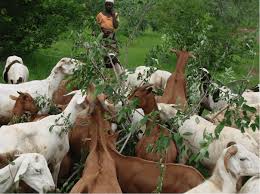
In this article, the focus is on sheep and goats, otherwise referred to as small ruminants. Since most of the features, reproductive patterns, and management practices of sheep and goats are similar, they are studied together. Where differences exist, particular attention is drawn to those areas.
Small ruminants (sheep and goats) are a major source of livelihood in many areas of Nigeria. Unlike cattle, they are owned even by the poorer sectors of the community. Efforts to increase the productivity of small ruminants represent an important route to improving the standard of living of the rural poor and landless peasants.
Read Also: Sheep gene insights could help farmers breed healthier animals
Origin and History of Domestication of Sheep and Goats

1. The Sheep
All domesticated sheep are classified under the genus Ovis aries. There are four major species of wild sheep:
i. Mouflon (O. musimon): mostly found in Europe and Western Asia.
ii. Urial (O. orientalis): found around Afghanistan to Western Asia.
iii. Argali (O. ammon): found around Central Asia.
iv. Bighorn (O. canadensis): found in Northern Asia and North America.
It is believed that the first three wild species contributed to the makeup of present-day sheep. Sheep and goats were among the first ruminants to be domesticated between 10,000 and 6,000 BC. About one-fifth of the world’s sheep are found in the tropics. The global sheep population has increased by about 13 percent over the last decade. Nigeria currently has about 22 million sheep.
2. The Goat
The domestic goat belongs to the genus Capra. This includes three species:
- The Bezoar (C. aegagrus aegagrus)
- The Ibex (C. aegagrus ibex)
- The Markhor (C. aegagrus falconeri)
The domestication of goats is believed to have occurred in the mountainous areas of Western Asia around 9,000–11,000 years ago. The goat is possibly the earliest domesticated animal after the dog. The Bezoar goat is considered the major ancestor of present-day goats. Goats represent about 15 percent of the total world domesticated ruminant population.
They perform best in the drier tropics and on lighter sandy soils. In Africa, the highest goat populations are found in East Africa, Morocco, and Northern Nigeria. Nigeria has about 34 million goats.
Read Also: 17 Medicinal Health Benefits Of Mucuna pruriens (Monkey Tamarind)
Advantages of Small Ruminants in Meat Supply

1. High contribution to national meat supply: In comparison to the world’s average of six percent, Nigerian small ruminants contribute about 33 percent to the nation’s meat supply.
2. High reproductive rate: Small ruminants have high fertility and prolificacy rates, ranging from 120–135 percent. Twinning is common in goats (55–60 percent) and lower in sheep (20–22 percent). Estrus cycles occur every 18 days, with estrus periods lasting 24–72 hours. These cycles are generally shorter in yearlings. Kidding/lambing intervals are about eight months, with a generation interval of two years, compared to four years in cattle.
3. Low feed requirement: As ruminants, sheep and goats can consume low-quality fibrous vegetation that cannot be eaten by humans or non-ruminant animals such as poultry and pigs.
4. Products are easy to manage: Meat and milk from small ruminants are produced in quantities that can be consumed within a day, eliminating the need for refrigeration or cold storage. This is particularly suitable for rural communities with limited technology.
5. Reduced risk during drought: In Sahelian regions, sheep and goats have shown greater drought resistance than cattle. They help to maintain meat supply during periods of cattle loss, making them valuable to traditional arable farmers during crop failures.
6. Low initial investment: Rearing small ruminants requires less capital. They can thrive on pasture, browse, and agricultural by-products. The cost of purchasing sheep is lower than cattle, making them more accessible to smallholders.
7. No cultural or religious restrictions: Unlike pigs or cattle, which face religious and cultural restrictions in some communities, there are almost no such barriers to keeping or consuming sheep and goats. Both poor and wealthy individuals can own them.
Classification of Sheep and Goats in Nigeria
Sheep and goats can be classified using several criteria such as origin, utility, body size, ear shape and length, and function. Based on height at the withers, Nigerian sheep are grouped into three categories:
- Large long-legged, long-tailed breeds
- Medium-sized breeds
- Short-legged, short-tailed breeds
Table: Size Classification of Sheep and Goats
ClassificationWeight (kg)Height at Withers (cm)Large breeds30–65>65Medium breeds19–3750–65Small or dwarf breeds18–25<50
Indigenous Breeds of Sheep in Nigeria

1. Large Long-Legged Long-Tailed Breeds
i. Balami: Also called Bororo, this breed is linked to the Borno tribe. It is large and predominantly white with a convex facial profile. It has droopy ears, a thin long tail, and horns in males. Males also have dewlaps. Balami sheep grow fast and produce a significant amount of milk (3–5 kg for singles, 2.5–3.5 kg for twins). Weaning weight is about 18 kg at 12 weeks. Yearling weights range from 35–45 kg in ewes and 45–60 kg in rams. The breed thrives in arid areas and can be used to utilize non-arable lands.
ii. Uda (Ouda): Also called Fulani or Bali-Bali, this breed is found throughout the Sahel and savanna regions. It has a distinct coat color with black or brown in front and white at the rear. Mature males stand up to 84 cm at the withers. The breed is adapted to hot, dry environments and extensive grazing. Males have large, outward-curving horns. Rams weigh up to 55 kg while females weigh about 45 kg. Uda sheep have limited survival outside their native region.
2. Medium-Sized Breeds
i. Yankasa: The most numerous and widely distributed Nigerian breed. Yankasa sheep are found across Sahel, Sudan, and Guinea savanna zones. They are intermediate between Uda and the West African Dwarf. Coat color is typically white with black patches around the eyes, ears, and muzzle. Males have curved horns. Mature rams weigh 30–45 kg and ewes 25–30 kg.
3. Short-Legged Short-Tailed Breeds
i. West African Dwarf Sheep (Fouta Djallon, Forest Sheep, Djallonke):1 Found in the forest belt, these sheep come in various coat colors: all white, black, brown, or spotted. They thrive in tsetse fly-infested areas and are considered trypano-tolerant. Mature females have tassels, while males have spiral or crescent-shaped horns and a heavy mane. Growth is slow, with maturity reached at 18–24 months. Twinning is common (55–58 percent). Mature females weigh 20–25 kg, and males 20–30 kg.
These are the major indigenous sheep breeds in Nigeria. Many other breeds exist in the tropics and beyond. Each breed has adapted remarkably to its local environment. For instance, the West African Dwarf sheep have evolved resistance to trypanosomiasis in humid regions. In the Middle East and East Africa, sheep with fat tails store food for the dry season.
There has also been some selection by humans for preferred traits. While developed countries have specialized breeds for milk or wool, in many developing regions, deliberate selection is limited, resulting in variability in breed characteristics and productivity. More information on sheep breeds is available in Payne (1990) and Catenly (1991).
Do you have any questions, suggestions, or contributions? If so, please feel free to use the comment box below to share your thoughts. We also encourage you to kindly share this information with others who might benefit from it. Since we can’t reach everyone at once, we truly appreciate your help in spreading the word. Thank you so much for your support and for sharing!
Frequently Asked Questions
We will update this section soon.