


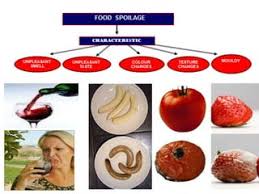
In this article, details about the agents of food spoilage are explored, examples of foods affected by these agents are provided, and strategies to reduce their effects are suggested. Foods that are more susceptible to each agent of food spoilage are highlighted.
For instance, tubers and some fruits are susceptible to enzymatic browning, while fresh animal products like meat are more susceptible to bacterial spoilage.
Understanding Bacteria as Food Spoilage Agents
Bacteria are single-celled microorganisms (invisible to the naked eye) that are present naturally in the environment. Bacteria cause spoilage mainly through the process of putrefaction.
Putrefaction refers to the series of anaerobic reactions through which amino acids detour to a mixture of amines, organic acids, and stiff-smelling sulfur compounds, such as mercaptans and hydrogen sulfide.
This is a biochemical phenomenon, as the presence of bacteria is essential throughout the process. Along with amino acids, indole, phenols, and ammonia are also formed due to protein putrefaction. Most of these chemicals have a displeasing odor. Putrefaction is quite common in meats and other protein-rich foods at temperatures greater than 15°C.
The spoilage factors in heat-treated foods are especially spore-forming bacterial groups. Bacterial spores can survive even at high temperatures. Gram-positive bacteria can grow in aerobic and anaerobic environments and can also tend to grow at high temperatures up to 55°C.
In this context, some groups of anaerobic bacteria produce hydrogen sulfide during growth in canned/hermetically sealed foods stored at high temperatures. Bacterial groups growing at ambient temperature can cause different spoilage, such as rotting of canned products, premature swelling of cheese, and production of butyric acid in canned vegetables and fruits.
Bacteria that can grow at low temperatures can produce gas and bad odors in cold meat products, pickled, and dried foods.
Some bacteria are useful, e.g., in the production of yogurt, while some are harmful. Some bacteria produce toxins, which can lead to spoilage. Spores can also be produced by some bacteria, leading to toxins being produced.
Read Also: Cold Weather Poultry Diseases and How to Manage them
1. Key Bacterial Species in Food Spoilage
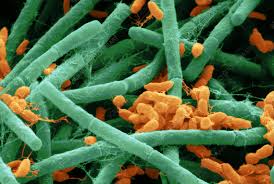
i. Brochothrix Species
Brochothrix spp. is a common spoilage organism of meat and meat products stored at chilled temperatures. B. thermosphacta and Brochothrix campestris are the two species assigned to the genus Brochothrix. B. thermosphacta is the predominant spoilage organism in pork, lamb, and fish, particularly on fatty surfaces, chilled raw, and processed products stored aerobically or under modified atmospheres.
It is a Gram-positive rod, non-sporing, non-motile, and facultative anaerobe. There is no evidence to support that it is pathogenic.
ii. Lactic Acid Bacteria (LAB)
Lactic acid bacteria (LAB) are a group of Gram-positive bacteria, including species of Lactobacillus, Pediococcus, Leuconostoc, and Oenococcus, some of which are useful in producing fermented foods such as yogurt and pickles. However, under low oxygen, low temperature, and acidic conditions, these bacteria become the predominant spoilage organisms in a variety of foods.
Undesirable changes caused by LAB include greening of meat and gas formation in cheeses (blowing), pickles (bloater damage), and canned or packaged meat and vegetables. Off-flavors described as mousy, cheesy, malty, acidic, buttery, or liver-like may be detected in wine, meats, milk, or juices spoiled by these bacteria.
LAB may also produce large amounts of an exopolysaccharide that causes slime on meats and ropy spoilage in some beverages.
iii. Pseudomonas Species
Pseudomonas and related genera are aerobic, Gram-negative soil bacteria, some of which can degrade a wide variety of unusual compounds. They generally require a high water activity for growth (0.95 or higher) and are inhibited by pH values less than 5.4.
Some species grow at refrigeration temperatures (psychrophilic), while others are adapted for growth at warmer, ambient temperatures. Four species of Pseudomonas (P. fluorescens, P. fragi, P. lundensis, and P. viridiflava), Shewanella putrefaciens, and Xanthomonas campestris are the main food spoilage organisms in this group.
Yeasts and Molds as Food Spoilage Organisms
1. Yeasts in Food Spoilage
Yeasts are a subset of a large group of organisms called fungi that also includes molds and mushrooms. They are generally single-celled organisms adapted for life in specialized, usually liquid, environments and, unlike some molds and mushrooms, do not produce toxic secondary metabolites.
Yeasts can grow with or without oxygen (facultative) and are well-known for their beneficial fermentations that produce bread and alcoholic drinks. They often colonize foods with high sugar or salt content and contribute to spoilage of maple syrup, pickles, and sauerkraut. Fruits and juices with a low pH are another target, and some yeasts grow on the surfaces of meat and cheese.
i. Important Spoilage Yeasts
There are four main groups of spoilage yeasts:
a. Zygosaccharomyces and related genera tolerate high sugar and high salt concentrations and are the usual spoilage organisms in foods such as honey, dried fruit, jams, and soy sauce. They usually grow slowly, producing off-odors and flavors and carbon dioxide that may cause food containers to swell and burst. Debaryomyces hansenii can grow at salt concentrations as high as 24%, accounting for its frequent isolation from salt brines used for cured meats, cheeses, and olives. This group also includes the most important spoilage organisms in salad dressings.
b. Saccharomyces spp. are best known for their role in the production of bread and wine, but some strains also spoil wines and other alcoholic beverages by producing gassiness, turbidity, and off-flavors associated with hydrogen sulfide and acetic acid. Some species grow on fruits, including yogurt containing fruit, and some are resistant to heat processing.
c. Candida and related genera are a heterogeneous group of yeasts, some of which also cause human infections. They are involved in spoilage of fruits, some vegetables, and dairy products.
d. Dekkera/Brettanomyces are principally involved in spoilage of fermented foods, including alcoholic beverages and some dairy products. They can produce volatile phenolic compounds responsible for off-flavors.
2. Molds in Food Spoilage
Molds are filamentous fungi that do not produce large fruiting bodies like mushrooms. Molds are very important for recycling dead plant and animal remains in nature but also attack a wide variety of foods and other materials useful to humans. They are well adapted for growth on and through solid substrates, generally produce airborne spores, and require oxygen for their metabolic processes.
Most molds grow at a pH range of 3 to 8, and some can grow at very low water activity levels on dried foods. Spores can tolerate harsh environmental conditions, but most are sensitive to heat treatment.
Different mold species have different optimal growth temperatures, with some able to grow in refrigerators. They have a diverse secondary metabolism, producing a number of toxic and carcinogenic mycotoxins. Some spoilage molds are toxigenic, while others are not.
i. Classification of Spoilage Molds
a. Zygomycetes are considered relatively primitive fungi but are widespread in nature, growing rapidly on simple carbon sources in soil and plant debris, and their spores are commonly present in indoor air. Generally, they require high water activities for growth and are notorious for causing rots in a variety of stored fruits and vegetables, including sweet potatoes.
Some common bread molds also are zygomycetes. Some Zygomycetes are also utilized for the production of fermented soy products, enzymes, and organic chemicals. The most common spoilage species are Mucor and Rhizopus. Zygomycetes are not known for producing mycotoxins (toxins from molds), but there are some reports of toxic compounds produced by a few species.
b. Penicillium and related genera are present in soils and plant debris from both tropical and Antarctic conditions but tend to dominate spoilage in temperate regions. They are distinguished by their reproductive structures that produce chains of conidia.
Although they can be useful to humans in producing antibiotics and blue cheese, many species are important spoilage organisms, and some produce potent mycotoxins (patulin, ochratoxin, citreoviridin, penitrem). Penicillium spp. cause visible rots on citrus, pear, and apple fruits and cause enormous losses in these crops.
They also spoil other fruits and vegetables, including cereals. Some species can attack refrigerated and processed foods such as jams and margarine. A related genus, Byssochlamys, is the most important organism causing spoilage of pasteurized juices because of the high heat resistance of its spores.
c. Aspergillus and related molds generally grow faster and are more resistant to high temperatures and low water activity than Penicillium spp. and tend to dominate spoilage in warmer climates.
Many aspergilli produce mycotoxins: aflatoxins, ochratoxin, territrems, cyclopiazonic acid. Aspergilli spoil a wide variety of food and non-food items (paper, leather, etc.) but are probably best known for spoilage of grains, dried beans, peanuts, tree nuts, and some spices.
Other molds, belonging to several genera, have been isolated from spoiled food. These generally are not major causes of spoilage but can be a problem for some foods. Fusarium spp. cause plant diseases and produce several important mycotoxins but are not important spoilage organisms. However, their mycotoxins may be present in harvested grains and pose a health risk.
Read Also: The Nutritional Requirements and Deficiency Symptoms for Poultry Chickens
Factors Influencing Microbial Food Spoilage
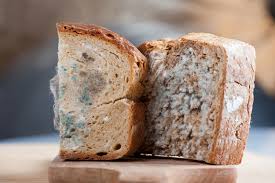
Factors affecting microbial spoilage include:
1. Intrinsic Factors: Endogenous enzymes, nutrient content, sensitivity to light, pH, water activity, and oxidation-reduction potential.
2. Extrinsic Factors: Relative humidity, temperature, presence and activities of other microbes, and oxygen.
Enzymes as Agents of Food Spoilage
1. Mechanisms of Enzyme-Induced Food Deterioration
Enzymes are chemicals found in food. These chemicals have important uses in food. They can cause food to deteriorate in three main ways:
i. Ripening: This will continue until the food becomes inedible, e.g., banana ripening.
ii. Browning: Enzymes can react with air, causing brown discoloration in certain foods, e.g., potatoes, yams, and apples discoloring, which leads to their deterioration.
iii. Oxidation: Loss of certain nutrients, such as vitamins A, C, and thiamin from food, e.g., over-boiling of green vegetables. This is due to the reaction of certain food components with oxygen.
Food Enzymes and Their Spoilage Actions
Food Enzymes and Their Spoilage Actions
| Enzymes | Food | Spoilage Action |
|---|---|---|
| Ascorbic acid oxidase | Vegetables | Destruction of vitamin C |
| Lipase | Milk, oils | Hydrolytic rancidity |
| Lipoxygenase | Vegetables | Destruction of vitamin A |
| Pectic enzymes | Fruits | Destruction of pectic substances (Softening) |
| Peroxidases | Fruits | Browning |
| Polyphenoloxidase | Fruits, vegetables | Browning, off-flavor, vitamin loss |
| Proteases | Eggs, crab, lobster, flour | Reduction of shelf life, over-tenderization, reduction in gluten network formation |
| Thiaminase | Meats, fish | Destruction of thiamine |
Food spoilage is mainly caused by the activities of microorganisms and enzyme activities. These various spoilage organisms and agents must be adequately controlled to ensure that food is wholesome for consumption.
The different agents of food spoilage include bacteria, yeasts, molds, and enzyme activities. The important bacterial species for food spoilage include Brochothrix spp., lactic acid bacteria, and Pseudomonas.
The important yeast species in food spoilage include Zygosaccharomyces and Saccharomyces. For molds, the important species are Zygomycetes and Penicillium.
Intrinsic factors like endogenous enzymes, pH, nutrient content, and extrinsic factors such as relative humidity, temperature, etc., influence microbial spoilage. Enzyme activities cause ripening, browning, and oxidation in foods, which lead to food spoilage.
To reduce the effects of these spoilage agents, strategies include:
i. Temperature Control: Refrigeration or freezing to slow microbial growth and enzyme activity.
ii. pH Adjustment: Lowering pH to inhibit microbial growth, e.g., through pickling or fermentation.
iii. Water Activity Reduction: Drying or salting to reduce water availability for microbial growth.
iv. Proper Packaging: Using vacuum or modified atmosphere packaging to limit oxygen availability and microbial growth.
v. Heat Treatment: Pasteurization or sterilization to destroy spoilage organisms and inactivate enzymes.
vi. Hygienic Handling: Ensuring clean processing environments to minimize contamination.
vii. Use of Preservatives: Adding natural or synthetic preservatives to inhibit microbial growth and enzyme activity.
Do you have any questions, suggestions, or contributions? If so, please feel free to use the comment box below to share your thoughts. We also encourage you to kindly share this information with others who might benefit from it. Since we can’t reach everyone at once, we truly appreciate your help in spreading the word. Thank you so much for your support and for sharing!