


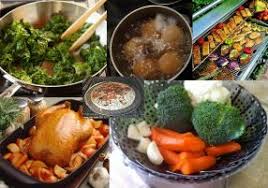
Moist heat and combination methods of cooking are used for a wide range of products (vegetables, meats, eggs, fish). They are also used to both tenderize tough pieces of meat and gently cook delicate fish and vegetables.
In the last article, the basic principles of heat transfer and the dry heat methods of cooking were discussed. In this article, the focus is on the moist heat and combination methods of cooking.
Overview of Moist Heat Cooking Methods
Moist heat methods of heat transfer include:
- Poaching
- Simmering
- Boiling/Blanching
- Steaming
Read Also: The Nutritional Requirements and Deficiency Symptoms for Poultry Chickens
1. Poaching: Gentle Cooking at Low Temperatures (160 – 185°F / 71 – 82°C)
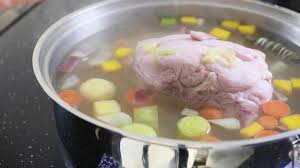
Poaching is when food is cooked in a liquid that is very hot but not boiling. It should be below boiling point. Poaching means to gently cook in a flavored liquid and relatively low temperature. It is usually applied to tender or delicate products:
- Eggs
- Fish
- Young Poultry
i. Poaching Media
A poaching medium is the liquid in which the food is cooked. Media is the plural of medium. Several different media can be used, depending on the food:
a. Water: Eggs are usually poached with a little vinegar added. Fruit is poached in water with sugar.
b. Milk: Fish fillets, such as smoked haddock, may be poached in milk.
c. Stock: Some foods may be poached in stock. The stock should be suited to the food. For example, fish fillets can be poached in fish stock and chicken breast fillets in chicken stock. Poultry and fish can also be poached in a rich vegetable stock.
d. Wine: Some fruit, such as pears, may be poached in wine.
Sometimes a tasty sauce can be made with the cooking liquid, e.g., parsley or other sauce can be made from the milk in which fish is poached.
ii. Purpose of Poaching
The purpose of poaching is to cook food so that it is:
- Very tender and easy to eat
- Very easy to digest
iii. Methods of Poaching
For most foods, heat the poaching liquid first. When it reaches the right temperature, lower the prepared food into the barely simmering liquid and allow it to cook in the gentle heat.
There are two ways of poaching: shallow and deep.
a. Shallow Poaching: Cook the food, such as cuts of fish and chicken, in only a small amount of liquid (water, stock, milk, or wine) and cover it with greased greaseproof paper. Never allow the liquid to boil – keep it at a temperature as near to boiling as possible without actually boiling. To prevent the liquid from boiling, bring it to the boil on top of the stove, then take it off the direct heat, then place the food in the liquid and complete the cooking in a moderately hot oven, approximately 180°C.
b. Deep Poaching: Cook eggs in approximately 8cm of gently simmering water. (When eggs are cooked in individual shallow metal pans over boiling water, this is actually poaching.) Whole fish (e.g., salmon), slices of fish on the bone (e.g., turbot), grilled cod and salmon, and whole chicken. All of these should be covered with the poaching liquid.
iv. Effects of Poaching
Poaching helps to tenderize the food, keep it moist, and improve the texture.
v. Temperature and Time Control for Poaching
The temperature must be controlled so that the cooking liquid does not become too cool or too hot. Poaching is cooking at just below simmering point.
It is important to time the cooking correctly so that food is neither undercooked nor overcooked. If it is undercooked, it will not be pleasant to eat and can sometimes be dangerous (e.g., undercooked chicken).
If it is overcooked, it will break up and lose some of its nutrients. The time and temperature needed to cook the food correctly will vary slightly for different types of food.
2. Simmering: Cooking at Low Heat (185 – 205°F / 85 – 96°C)
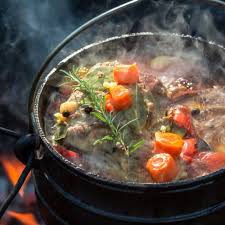
Often mistakenly called “boiling,” simmering is a moist heat method. As water is a much better conductor of heat than air, moist heat cooking is generally applied to tougher cuts of meat. Moist heat is very effective in breaking down connective tissue.
Used for meats that require wet methods. Broth is sometimes used for soups or sauces. Examples: Pot au Feu or Chicken & Dumplings.
3. Blanching: Quick Cooking at Boiling Point (212°F / 100°C)
Blanching involves cooking quickly in rapidly boiling liquid for the purpose of:
- Par-cooking (vegetables)
- Removing impurities (offal meats and bones)
- Removing bitterness from vegetables (greens and cabbage)
4. Boiling: Vigorous Cooking in Liquid
Boiling is when food is covered in water or stock, which is then heated up until the liquid starts to bubble vigorously. At that point, it is boiling. Usually, the heat is then turned down so that the liquid is just bubbling gently (also known as simmering).
i. Purpose of Boiling
Boiling is a healthy method of cookery as it does not use any fat but, when done properly, will keep the flavor and nutritional value of the food.
ii. Methods of Boiling
There are two ways of boiling:
- Place the food in boiling liquid. The liquid will stop boiling when the food is put in, so heat it up to bring it back to boiling. Then reduce the heat so that the liquid just bubbles gently (this is known as simmering) and boil the food.
- Cover food with cold liquid. Heat it up and bring it to the boil, then reduce the heat to allow the food to simmer.
iii. Effects of Boiling
Gentle boiling helps to break down the tough fibers of certain foods. When boiling meats, some of the meat extracts dissolve in the cooking liquid.
iv. Advantages of Boiling
- Older, tougher, cheaper joints of meat and poultry can be made tastier and tender.
- It is an economical way of cooking lots of food as it does not use too much fuel. Nutritious, well-flavored meat and vegetable stock can be produced from the cooking liquor.
- It is labor-saving, as boiling food does not need much attention from the cook.
v. Temperature and Time Control for Boiling
The temperature must be controlled so that the liquid is brought to the boil and then adjusted so that it goes to a gentle boil (simmer) until the food is cooked. Stocks, soups, and sauces must only simmer. Pasta should not be overcooked but left slightly firm (called al dente). Meat and poultry should be well-cooked and tender. Vegetables should not be overcooked but left slightly crisp.
vi. General Rules for Boiling
- Choose pans that are neither too small nor too large.
- When putting food into boiling liquid (e.g., when cooking green vegetables), make sure that there is enough liquid in the pot and that it is boiling before adding the food.
- When boiling meat, skim the surface of the liquid regularly during the cooking.
- Simmer rather than boil vigorously whenever possible. This will mean that less water evaporates, so the amount of liquid will stay more or less the same, and the food will not shrink too much.
5. Steaming: Cooking with Steam (Above 212°F / 100°C)
Steaming is the act of using steam, not water vapor, as a heat transfer agent. Steaming is another method of cooking using moist heat. Food is cooked under pressure in the steam produced by a boiling liquid (rather than placing the food itself in the boiling liquid).
Adding pressure accelerates the cooking process. Due to the fact that high heat toughens proteins, this method is rarely used with meats.
Steam is best for:
- Shellfish
- Starches (rice and potatoes)
- Vegetables (except fresh green)
i. Purpose of Steaming
The purpose of steaming food is to cook it so as to keep it as nutritious as possible (steaming keeps most of the nutrients in the food). Also, because the steaming process is gentle, it prevents the food from becoming too saturated with water.
ii. Methods of Steaming
There are four main methods of steaming:
a. Atmospheric Steaming: Steam is produced by placing water in the bottom of a saucepan and bringing it to a rapid boil. Food is placed in a container above the boiling water. The steam from the boiling water heats the container and cooks the food inside it.
b. High-Pressure Steaming: This is done in high-pressure steamers, such as pressure cookers. The high pressure in the steamer produces higher temperatures and forces steam through the food, which makes the food cook faster.
c. Low-Pressure Steaming: Because the pressure is lower in these steamers, the steam is also at a lower temperature, so the food cooks more slowly and gently.
d. Combination Steaming: This is done in a combination (‘combi’) oven. This combines dry heat and steam in the oven, which helps to add a little moisture to the food as it cooks.
iii. Effects of Steaming
When food is steamed, its texture is changed, and it becomes edible. The texture will vary according to the type of food, type of steamer, and level of heat. Sponges and puddings are lighter in texture if steamed rather than baked.
Note: Meat and sweet pudding basins must be greased. Once they have been filled, they must be covered with greased greaseproof or silicon paper and foil to prevent moisture getting in and making the pudding soggy.
iv. Advantages of Steaming
- The food keeps more of its nutritional value (retains its goodness).
- It makes some foods lighter and easier to digest, for example, it is a good way of cooking for people who are ill.
- Low-pressure steaming reduces the risk of overcooking, which can cause food to go soft and fall apart.
- High-pressure steamers are also used for ‘batch’ cooking, where small quantities of vegetables are cooked frequently throughout the service. This means the vegetables are always freshly cooked, so they keep their color, flavor, and nutritional content.
- The natural juices that result from steaming fish can be served with the fish or used to make the accompanying sauce.
- Steaming uses a low heat, and multi-tiered steamers (where several containers are placed one on top of the other in the steamer) can be used, making it economical on fuel.
v. Temperature and Time Control for Steaming
When using steamers, timing and temperature are very important to make sure that the food is not undercooked. Food cooks much faster in high-pressure steamers, and so there is a great danger of the food overcooking very quickly.
When using a high-pressure steamer, wait until the pressure gauge shows that it has reached the correct pressure, then open the door very carefully to allow the steam to escape before placing the food in the steamer. This way, the necessary cooking temperature will be reached.
Certain reheating operations:
a. High Pressure: Usually 10 – 15 minutes. Good for cooking vegetables fast, especially frozen. Good for fast cooking of meats that require wet methods.
b. Low Pressure: For every 1g of pressure, about 3°F is gained.
c. “No Pressure” Steaming: Does not work well for green vegetables.
Read Also: Layers or Broilers which One is More Profitable in Poultry Farming? Find Out!
Combination Cooking Methods: Stewing and Braising
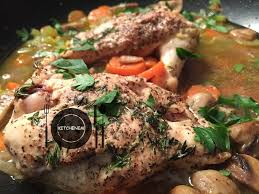
Braising and some stewing of meats are considered combination cooking methods because they employ both dry and moist heat.
1. Stewing/Casseroling: Slow and Gentle Cooking
Stewing and casseroling are slow, gentle, moist-heat methods of cooking in which the food is completely covered by a liquid. Both the food and the sauce are served together. Stews are cooked on top of the stove. Casseroles are stews cooked in the oven.
i. Stewing
Stew is a liquid food containing meat, poultry, fish, or vegetables, or any combination. Stewing is a moist cooking method carried out with smaller cuts of meat by:
- Braising
- Simmering
Stews can be divided into two classifications:
- Brown Stews (red meats)
- White Stews (white meats)
- Blanquettes
- Fricassees
- Ragout: A general term referring to white or brown stews.
- Fricassee: A white ragout usually made from white meat or small game, seared without browning and garnished with small onions and mushrooms.
- Chili (con carne): A ragout of diced or ground meat, cooked with chilies, onions, and spices. Served with beans in the stew or on the side.
- Navarin: A brown ragout generally made with lamb, turnips, peas, onions, and other root vegetables.
- Blanquette: A white stew in which the meat is first blanched, then added to a stock or sauce to complete cooking. Blanquettes are finished with an egg and cream liaison.
- Goulash/Paprikash: A Hungarian stew made with red meat, onions, and paprika.
ii. Purpose of Stewing
The purpose of stewing is to:
- Cook cheaper cuts of meat and poultry in a way that makes them tender and palatable.
- Keep many of the nutrients from the food, which go into the cooking liquid.
- Give a rich flavor to the food.
iii. Methods of Stewing
Stews can be cooked on a hob or in an oven:
- When cooked on a hob, meat and vegetables are placed in a saucepan and covered with liquid (water or stock). The liquid is brought to the boil, then turned down to a low simmer. A lid is placed on the pan, and the food is left to cook slowly.
- A stew may also be cooked in the oven, when it is referred to as a casserole. The term ‘casserole’ refers to both the baking dish and the ingredients it contains. Casserole dishes are usually deep, round, ovenproof dishes with handles and a tight-fitting lid. They can be made of glass, metal, ceramic, or any other heatproof material.
Both are slow, moist methods of cooking.
iv. Effects of Stewing
This is the slow process of cooking in gentle heat; the connective tissue in meat and poultry is changed into gelatine so that the fibers fall apart easily and become tender. Less liquid is used for stewing than for boiling, and the cooking temperature is slightly lower. The effects of boiling also apply to stewing.
v. Advantages of Stewing
- Stewing can make cheaper, tougher cuts of meat and poultry tender and palatable, so it is an economical method of cooking. The tougher cuts of meat often have more flavor than more tender cuts of meat, which tend to dry out in stews due to the long cooking times.
- If stews and casseroles are cooked correctly, very little liquid will evaporate, leaving plenty of sauce to serve up as part of the stew. The meat and vegetable juices that escape from the food during cooking stay in the liquid. This means that any vitamins and minerals are not lost but are served up in the tasty and nutritious sauce.
- Usually, everything in a stew can be eaten, so there is little waste. Also, because it is a gentle cooking method, the food does not shrink much and keeps its flavor.
- Stews reheat easily.
- Stews and casseroles are labor-saving because foods can be cooked in bulk and do not need to be monitored too closely.
vi. Temperature and Time Control for Stewing
Good stews are cooked slowly, so it is important to control the temperature properly. The liquid must barely simmer. Use a tight-fitting lid to keep in the steam. This helps to keep the temperature correct and reduces evaporation.
vii. General Rules for Stewing
- All stews should have a thickened consistency. This comes from thickening agents. Unparsed ingredients can cause thickening. For example, in stews such as Irish stew, all the vegetables are left in the stew and help to make it the right consistency.
- Flour can be added to the sauce, for brown lamb stew (navarin), for example.
- Egg yolks and cream can also be used to thicken white stews, such as blanquette. However, stews should not be over-thickened, and the sauce should stay light. Make sure the correct amount of thickening agents is used.
- Adjust the consistency during cooking if necessary by adding more liquid or more thickening agent.
- Do not overcook stews as this:
- Causes too much liquid to evaporate
- Causes the food to break up
- Causes the food to lose its color
- Spoils the flavor and makes the food feel dry when it is eaten.
2. Braising: Enhancing Flavor and Texture
Braising is a moist-heat method of cooking larger pieces of food. The food is only half covered with liquid and can be cooked on the stovetop or in the oven.
The food is cooked very slowly in a pan with a tightly fitted lid, using very low temperatures. A combination of steaming and stewing cooks the food. Food is usually cooked in very large pieces and carved before serving.
i. Purpose of Braising
The purpose of braising food is to enhance the flavor and texture.
ii. Methods of Braising
Whole joints of meat, whole chickens, and game (meat or fowl) can all be braised, as can vegetables. Tougher cuts of meat and other foods can also be braised. There are two methods of braising: brown braising and white braising.
a. Brown Braising: Used, for example, for joints and portion-sized cuts of meat.
b. White Braising: Used, for example, for vegetables. The first step is to blanch the vegetables, then place them in a braising pan with mirepoix and white stock.
For both methods, the liquid used for braising is usually a stock, but it may also be water, wine, or beer. Once the liquid is added, place a heavy, tight-fitting lid on the cooking pan. The lid keeps the moisture in the pan and around the food and creates steam. This prevents the food from becoming dry and tough.
iii. Effects of Braising
Braising breaks down the tissue fiber in certain foods, which softens them and makes them tender and edible. Cooking them in the braising liquid also improves the texture.
iv. Advantages of Braising
- Tougher, less expensive meats and poultry can be used.
- Maximum flavor and nutritional value are retained.
v. Temperature and Time Control for Braising
It is essential to cook the food slowly. The liquid must barely simmer. Use a tight-fitting lid to reduce evaporation and maintain the temperature. The time needed for braising will vary according to the quality of the food. The ideal oven temperature for braising is 160°C.
vi. General Rules for Braising
These are the same as for stewing. However, if the joint is to be served whole, remove the lid three-quarters of the way through cooking. Then baste the joint frequently to protect it from burning and glaze it – this makes it look attractive when it is served.
vii. Ideal Items for Braising
Typically tough pieces of meat that require long, slow cooking. Collagen-rich meats contribute gelatine. Examples: shoulder, leg, breast, and shank cuts. Braising can be done with:
- Large pieces (pot roast)
- Portion-size pieces (Swiss steak)
- Small pieces (stews)
viii. Procedure for Braising
- Meat must be seared by browning it at high heat in a small amount of fat.
- After searing, mirepoix is added and placed on the bottom of the pan; meat is placed on top.
- Red meats: Mirepoix is browned.
- White meat: Mirepoix is sweated.
- Tomato product is added (red meats only). Usually, meat is seared in the pan it is to be braised in; if not, the pan should be deglazed.
- Liquid is added – stock, wine, marinade, beer, light sauce, or water. The amount of liquid added is in direct relation to the amount of sauce needed for the finished product. Recommended ratio is to cover the meat by 1/3 to 2/3.
- Herbs and spices are added.
- Pan is brought to a simmer. A lid is placed on it, and it is placed in the oven.
- Meat should be turned or basted occasionally during the braising process to produce a nice glaze.
ix. White Braising
This is different from standard braising in that the items are either lightly colored (seared) or not colored at all. This is done with some poultry items and occasionally with large pieces of fish.
x. Testing for Doneness
“Fork tender” – insert a meat fork; if it pulls off easily, the meat is done. After the meat is done, a sauce can be made from the degreased cooking liquid (cuisson):
- Served as is
- Reduced to thicken and/or intensify flavor
- Thickened with cornstarch or with roux to make a sauce (jus lié)
Do you have any questions, suggestions, or contributions? If so, please feel free to use the comment box below to share your thoughts. We also encourage you to kindly share this information with others who might benefit from it. Since we can’t reach everyone at once, we truly appreciate your help in spreading the word. Thank you so much for your support and for sharing!