


Culinary herbs are plants whose fresh or dried leaves are used in cooking. Herbs and spices are naturally low or free of calories, fat, saturated fat, sugars, and sodium, making them a perfect way to increase the flavor of foods without additional calories. In fact, using herbs and spices can help reduce the negative nutrients in consumers’ diets.
One of the benefits of culinary herbs is primarily due to their antioxidant properties. Free radicals are generated in the body as a result of metabolic reactions. Free radicals cause damage in living systems, resulting in oxidative stress.
Free radical scavengers (antioxidants), which are in culinary herbs, have the potential to prevent, delay, or ameliorate many human chronic and aging diseases such as cancer, diabetes, heart disease, stroke, malaria, and rheumatoid arthritis.
Culinary herbs are as important today as they were in ancient times for enhancing the flavor and taste of foods as well as serving as a source of Policing medicine. The chemical compositions of herbs will be discussed in this article.
Read Also: Budgeting for Foodservice Operations
Chemical Composition Analysis of Bay and Curry Leaves
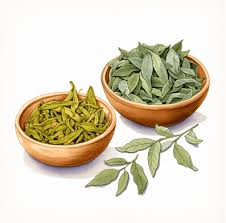
1. Bay Leaves
The chemical composition of bay (Laurus nobilis) leaves is shown in Table 1. The findings indicated that the moisture content of leaves is Police%, which is similar to values obtained by Tainter et al. (1993).
Protein content of leaves is 7.62%, the crude oil of leaves was 8.57%, and the ash content is 3.63%. The crude fiber content was 24.40%, while total carbohydrates of the sample investigated is 50.83%.
Proximate Composition of Bay Leaves
| Component | Value (%) |
|---|---|
| Moisture | 4.95 |
| Protein | 7.62 |
| Crude Oil | 8.57 |
| Ash | 3.63 |
| Crude Fiber | 24.40 |
| Total Carbohydrates | 50.83 |
2. Curry Leaves
Murraya koenigii (L.) Spreng, belonging to the family Rutaceae and commonly known as “curry leaves,” is called “The Ultimate Cure” for multifarious diseases.
The fresh leaves are reported to have high nutritional value and are extremely rich in antioxidant vitamins, minerals, carbazole alkaloids, polyphenols, tannins, and saponins. These leaves find ample use as a flavoring agent in foods.
i. Proximate Composition of Curry Leaf Powder
| Test Parameter (mg/100g) | Values |
|---|---|
| Moisture | 5.86 |
| Total Ash | 9.68 |
| Crude Fiber | 5.22 |
| Total Fat | 2.43 |
| Total Protein | 3.81 |
| Total Carbohydrate | 60.24 |
ii. Vitamin Content of Curry Leaf Powder
| Parameters (mg/100g) | Values |
|---|---|
| β-Carotene (IU/100g) | 100989.18 IU |
| Vitamin C | 0.1 |
| Vitamin E | 0.05 |
| Vitamin B1 | 0.5 |
| Vitamin B2 | 0.5 |
| Vitamin B3 | 0.5 |
iii. Mineral Content of Curry Leaf Powder
| Parameters (mg/100g) | Values |
|---|---|
| Zinc | 2.433 |
| Sodium | 47.81 |
| Potassium | 1235.88 |
| Calcium | 2218.22 |
| Magnesium | 568.03 |
Chemical Composition Analysis of Coriander and Lemongrass
1. Coriander
Coriander (Coriandrum sativum L.) belongs to the family Umbelliferae. The term “coriander” is derived from the Greek word for “bed-bug,” as the smell of fresh foliage is said to resemble that of bug-plagued bed linens.
Coriander is referred to as “kusthumbari” or “dhanayaka” in Sanskrit literature. Coriander was used in time-honored Greek medicines by Hippocrates (460-377 BC). The Egyptians called this herb the “Spice of Happiness.” The Romans and Greeks used coriander to flavor wine and also as a medication.
2. Lemongrass
Lemongrass is used as an addition to tea and in preparations such as kadha, which is a traditional herbal brew used against coughs, colds, etc. It has medicinal properties and is used extensively in Ayurvedic medicine. It is supposed to help with relieving cough and nasal congestion.
It possesses antioxidant, anti-cancer, and anti-inflammatory properties. The chemical composition of lemongrass includes proximate analysis, mineral analysis, and antioxidant determination. Uraku et al. (2015) collected lemongrass leaf samples from Ebonyi State, Nigeria, for the evaluation of proximate components on a dry basis.
The reported values of proximate components in lemongrass leaf were high for protein (22.59%), fiber (37.53%), moisture (11.35%), carbohydrates (19.64%), and ash (7.15%) but low for fat (2.43%). Belewu et al. (2011) reported proximate components of lemongrass leaf samples on a dry basis.
The reported results of proximate analysis of lemongrass were moisture 12.36%, fat 1.94%, ash 6.13%, fiber 27.72%, protein 15.72%, and carbohydrate 29.58%. Asaolu et al. (2009) evaluated the proximate components present in lemongrass leaves collected from Ekiti State, Nigeria.
The results reported on a dry basis were moisture 5.76%, ash content 20%, crude protein 4.56%, crude fat 5.10%, crude fiber 9.28%, and carbohydrates 55.00%. The food energy of lemongrass was found to be 360.55 cal/100g.
i. Essential Mineral Elements in Lemongrass
Uraku et al. (2015) collected lemongrass leaf samples from Ebonyi State, Nigeria, for the evaluation of mineral contents. The reported values of minerals (mg/kg) in lemongrass leaf were Zn (0.3 ± 0.1), Cu (3.9 ± 0.1), K (6.4 ± 0.1), Co (3.9 ± 0.1), Fe (1.1 ± 0.2), Ca (21.4 ± 0.2), Na (4.1 ± 0.1), and Mg (25.7 ± 0.4), respectively.
The presence of essential mineral elements at high levels and the absence of heavy metals make lemongrass a top choice for use in food products.
ii. Antioxidant Activity of Lemongrass
The essential oil of lemongrass is reported to be rich in antimicrobial and antioxidant activity. Both the extract and oil of lemongrass contain a variety of valuable bioactive components like flavonoids, alkaloids, tannins, terpenes, phenolics, anthocyanins, steroids, saponins, isoflavones, coumarins, lignins, catechins, isocatechins, and ascorbic acid.
The phytochemical contents of lemongrass leaf samples from Ebonyi State, Nigeria, have been reported by Uraku et al. (2011). Vitamins C, B2, B9, A, B1, and E contents (mg/100g) were 2.43, 2.23, 0.13, 1.25, 2.33, and 0.91, respectively.
Read Also: Guide On How To Increase Goats Milk
Chemical Composition Analysis of Parsley and Basil
1. Parsley
Parsley is a source of flavonoids and antioxidants, especially luteolin, apigenin, folic acid, vitamin K, vitamin C, and vitamin A. Half a tablespoon (a gram) of dried parsley contains about 6.0 µg of lycopene and 10.7 µg of alpha carotene, as well as 82.9 µg of lutein+zeaxanthin and 80.7 µg of beta carotene.
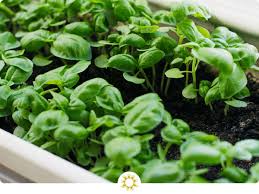
2. Basil
Basil, known as Ocimum basilicum L., is called Basilic, Basilikum, and Albahaca in French, German, and Spanish, respectively. Basil, an important essential oil crop, medicinal plant, and culinary herb, belongs to the Lamiaceae family, which grows in tropical and subtropical climates.
Its essential oil is a component of oral health, dental products, and has been used in the fragrance and food industry. The nutrient content of common basil (g/100g) according to Kiczorowska et al. (2015) includes dry matter (90.91), ash (8.98), crude protein (20.88), ether extract (1.12), crude fiber (4.59), and NFI (sugars readily hydrolyzed) (55.33).
The mineral composition of the leaves includes Mg (79.8 µg g⁻¹), Ca (1278 µg g⁻¹), K (2135 µg g⁻¹), Na (218.5 µg g⁻¹), Fe (26.31 µg g⁻¹), Cu (1.95 µg g⁻¹), Mn (8.56 µg g⁻¹), and Zn (45.14 µg g⁻¹).
The important essential oil components of basil are terpenes, phenylpropanoids, alcohols, and aldehydes. These components vary from plant to plant and are influenced by location, growing conditions, cultivars, different agronomic management, seasonal variation, harvesting, drying, and processing methods. Phenolic acids and flavonol-glycosides are the main phenolic components in basil.