


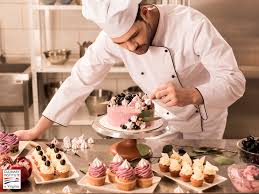
In the previous article, the focus was on grains used in cookery. This article explores pastries, a diverse category of baked goods integral to culinary traditions, emphasizing their preparation and historical significance in agriculture.
Pastry refers to various baked products made from ingredients such as flour, sugar, milk, butter, shortening, baking powder, and/or eggs. Small cakes, tarts, and other sweet baked goods are collectively known as “pastries.”
Originating with the Egyptians, pastry began as a flour and water paste used to wrap meat, soaking up juices during cooking. Developed further in the Middle East, it reached Europe via Muslims in the 7th century.
By medieval times, local areas had distinct puddings and pies. In the 17th century, flaky and puff pastries emerged, with intricate pie patterns becoming a work of art. Today, pastry primarily complements the flavor of fillings while providing a casing.
Understanding Pastry in Culinary Applications
Pastry differs from bread due to its higher fat content, resulting in a flaky or crumbly texture. A good pastry is light, airy, and fatty, yet firm enough to support the filling’s weight.
For short crust pastry, thorough blending of fat and flour before adding liquid ensures flour granules are coated with fat, reducing gluten development. Overmixing, however, creates long gluten strands, toughening the pastry.
In pastries like Danish pastry and croissants, the flaky texture results from repeatedly rolling out dough similar to yeast bread, spreading it with butter, and folding it to create multiple thin layers.
Short crust, or short, pastry is the simplest and most common type, made with flour, fat, salt, and water. Primarily used in tarts and quiches, it involves mixing fat and flour, adding water, and rolling out the paste.
Rubbing fat into flour with fingers or a pastry blender inhibits gluten formation, yielding a soft, tender pastry. Sweet crust pastry, a sweetened variant, includes sugar and sometimes eggs. Short pastry suits savory meat pies, while short sweet pastry is ideal for fruit pies, Christmas mince pies, and other dessert recipes. Suet pastry serves as a delicious cover for stews.
Historical Evolution of Pastry
Pastries trace back to the ancient Mediterranean with paper-thin, multi-layered baklava and filo. Northern Europe adopted pastry-making after Crusaders brought it from the Mediterranean.
During the Renaissance, French and Italian chefs perfected puff and choux pastries, while 17th- and 18th-century chefs introduced brioche, Napoleons, cream puffs, and éclairs. French chef Antonin Carême is credited as the first to incorporate art into pastry making.
Read Also: Poultry Management during Winter Cold
Chemistry Behind Pastry Making
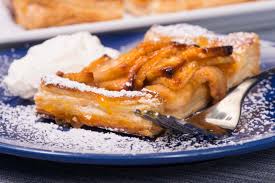
The nature of wheat flour and specific fats determines pastry types. When wheat flour is kneaded with water into plain dough, it develops gluten strands, making bread tough and elastic. In pastry, this toughness is undesirable, so fat or oil slows gluten development. Lard or suet, with their coarse, crystalline structure, is effective.
Unclarified butter, due to its water content, may not work well; clarified butter, nearly water-free, is preferable. Short crust pastry using only butter may yield an inferior texture. If fat is melted with hot water or liquid oil is used, the thin oily layer between grains offers fewer obstacles to gluten formation, resulting in tougher pastry.
European pastry traditions stem from the short crust era’s flaky dough, prevalent in the Mediterranean in ancient times. Romans, Greeks, and Phoenicians used filo-style pastries. Evidence suggests Egyptians produced pastry-like confections, with professional bakers skilled in using flour, oil, and honey.
In Aristophanes’ 5th-century BC plays, sweetmeats, including small fruit-filled pastries, are mentioned. Roman cuisine used flour, oil, and water to make pastries covering meats and fowls during baking to retain juices, though these were not meant for consumption. Richer pastries, containing eggs or small birds, were served at banquets. Greeks and Romans struggled with pastry due to oil use, which reduced stiffness.
In medieval Northern Europe, stiff pastries were achievable with shortening and butter. Medieval cookbooks listed incomplete ingredients, with stiff, empty pastries called coffins or “huff paste” consumed by servants, often with an egg yolk glaze for palatability. Small tarts added richness.
Actual pastry recipes emerged around the mid-16th century, adapted across Europe, leading to traditions like Portuguese pastéis de nata and Russian pirozhky.
Chocolate in pastry-making became common in the West after its introduction from the New World in the 16th century. French chef Antonin Carême (1784–1833) is considered the first great modern pastry master.
In Asia, Chinese pastry uses rice or various flours with fruit, sweet bean paste, or sesame fillings. Western-style pastry, introduced by the British in the 19th century and popularized by French-influenced Maxim in Hong Kong during the 1950s, is distinguished as “Western Cake.”
Other Asian countries, like Korea with tteok, hangwa, and yaksik, and Japan with mochi and manju, create distinct pastry-confections using regional ingredients.
For some, pastry-making seems time-consuming, complex, or strenuous. However, with few ingredients and mastered techniques, delicious pies, quiches, and tarts can be produced regularly. Pastry is essentially dough made from flour, fat, salt, and water, rolled out to serve as a base, cover, or envelope for sweet or savory fillings.
Shortcrust pastry, widely used in cherry pie, pumpkin pie, quiche, and banoffee fudge pie, melts in the mouth, offering rich flavor for both sweet and savory dishes. Various pastry types suit different recipes.
Types of Pastries in Culinary Arts
1. Flaky Pastry
Flaky pastry, a simple pastry, expands when cooked due to its layered structure, baking into a crisp, buttery texture. Baking begins at a high temperature, lowered to finish.
2. Puff Pastry
Puff pastry, with many layers, “puffs” when baked due to the interaction of flour, butter, salt, and water. The dough is layered with fat, preferably butter, through folding and rolling, creating hundreds of layers.
Water in the dough turns to steam during baking, puffing up the pastry into light, flaky, tender layers. Used for pies, pasties, vol-au-vents, savories, and desserts, puff pastry varies by bakers’ methods, butter-to-flour ratios, and folding techniques.
2. Choux Pastry
Choux pastry, a light pastry, is often filled with cream and topped with chocolate. It can also hold savory fillings like cheese, tuna, or chicken for appetizers. A French specialty, it is used for cream buns, chocolate éclairs, and profiteroles.
Butter is boiled with a water-milk mix, flour is added, and the mixture is beaten with eggs. Piped into rounds or lengths, it is baked in a hot oven. After cooling, it is pierced to release steam and filled with flavored cream (e.g., orange, coffee, caramel, or chocolate), often iced with chocolate.
3. Phyllo (Filo) Pastry
Phyllo pastries, paper-thin and stretched, involve multiple layers wrapped around fillings and brushed with butter. Delicate and prone to breaking, they are traditional in Europe, the Mediterranean, the Middle East, and China.
Made from dough stretched into thin sheets, phyllo is brushed with butter or oil before baking. It is used in layered sheets, individual rolls, or large rolls, filled with sweet (fruit, nuts, honey) or savory (meat, cheese, spinach) fillings for dishes like Austrian strudel, Mediterranean baklava, Middle Eastern borek, and Chinese spring rolls.
4. Other Pastry Varieties
Additional pastry types include rough puff pastry, hot water crust pastry, suet crust pastry, French flan pastry, rich flan pastry (pâte brisée), and rich short pastry (pâte sucrée). Each has unique preparation methods, ingredient ratios, and textures when baked, with some being more complex and time-intensive.
Key Ingredients in Pastry Making
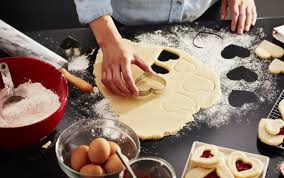
1. Flour
Flour, the primary ingredient, is typically plain flour for a crisp, light result. Yeast-containing pastries may use self-rising flour.
2. Shortening
Shortening or fat butter, margarine, lard, suet, vegetable fat, or combinations enhances flavor. All-butter pastry is richer, while half butter, half lard is common.
3. Liquid
Liquid, usually water, binds ingredients into pliable dough. Milk, cream, eggs, or buttermilk may be used, especially in sweet dishes like fruit tarts or flans, which often include whole eggs or yolks.
4. Salt
A pinch to one teaspoon of salt enhances ingredient flavors.
5. Sugar
Sugar sweetens pastry mixtures for tarts and flans.
6. Flavorings
Herbs, spices, nuts, or cheese may flavor shortcrust pastry for added zest.
Pastry Glazing Techniques
Pie tops are glazed for a shiny, attractive finish, sealing the surface. Applied with a pastry brush, glazes include lightly beaten egg yolk (shiniest), beaten egg white with sugar, milk, or a whole beaten egg.
Lamination Process in Pastry
Lamination involves adding fat between dough layers. Dough is made with minimal fat, then more fat is added via folding and rolling. Three methods exist:
1. Scotch or Blitz Method: Suitable for pies, sausage rolls, and pasties, it mixes flour, salt, cold water, and dough fat. Walnut-sized fat lumps are mixed in, leaving large pieces for flat discs in the dough, though it may not rise evenly.
2. English Method: Dough is rolled into a rectangle three times as long as wide, with two-thirds covered by butter dabs. The uncovered third folds into the middle, followed by the other end.
3. French Method: A square layer of fat is wrapped in dough made with 10% soft fat rubbed into flour, mixed with cold water. The dough is rolled into a square, fat is placed centrally, and corners are folded to cover it.
After lamination, the dough is folded and rolled multiple times, creating 100 to 700 layers. Over 700 layers cause dough to break during baking, leading to uneven rising. Dough is rolled to 12 mm, folded using the half-turn or book-fold method, and rolled to 5 mm for final use. To line tins, paste is rolled around a pin, unrolled over the tin, and trimmed. Puff pastry bakes best at 220°C.
Bakers calculate layers for desired height, often achieving maximum height with about 130 layers. The half-turn method yields two fat layers after the first turn, tripling with each subsequent turn, with dough layers calculated as 2(3^n-1)+1. The book-fold method quadruples fat layers, with dough layers as (4^n)+1, or 2(4^n)+1 for the English method.
Unbaked puff pastry has alternating fat and dough layers. During baking, water in the gluten boils into steam, expanding into fat layers, inflating the pastry up to eight times its height.
Read Also: Poultry Management during Winter (Cold)
Yeasted Pastries: A Bread-Pastry Hybrid
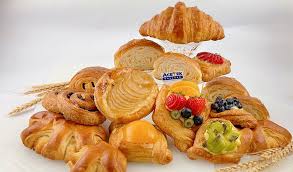
Yeasted pastries, a cross between puff pastry and bread, combine techniques from both. Dough, made like bread dough with flour, sugar, dough fat, salt, yeast, and cold liquid (water or milk), sometimes includes eggs for a golden color.
High-protein flour forms strong, elastic gluten, supporting the baked pastry. After kneading, the dough rests in a cool place to prevent distortion. It cools further for lamination.
Yeasted pastries are light, flaky, crisp outside, and soft inside. Examples include croissants and Danish pastries. Croissants, horseshoe-shaped, are eaten warm with butter and jam for breakfast. Danish pastries, in shapes like swirls or figures of eight, are sweet, often filled with custard and iced.
1. Croissants
Originating in Austria in 1683, croissants commemorated bakers alerting Vienna to a Turkish attack, shaped like the Turkish crescent. Introduced to France by Marie Antoinette, croissants evolved into today’s product.
Once time-consuming, new technologies enable mass production. Made from sweet yeasted paste layered with fat, croissants are eaten anytime, filled with savory or sweet fillings like chocolate, fruit, or almond paste.
2. Danish Pastries
Danish pastries, known as Wienerbrod in Denmark and Kopenhagener in Austria, were introduced to America by Danish bakers. Made from yeast-leavened sweet dough layered with butter or margarine, they are tenderer than croissants.
Rolled to 4 mm, cut into shapes like snails or knots, they are filled with almond paste, fruit, nuts, or custard, topped with nuts or egg glaze, and baked. After baking, they are glazed with diluted apricot jam and sometimes iced, often with lemon icing.
3. Lamination in Yeasted Pastries
Lamination uses the English method, with butter as the tastiest fat. The paste is rolled into a rectangle, folded in three via four half-turns, rested in a fridge for 10–15 minutes between turns, and rolled to 3.5 mm for croissants.
Cut into triangles, rolled into crescents, and risen for 40 minutes at 32°C, croissants are brushed with egg for a golden finish. During baking, moisture turns to steam, puffing the pastry into flaky layers, resembling a bread-puff pastry hybrid.
Do you have any questions, suggestions, or contributions? If so, please feel free to use the comment box below to share your thoughts. We also encourage you to kindly share this information with others who might benefit from it. Since we can’t reach everyone at once, we truly appreciate your help in spreading the word. Thank you so much for your support and for sharing!