


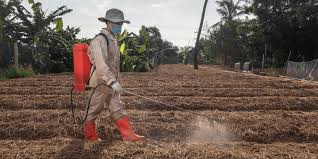
Pesticides are not sold in pure form due to their high toxicity and are diluted with carriers to minimize poisoning risks to applicators and the environment.
Technical-grade pesticides are used solely for analytical and toxicological studies. Commercially, pesticides are formulated with additives as emulsifiable concentrates, water-dispersible powders, dusts, granules, or solutions, with the active ingredient strength indicated on the label. Liquid concentrates require dilution, typically with water, before use.
Objectives of Pesticide Dosage Calculation
- Identify various pesticide types (insecticides, herbicides, fungicides) available commercially.
- Quantify the pesticide amount needed per hectare.
- Determine the pesticide quantity per tank load.
- Calculate the active ingredient or acid equivalent per hectare (kg a.i./ha).
Read Also: Economic Importance, Uses, and By-Products of Watermelon Axils
Pesticide Types and Application Methods

Commercially available pesticides include:
1. Insecticides for Pest Control: Endosulfan 35EC, Malathion 50EC, Metasystox 25EC, Dimethoate 30EC, Phorate 10G, Carbafuron 3G.
2. Herbicides for Weed Management: Atrazine 50 WP, Simazine 60 WP, Paraquat 24WSC, Fluchloralin 45EC, Alachlor 50EC or 100G, Butachlor 50EC or 5G, Glyphosate 41WSC, Propanil 35EC, 2,4-D Ethyl ester 18 & 35%, 2,4-D Amine salt 58 & 72%, 2,4-D Sodium salt 80 & 85P.
3. Fungicides for Disease Prevention: Carbendazim 50 SC, Carbendazim 50 WP, Copper Oxychloride 50WP, Difenconazole 24.9EC, Dithianon 5, 10EC, Dithianon 5SC, Hexaconazole 5, 10EC, Hexaconazole 5 SC, Mancozeb 80, 75 WP, Miclobutanil 10 WP, Propiconazole 10, 25 EC, Tebuconazole 24.9 EW, Tricyclozole 75 WP.
Pesticides are recommended for field application in three ways: amount per hectare (kg/ha), active ingredient or acid equivalent per hectare (kg a.i./ha), and solution concentration (e.g., 0.07% endosulfan).
Farmers must estimate required insecticide, herbicide, or fungicide quantities for a specific farm size as part of planning to purchase only the necessary amount.
Calculations for Pesticide Application
Four calculation categories are commonly used:
- Quantity of chemical per sprayer tank.
- Number of tank loads per hectare.
- Area covered by a tank load.
- Active ingredient per hectare.
Calculating Chemical Concentrate per Knapsack Tank
Formula: Tank Capacity (TC) × Dose Rate (DR) ÷ Spray Volume (SV) = Amount of Concentrate (C) in liters.
Example: For a 15-liter knapsack, a chemical applied at 5 liters/ha, and a calibrated spray volume of 200 liters/ha:
15 × 5 ÷ 200 = 0.375 liters.
Calculating Tankfuls per Hectare
Formula: Spray Volume (SV) ÷ Tank Capacity (TC) = Number of full tanks per hectare.
Example: 200 ÷ 15 = 13.33 tanks/ha.
Read Also: How to determine if the Oxygen Level of the water in your Fish Pond is enough
Calculating Area Covered by One Tank

Formula: 10,000 (square meters in a hectare) ÷ number of tanks per hectare = Area covered per tank.
Example: 10,000 ÷ 13.33 = 750 square meters per full tank. Assessing the area to be sprayed beforehand is critical.
Advantages of Pesticide Dosage Calculation
- Reduces chemical wastage.
- Minimizes environmental damage by using only required quantities.
- Supports farm business planning.
- Ensures effective pest control.
Disadvantages of Pesticide Dosage Calculation
- Involves calculations that may discourage some farmers.
- Calibration errors can be costly.
Best Practices for Safe Pesticide Application
Pesticides must be diluted before farm use due to the high toxicity of their pure forms. Correct dilution ensures effective pest control while protecting the environment and applicator, reducing material wastage.
Do you have any questions, suggestions, or contributions? If so, please feel free to use the comment box below to share your thoughts. We also encourage you to kindly share this information with others who might benefit from it. Since we can’t reach everyone at once, we truly appreciate your help in spreading the word. Thank you so much for your support and for sharing!