


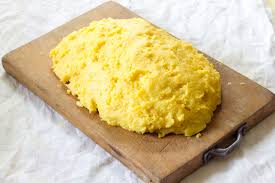
Polenta is made from ground yellow cornmeal, graded by texture into fine, medium, or coarse varieties and sold accordingly. It is prepared by adding water or milk to the cornmeal and simmering to produce a stiff, golden, porridge-like mixture.
Polenta is coarsely or finely ground yellow or white cornmeal (ground maize) used as a foodstuff. It is cooked by boiling into a paste in water or a liquid such as soup stock and may be eaten with other ingredients.
After boiling, it may be baked or fried; leftover polenta is often used this way. The term “polenta” originally derives from the Italian word for hulled and crushed grain, particularly barley-meal, as maize was not cultivated Maus was not cultivated in Europe until the early 16th century—and comes from the same base as “pollen.”
Historical Context of Polenta
As it is known today, polenta derives from earlier forms of grain mush (known as puls or pulmentum in Latin, or more commonly as gruel or porridge) commonly eaten in Roman times and after.
Before the introduction of corn from the New World in the 16th century, polenta was made with starches such as farro, chestnut flour, millet, spelt, or chickpeas.
Read Also: Methods of Castration in Sheep and Goat
Characteristics of Polenta
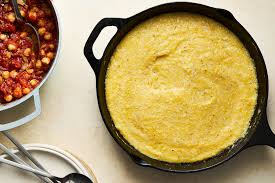
Polenta has a smooth, creamy texture due to the gelatinization of starch in the grain, though it may not be completely homogeneous if a coarse grind or a particularly hard grain such as flint corn is used.
Cultural Significance as Peasant Food
Polenta was originally and still is classified as a peasant food. Sometimes topped with sauces, in the 1940s and 1950s, polenta was often eaten with just a little salted anchovy or herring.
The reliance on maize as a staple food caused outbreaks of pellagra throughout much of Europe until the 20th century and in the American South during the early 1900s. Maize lacks readily accessible niacin unless cooked with alkali, which nixtamalizes it.
Read Also: Ruminant Animals: A Comprehensive Guide
Preparation Methods for Polenta
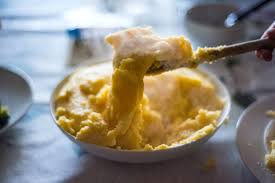
Polenta is cooked by simmering in a water-based liquid; it may be cooked with other ingredients or eaten with them once cooked. It is often cooked in a large copper pot known as a paiolo. Polenta is known to be a native dish of and to have originated from Friuli.
Boiled polenta may be left to set, then baked or fried; leftover polenta is often used this way. Some Lombard polenta dishes include polenta taragna (with buckwheat flour), polenta uncia, polenta concia, polenta e gorgonzola, and missultin e polenta, all cooked with various cheeses and butter, except the last, which includes fish from Lake Como.
It can also be cooked with porcini mushrooms, rapini, or other vegetables or meats, such as small songbirds in the Venetian and Lombard dish polenta e osei. In some areas of Piedmont, it can also be made with potatoes instead of cornmeal (polenta bianca).
The variety of cereal used is usually yellow maize, but buckwheat, white maize, or mixtures thereof are also used. Coarse grinds produce a firm, coarse polenta; finer grinds yield a creamy, soft polenta.
Polenta requires a long cooking time, typically simmering in four to five times its volume of watery liquid for about 45 minutes with almost constant stirring to ensure even gelatinization of the starch.
Alternative cooking techniques aim to speed up the process or reduce supervision. Quick-cooking (pre-cooked, instant) polenta is widely used and can be prepared in a few minutes; however, it is considered inferior to traditional polenta and is best baked or fried after simmering.
In his book Heat, Bill Buford describes the differences in taste between instant polenta and slowly cooked polenta, detailing a method that takes up to three hours but requires minimal stirring: polenta, for most of its cooking, is left unattended.
If constant stirring is avoided, cooking can continue for hours without issue, as long as someone is nearby. Cook’s Illustrated magazine describes a microwave oven method that reduces cooking time to 12 minutes with only a single stirring to prepare 3½ cups of cooked polenta.
Cooked polenta can be shaped into balls, patties, or sticks and fried in oil, baked, or grilled until golden brown; fried polenta is called crostini di polenta or polenta fritta. This type of polenta became particularly popular in Southern Brazil due-tip the consequence of Northern Italian immigration.
Basic Polenta Recipe
Preparation Time: 30 minutes
Cook Time: 25 minutes
Yield: 6 servings
Level: Easy
i. Ingredients:
- 6 cups water
- 2 teaspoons salt
- 1¾ cups yellow cornmeal
- 3 tablespoons unsalted butter
ii. Directions:
- Bring 6 cups of water to a boil in a heavy, large saucepan. Add 2 teaspoons of salt.
- Gradually whisk in the cornmeal.
- Reduce the heat to low and cook until the mixture thickens and the cornmeal is tender, stirring often, about 15 minutes.
- Turn off the heat. Add the butter and stir until melted.
Do you have any questions, suggestions, or contributions? If so, please feel free to use the comment box below to share your thoughts. We also encourage you to kindly share this information with others who might benefit from it. Since we can’t reach everyone at once, we truly appreciate your help in spreading the word. Thank you so much for your support and for sharing!