


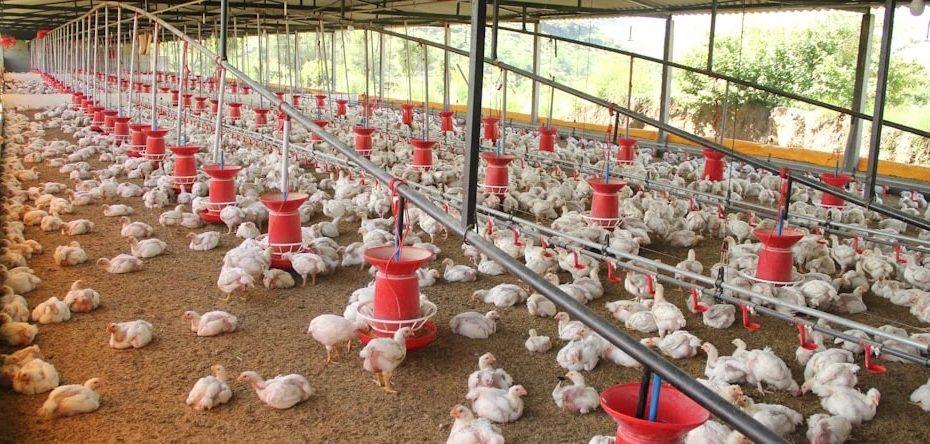
Choosing the right location for your poultry farm is one of the most important decisions you’ll make as a farmer. It’s not just about finding empty land and building a structure. The site you pick will affect everything from your birds’ health to your relationship with neighbors to your farm’s long-term profitability.
Many new poultry farmers make the mistake of focusing only on the cost of construction. They forget that a poorly chosen site can lead to problems that cost far more in the long run. You might face complaints from neighbors about odors. Your birds might get sick more often because of poor drainage. You could struggle with high electricity bills if utilities are far away. Or you might find yourself in legal trouble because you didn’t follow setback regulations.
Today’s poultry farming is different from what it used to be. You can’t just build anywhere and hope for the best. Modern farmers need to think about environmental issues like water quality, odors, flies, and soil phosphorous levels. You need to consider the people living nearby and public spaces like churches, parks, and businesses. And you absolutely must understand the laws and regulations that affect farming operations in your area.
Site selection requires careful planning. You need to think about utilities, roads, topography, prevailing winds, existing buildings on your property, your neighbors, public areas, setbacks, and both state and federal laws. Each of these factors can make or break your poultry farming operation.
This guide will walk you through everything you need to know about selecting the perfect site for your poultry housing. We’ll cover practical considerations that will save you money, time, and headaches. Whether you’re planning to start with two houses or build a larger operation, understanding site selection will help you make smart decisions from the beginning.
1. Considering Your Neighbors
A. Why Neighbor Location Matters Most
The location of nearby homes should be your number one consideration when picking a site for your poultry facilities. This isn’t just about being nice. It’s about protecting your business.
Good neighbors can quickly become enemies if your building site is too close to their homes. Once that happens, you’ll face constant complaints, possible legal action, and a stressful environment that makes farming miserable.
B. Talking to Neighbors Before You Build
Some poultry companies require you to discuss your building plans with neighbors before construction starts. Even if this isn’t required in your area, it’s still a smart move.
Your neighbors’ reactions might force you to choose alternate sites. It’s better to know this early than to invest money and time only to face opposition later.
C. Understanding Wind Patterns
The distance from your poultry house to any residence needs to be greater if prevailing winds blow toward that residence. Wind direction affects how far odors travel.
Since modern poultry companies require mechanical ventilation in all poultry houses, you can’t rely on natural ventilation anymore. But wind still matters for odor control.
D. What Is Wind Shed
Wind shed describes the wind flow pattern on the downside of an existing building. To minimize complaints from neighbors, you need to keep nearby homes out of the wind shed area.
Think about how wind moves around and past your buildings. Where will the air carrying odors from your farm end up? Make sure it’s not blowing directly toward someone’s house.
2. Evaluating Utilities and Infrastructure
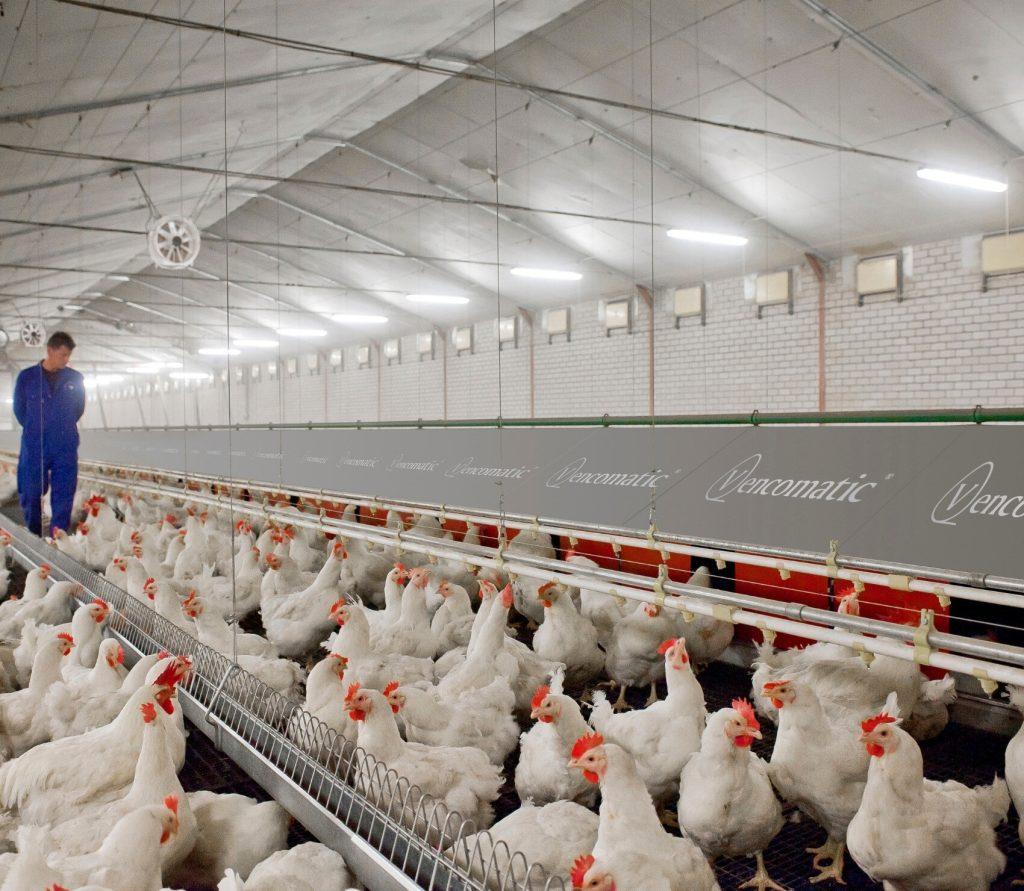
A. Electricity Availability
You need to answer some basic questions about utilities before choosing your site. Is electricity readily available at the location you’re considering? Or will the local electric utility need to run new lines?
If new lines are needed, find out the cost. Sometimes the expense of bringing electricity to a remote site makes that location impractical, no matter how good it looks otherwise.
B. Water Supply
Clean water must be available at your chosen site. Poultry need constant access to fresh water, and you’ll also need water for cleaning and sanitation.
Check both the availability and quality of water sources. If you need to drill a well, factor that cost into your planning. If you’ll connect to municipal water, verify that the pressure and flow rate will meet your needs.
C. Road Access
Your farm needs good road access for several reasons. Chicks need to be delivered. Feed trucks will make regular visits. You’ll need to transport eggs or birds to market.
Poor road access means higher transportation costs and potential delays. In bad weather, inadequate roads can leave you stranded without supplies or unable to get your products to buyers.
3. Understanding Topography and Land Features
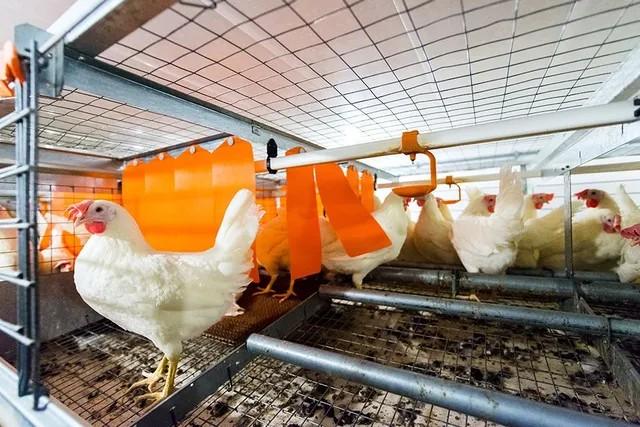
A. Level vs. Sloped Land
Whether your site is level, gently rolling, or hilly will determine how much grade work you need to do. Grade work means moving dirt to create level areas for buildings.
This work can add substantially to your total construction cost. Get quotes for any necessary grading before you commit to a site.
B. Avoiding Flood-Prone Areas
Never build in low-lying areas near streams with flooding potential. Even if a site seems perfect otherwise, flooding risk makes it unsuitable for poultry housing.
Floods can destroy your buildings, kill your birds, and contaminate your entire operation with disease-causing organisms from floodwater.
C. East-West Orientation
When possible, locate the long axis of your poultry house in an east-west direction. This orientation helps with temperature control and reduces direct sunlight stress on birds during the hottest parts of the day.
The topography of your site should allow for this preferred orientation without excessive grading costs.
4. Planning for Expansion and Additional Buildings
A. Room to Grow
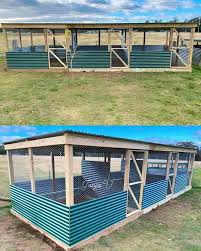
Many poultry farmers start with two houses and plan to build an additional two houses later. Your initial site selection needs to account for this future expansion.
Make sure you have adequate land area not just for your current plans but for the growth you anticipate. It’s frustrating to find the perfect site only to realize it can’t accommodate your five-year plan.
B. Supporting Structures
Your building site needs adequate land area for other essential buildings besides the main poultry houses. These include:
i. Dead-bird composting facilities: You need a designated area for properly disposing of birds that die. This is both a biosecurity measure and often a legal requirement.
ii. Litter storage buildings: Poultry litter needs to be stored properly before it can be used or moved. You’ll need covered storage to prevent rainwater from contaminating the litter.
These support buildings should be out of public view if possible. Nobody wants to see composting facilities or manure storage when they drive past your farm.
C. Proper Distancing
Support buildings need to be located close enough to your production facilities to minimize travel time. But they also need to be far enough away to reduce possible disease transmission.
A distance of about 100 feet is a reasonable compromise. This keeps these facilities convenient without creating biosecurity risks.
Read Also: Poultry Housing Management: Poultry Pen/House Construction Guide
5. Managing Litter and Nutrient Requirements
A. Litter Production Volume
You need to understand how much litter your operation will produce. Approximately 300 tons of litter will be generated each year on a 50,000-bird capacity broiler farm.
That’s a lot of material to manage. You can’t just pile it up and ignore it.
B. On-Farm Utilization
Is there sufficient land available on your farm to properly utilize the litter as fertilizer? Or will you need to move some of it off-site?
Using litter on your own land is usually the most economical option. But you need enough acreage to apply it at rates that don’t damage soil or water quality.
C. Nutrient Management Planning
A nutrient management plan will help you determine if adequate land area is available for litter utilization. This plan calculates how much litter can be safely applied based on your soil type, crops, and environmental regulations.
Many areas now require nutrient management plans before you can build poultry facilities. Check local regulations early in your planning process.
6. Understanding Setback Requirements
A. What Are Setbacks
How far should poultry houses be set back from residences, property lines, public areas, public roads, streams, wells, sinkholes, and flood plains?
Setbacks are minimum distances that buildings must maintain from certain features. They’re designed to protect water quality, reduce nuisance complaints, and maintain public safety.
B. State and Local Regulations
Currently, some states don’t have any laws or regulations that govern setbacks for agricultural building sites. But that doesn’t mean you should build without considering setbacks.
Most poultry industry companies have self-imposed setback guidelines that you need to follow. Your integrator will likely require you to meet these standards even if your state doesn’t mandate them.
C. Purpose of Setback Guidelines
These guidelines help reduce problems associated with:
i. Odors: Keeping buildings farther from homes reduces odor complaints.
ii. Dust: Poultry operations generate dust that can bother neighbors if buildings are too close.
iii. Feathers: Feathers blow around during cleanout and can become a nuisance.
iv. Noise: Fans, feed delivery, and bird sounds all create noise.
v. Water quality: Setbacks from streams, wells, and sinkholes protect drinking water sources.
7. Evaluating Environmental Factors
A. Water Quality Concerns
Your site selection must consider how your operation will affect local water quality. Runoff from your poultry houses and litter storage areas can contaminate streams, ponds, and groundwater.
Choose a site where you can implement proper erosion control and runoff management. Avoid sites where containment would be difficult or expensive.
B. Odor Management
Odor is one of the biggest complaints about poultry farms. Your site selection can make odor management easier or harder.
Sites with good air movement and distance from neighbors naturally handle odors better. Sites in valleys or other areas where air stagnates will trap odors and cause more problems.
C. Managing Flies
Flies breed in poultry litter and can become a major nuisance. While good management practices are essential for fly control, site selection also plays a role.
Sites close to neighbors mean any fly problem quickly becomes a complaint. More distance gives you more margin for error in your fly management program.
8. Complying with Laws and Regulations
A. Federal Regulations
Federal laws may apply to your poultry operation depending on its size and location. These can include Clean Water Act requirements, especially if your farm is near wetlands or navigable waters.
Research federal requirements early. Violating federal environmental laws can result in serious penalties and even criminal charges.
B. State Requirements
State regulations vary widely. Some states have detailed regulations for poultry operations. Others have minimal requirements.
Contact your state department of agriculture or environmental protection to learn what regulations apply to poultry farms in your area.
C. Local Zoning and Ordinances
Local governments may have zoning laws that restrict where you can build poultry houses. Some areas prohibit agricultural buildings in certain zones. Others require special permits.
Check with your county planning office before you buy land or invest in site preparation. Buying land only to discover you can’t get a building permit is an expensive mistake.
D. Right-to-Farm Laws
Many states have right-to-farm laws that protect farmers from nuisance lawsuits if they follow accepted agricultural practices. But these laws don’t give you unlimited protection.
To benefit from right-to-farm protection, you typically need to follow industry standards and environmental regulations. Poor site selection that ignores neighbors and environmental concerns may not be protected.
9. Assessing Existing Buildings and Features
A. Working Around Existing Structures
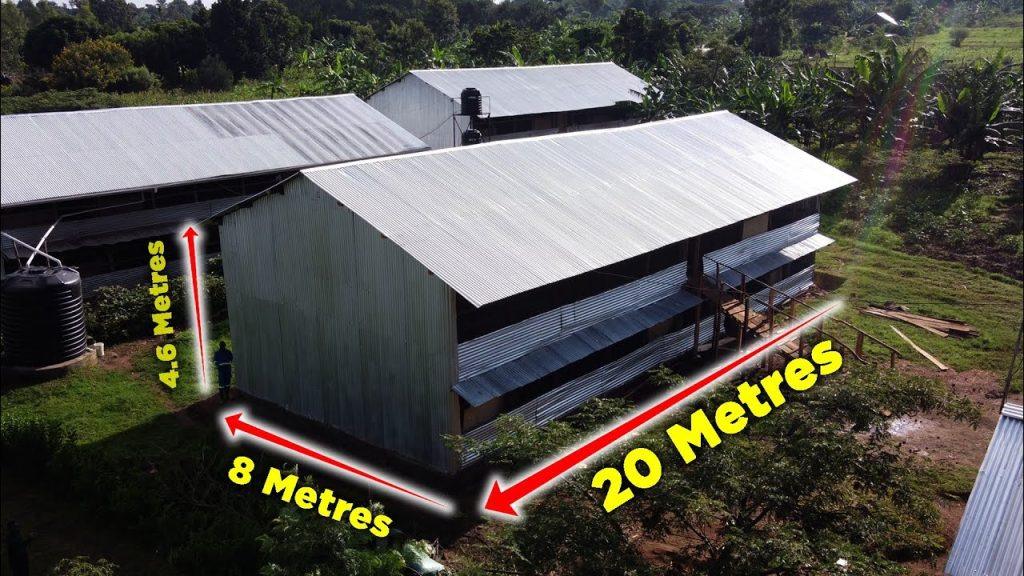
If you already have buildings on your property, you need to consider how new poultry houses will fit with existing structures. Will the new buildings interfere with access to old buildings? Will they create drainage problems?
Think about how the entire farmstead will function with new poultry houses added. Sometimes the best site for poultry conflicts with other farm operations.
B. Using Existing Infrastructure
Existing infrastructure like roads, water lines, and electrical service can make some sites more attractive than others. If you can connect to existing utilities rather than running new lines, you’ll save money.
But don’t let existing infrastructure force you into a bad site. It’s usually cheaper to run new lines to a good site than to deal with problems from a poor site.
C. Biosecurity Considerations
If you already raise poultry or other livestock, biosecurity becomes important in site selection. New poultry houses should be separated from existing animal facilities to reduce disease transmission risk.
Plan for separate access routes if possible. This allows visitors to reach your poultry houses without driving through areas where other animals are kept.
10. Planning for Public Perception
A. Visibility from Roads
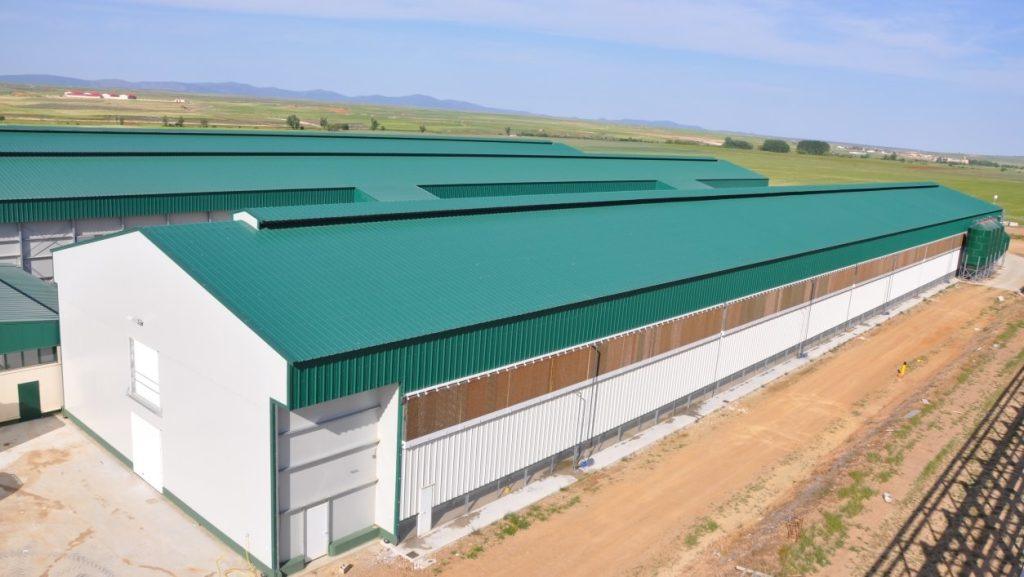
Sites visible from main roads attract more attention. This visibility can be good or bad depending on how professional your operation looks.
If your buildings and grounds are well-maintained, roadside visibility can build community goodwill. If they’re run-down, that same visibility creates a negative impression that can lead to complaints and regulatory scrutiny.
B. Distance from Public Gathering Places
Churches, schools, parks, and other public gathering places deserve special consideration. People are more likely to notice and complain about odors or other nuisances when they’re at these locations.
Maintain greater distances from public gathering places than you might from individual homes. A single home has one household that might complain. A church has dozens or hundreds of people who might notice problems.
C. Community Relations
Good community relations start with thoughtful site selection. Choosing a site that minimizes impacts on neighbors and the public shows respect for your community.
This respect pays dividends when you need community support, whether that’s for a zoning variance, an expansion permit, or just maintaining good relationships with the people around you.
11. Conducting a Complete Site Evaluation
A. Making a Site Visit Checklist
Before you commit to a site, visit it multiple times under different conditions. See it in rain to check drainage. Visit on a windy day to understand air movement. Drive by at different times to assess traffic and neighbor activities.
Create a checklist of everything you need to evaluate. Don’t rely on memory or assume you’ll notice important details.
B. Getting Professional Input
Consider hiring professionals to evaluate potential sites. This might include:
i. Agricultural engineers: They can assess grading requirements and drainage.
ii. Environmental consultants: They can identify potential water quality or wetland issues.
iii. Lawyers: They can review zoning laws and regulations.
The cost of professional input is small compared to the investment you’re making in your poultry operation.
C. Involving Your Integrator Early
If you’re planning to raise birds for an integrator, involve them in site selection from the beginning. They have experience with what works and what doesn’t. They can tell you if a site will meet their requirements.
Getting their approval early saves you from investing in a site that your integrator won’t approve.
Read Also: 12 Management Tips for better Poultry Performance Potential
12. Making Your Final Decision
A. Weighing Multiple Factors
Site selection involves balancing many competing factors. The perfect site probably doesn’t exist. You’ll need to make trade-offs.
Make a list of must-have requirements versus nice-to-have features. Focus on getting the must-haves right. Be willing to compromise on less critical items.
B. Thinking Long-Term
Don’t just think about your immediate needs. Consider where your operation might be in 10 or 20 years.
Will the site support expansion? How might the surrounding area change? Are new subdivisions planned nearby that could bring complaints?
C. Trusting Your Instincts
After you’ve done all your research and evaluation, trust your instincts. If a site feels wrong despite looking good on paper, there’s probably a reason.
Take your time making this decision. Rushing into a poor site choice is one of the most expensive mistakes you can make in poultry farming.
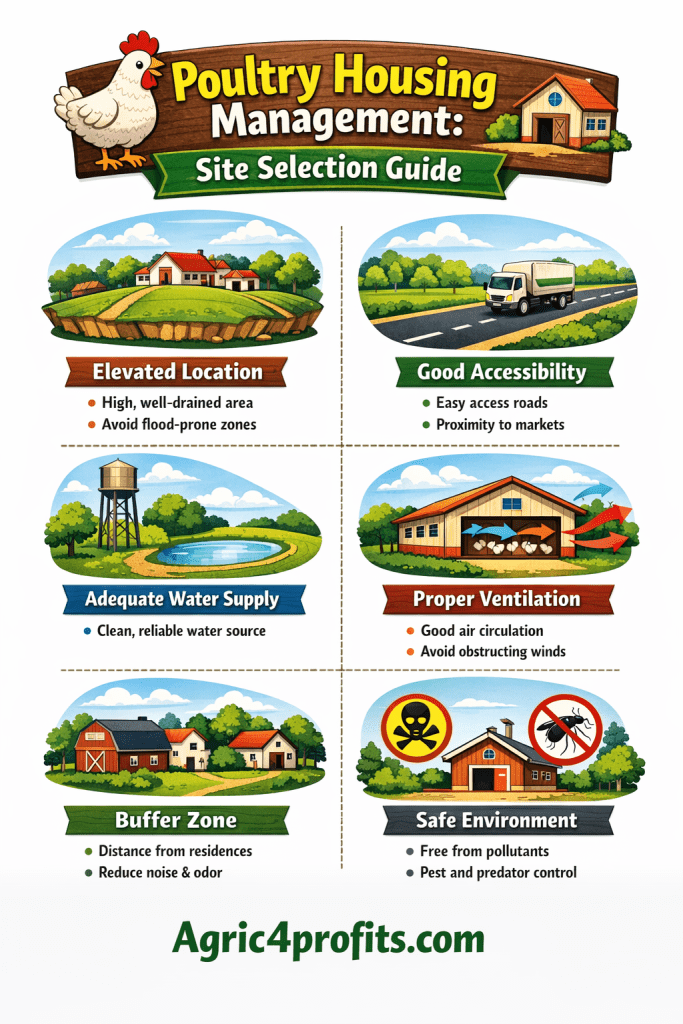
Summary on Poultry Housing Management: Site Selection Guide
| Category | Key Points |
|---|---|
| Neighbors | Location of nearby homes is the #1 consideration; discuss plans with neighbors before building; consider wind patterns and wind shed effects |
| Utilities | Verify electricity availability and cost; ensure clean water access; confirm adequate road access for deliveries and market transport |
| Topography | Assess grading costs for level ground; avoid flood-prone low-lying areas; prefer east-west orientation for temperature control |
| Expansion Planning | Allow space for future growth; plan for dead-bird composting and litter storage buildings; maintain 100-foot distance between support and production buildings |
| Litter Management | Expect 300 tons/year for 50,000-bird capacity; determine if on-farm land is sufficient; develop nutrient management plan |
| Setbacks | Follow industry guidelines even without state laws; maintain distances from residences, roads, streams, and wells; reduce odor, dust, and water quality issues |
| Environmental Factors | Protect water quality from runoff; choose sites with good air movement for odor control; distance reduces fly complaints |
| Legal Compliance | Research federal Clean Water Act requirements; understand state regulations; verify local zoning and permits; know right-to-farm law limitations |
| Existing Features | Plan around current buildings; leverage existing infrastructure when beneficial; maintain biosecurity separation from other livestock |
| Public Perception | Consider visibility from roads; maintain distance from churches, schools, parks; build community goodwill through respectful site selection |
| Site Evaluation | Visit multiple times under different conditions; hire professionals for technical assessment; involve integrator early in process |
| Final Decision | Balance must-have vs. nice-to-have features; think 10-20 years ahead; trust instincts if site feels wrong |
Frequently Asked Questions About Poultry Housing Site Selection
1. How far should my poultry house be from my neighbor’s home?
While regulations vary by location, most industry guidelines recommend significant setback distances to prevent odor and noise complaints. The exact distance depends on prevailing winds and local regulations. If winds blow toward a neighbor’s house, you need greater distance. Discuss your plans with neighbors before building to avoid conflicts.
2. Can I start with just one or two poultry houses and expand later?
Yes, many farmers start small and expand over time. However, you must choose a site with enough land to accommodate future buildings from the beginning. Plan for the space you’ll eventually need, not just your starting size. This includes room for additional poultry houses, support buildings, and litter storage.
3. What happens if my chosen site doesn’t have electricity nearby?
You’ll need to contact your local electric utility to get a quote for running new lines to your site. The cost varies greatly depending on distance and terrain. Sometimes these costs make a remote site impractical. Factor electrical service costs into your site selection decision before purchasing land.
4. Do I really need a nutrient management plan for poultry litter?
Many areas now require nutrient management plans before you can build poultry facilities. Even if not legally required, these plans help you determine if you have enough land to properly utilize the litter your operation will produce. A 50,000-bird broiler operation produces approximately 300 tons of litter annually, which requires significant land area for proper application.
5. What should I do if my state has no setback regulations for poultry buildings?
Even without state regulations, you should follow industry setback guidelines. Most poultry integrators have their own requirements that exceed state minimums. Following these guidelines protects you from neighbor complaints and potential lawsuits. Good setback practices also help maintain water quality and reduce environmental impacts.
6. How important is topography when selecting a poultry farm site?
Topography significantly affects your construction costs and long-term operation success. Level or gently rolling land requires less grading work, saving construction costs. Avoid low-lying areas prone to flooding. Sites that allow east-west building orientation help with temperature control and reduce stress on birds.
7. Should I involve my poultry integrator in site selection?
Absolutely. Involve your integrator from the very beginning of the site selection process. They have extensive experience with what works and what doesn’t. Your integrator will need to approve your site anyway, so getting their input early prevents you from investing in a location they might reject later.
8. Can I build poultry houses on the same property where I keep other livestock?
While possible, you need to maintain proper biosecurity separation between poultry and other livestock. This reduces disease transmission risk. Plan for separate access routes if feasible, allowing visitors to reach poultry houses without passing through areas where other animals are kept. Consult biosecurity guidelines specific to your operation type.
9. How do I find out about local zoning laws and building permits?
Contact your county planning office or zoning department. They can tell you if agricultural buildings are permitted in your chosen location and what permits you’ll need. Do this before purchasing land. Some areas prohibit agricultural buildings in certain zones or require special permits that can be difficult to obtain.
10. What’s the most common mistake in poultry farm site selection?
Focusing only on purchase price and construction costs while ignoring long-term operational factors. A cheap site that’s too close to neighbors, has poor drainage, lacks utility access, or violates setback guidelines will cost far more in the long run through complaints, legal problems, disease issues, and operational inefficiencies. Choose sites based on suitability, not just initial cost.
Do you have any questions, suggestions, or contributions? If so, please feel free to use the comment box below to share your thoughts. We also encourage you to kindly share this information with others who might benefit from it. Since we can’t reach everyone at once, we truly appreciate your help in spreading the word. Thank you very much for your support and for sharing!
Read Also: Top 5 Trends in Agriculture