


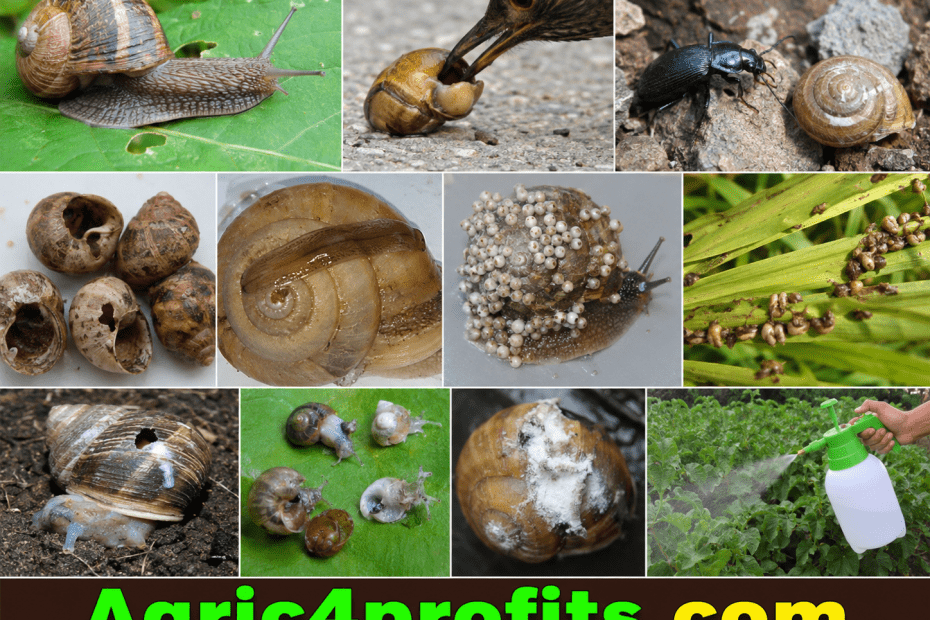
Snail farming stays profitable when farmers understand the threats that attack stock at every stage of growth. Predators, parasites, and diseases can reduce numbers quickly if pens, feeding routines, and sanitation are poorly managed.
Many losses begin quietly, because rats, birds, insects, and other pests exploit small weaknesses before the farmer notices them. Good planning, including proper housing and regular inspection, gives the colony a better chance of survival.
Snails in the wild also face pressure from habitat loss, pollution, and human harvesting. On farms, those same risks become more severe when protection is weak, so every farmer needs a practical control plan early.
Healthy snails grow best in a clean, secure environment. A farmer who combines careful stocking, sound feeding, and hygiene reduces stress and mortality across the whole colony over time in practice.
Predators of Snail

Field mice, rats, shrews, birds, frogs, toads, lizards, snakes, beetles, millipedes, and centipedes are common snail predators. Farmers should treat them as serious threats because they attack eggs, juveniles, and adult snails alike.
Frogs and toads usually focus on younger snails, while reptiles often eat both eggs and mature stock. Because these attacks happen at different stages, farmers need layered protection rather than one weak barrier.
🌿 Go Organic on Your Farm: Instead of harmful chemical pesticides and fertilisers, try our organic farming products — including neem oil spray, bio-pesticides, natural plant treatments, organic seeds and seedlings, suckers, and many more organic products that are safe for your health, your family, your soil and your harvest. Shop Now →
Good snail housing reduces losses before they begin. A built pen, as shown in the snail house guide, makes predator entry harder and helps protect breeding stock from repeated attacks.
Where birds create pressure, cover nets offer protection and preserve stock that might otherwise be lost. Farmers who study housing equipment often detect weak points faster and improve repairs quickly.
Low fences dug firmly into the ground help block crawling and burrowing pests. Height alone is not enough, because rats and similar animals exploit gaps, so the fence must match the pen design carefully.
Traps and bait placed outside the snail area can reduce surrounding pest numbers before they reach the pens. This approach works best when the farm stays tidy, because clutter gives predators more hiding places.
🔧 Free Farm Tool Available: Use our free Agric4Profits Farm Tools to calculate your farm profits, formulate feeds, identify pests and diseases on both your crops and animal farms, plan your planting and harvesting season, including many more farm tasks to get free expert advice and recommendations — completely free, no registration required. Access Free Tools →
Daily removal of leftover food is essential, since rats and field mice are drawn to waste feed. Clean routines also support simple tools that ease maintenance and reduce hidden pest pressure.
Farmers should inspect the perimeter often, repair weak sections immediately, and keep vegetation around the pens short. Consistent observation matters more than panic responses, because early action protects the colony before losses spread.
Read Also: Recommended Methods of Selecting Snail Breeding Stock
Parasites of Snail
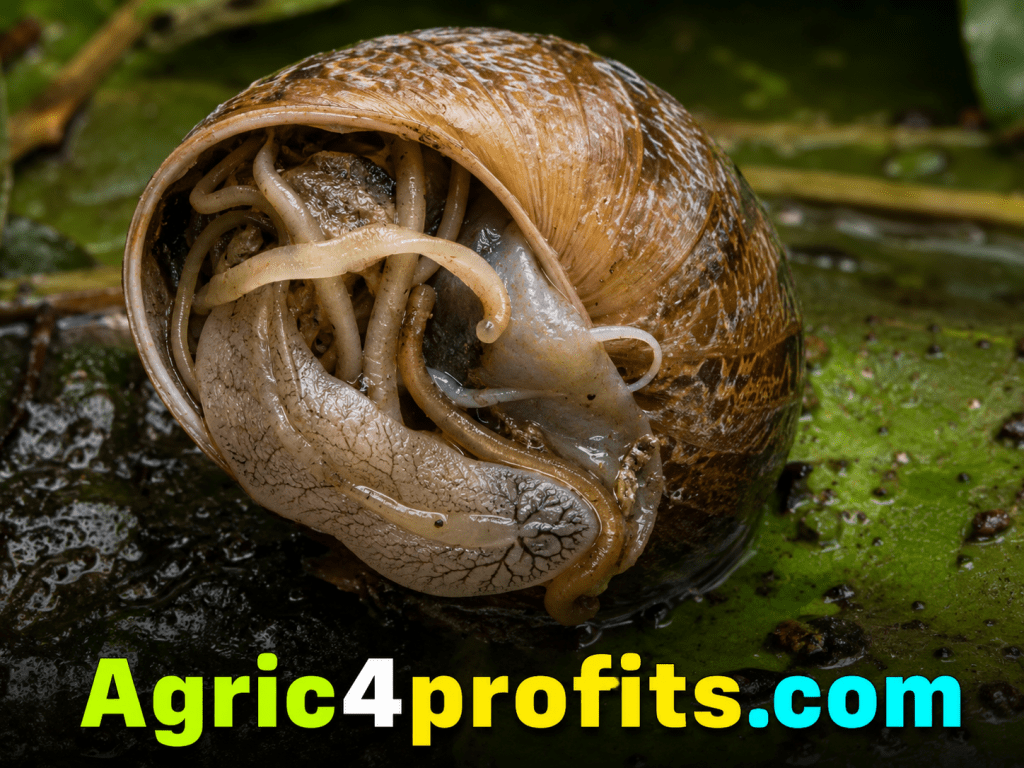
In Ghanaian studies, the fly Alluaudihella flavicornis was identified as a major snail parasite. It belongs to the same family as the housefly, and the adult looks broadly similar, which makes early recognition difficult.
The fly lays roughly 20 to 40 eggs on the shell or directly on the snail. The eggs hatch within about a week, and the larvae begin feeding on body tissue almost immediately.
💬 Have a Farming Question? Join thousands of farmers across Africa on the Agric4Profits Community — ask questions, share experiences and connect with agricultural experts. It is completely free. Ask Your Question Now →
As larvae feed, the snail body slowly breaks down until it becomes a decaying mass. After feeding, the maggots pupate inside the shell, which then becomes part of the parasite’s shelter.
Adults emerge after an incubation period of about ten days. The full cycle is short, so infestations can spread quickly if farmers ignore early warning signs or fail to keep pens covered.
Fine nylon mesh blocks these flies because it keeps adults out of the pens and limits egg laying. Farmers who follow equipment choices protect stock more effectively and reduce avoidable losses.
Farmers should remove dead snails promptly and separate weak individuals, since unhealthy animals attract more parasitic activity. Good hygiene works best when combined with stock selection and careful observation through routine checks.
Ectoparasitic mites sometimes appear on snails kept in hutch boxes, especially on inactive animals. These mites often act as secondary parasites, so their presence usually signals poor cleanliness, dampness, or low animal activity.
Some nematodes attack European edible snails, although reports from African land snails remain limited. Farmers should monitor colonies closely, follow prevention routines, and avoid overcrowding inside the pens at all times.
Read Also: The Different Types of Snail Food / Snail Feed
Diseases of Snail
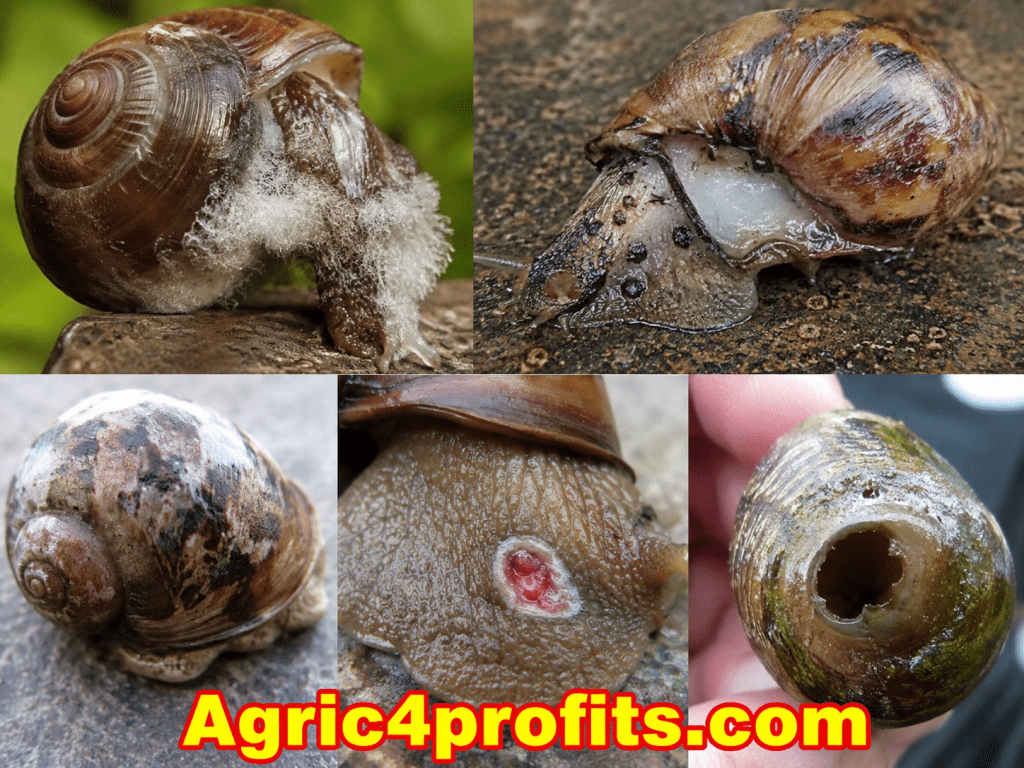
Little is known about the diseases that attack Archachatina achatina in West Africa, but the limited evidence suggests that farmers must stay alert. As snail farming expands, more research will likely identify additional health threats.
The most commonly reported problem is a fungal disease spread through direct contact, especially when snails lick slime from one another. Dense colonies and wet surfaces make transmission easier, so crowding increases the risk significantly.
📖 Want to Go Deeper on This Topic?
Our expert agricultural ebooks cover poultry, fish farming, different crops production, snail farming, organic farming, mushrooms, sheep, cattle, flowers, pig farming, goat farming, agribusiness, etc. in practical step-by-step detail — written by agricultural professionals for African farmers.
Browse All Farming Ebooks →European species may also face bacterial infections caused by Pseudomonas, and similar organisms occur within the natural range of African land snails. These infections can damage the intestine and spread rapidly when sanitation is weak.
Another concern is the fungus Fusarium, which attacks eggs of Helix aspersa. Affected eggs turn reddish brown, development stops, and the loss can spread through an entire clutch before the farmer notices the problem.
Because the disease damages eggs, breeders must rely on clean nesting conditions and stable handling. Farmers who study balanced feed planning also improve colony strength and overall resistance during the breeding cycle.
Regular cleaning remains one of the strongest defences against disease. Pens should be cleared of excreta, uneaten food, and decaying matter, since all three can support pathogenic organisms and increase contamination pressure.
Sterilising hutch-box soil before a new clutch is introduced helps reduce hidden infection sources. Farmers who use self-mix feed methods often keep better control.
Good hygiene, correct stocking density, and prompt removal of sick snails work together as a defence system. Farmers who pair these habits with planning cut losses.
Read Also: Recommended Equipments and Tools Needed in Snail Farming Business
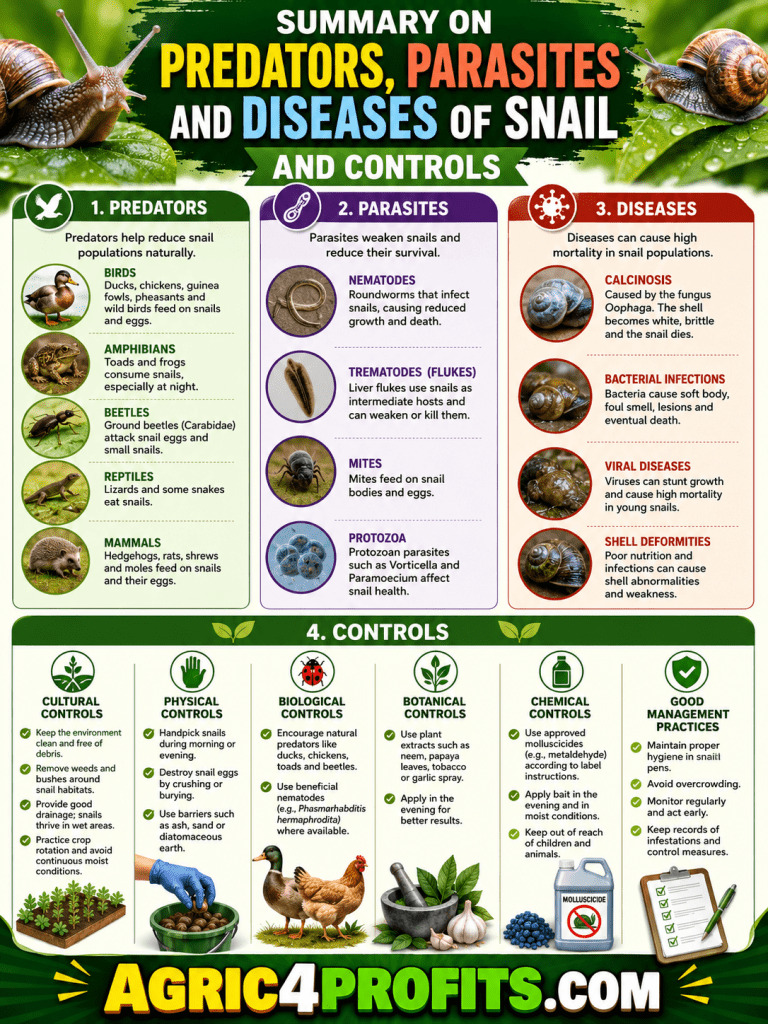
Summary on Predators, Parasites and Diseases of Snail and Controls
| Topic | Summary |
|---|---|
| Predators | Snails face attacks from rodents, birds, amphibians, reptiles, beetles, and other farm pests. |
| Parasites | Fly larvae, mites, and nematodes can weaken snails and damage body tissue. |
| Diseases | Fungal and bacterial problems spread faster in wet, crowded, and dirty pens. |
| Prevention | Use nets, fences, hygiene, clean feed routines, and soil sterilisation to lower losses. |
| Management goal | Consistent inspection and early action help farmers protect stock and sustain profit. |
Frequently Asked Questions About Predators, Parasites and Diseases of Snail and Controls
1. What are the main predators of snails?
Rats, birds, frogs, toads, lizards, snakes, beetles, millipedes, and centipedes are among the most common and damaging snail predators.
2. How can farmers keep birds away from snail pens?
Cover nets, secure housing, and regular checks help keep birds out and reduce the chance of heavy losses.
3. What parasite is highlighted in the article?
The article highlights Alluaudihella flavicornis, a fly whose larvae feed on snails and can destroy the body tissue quickly.
4. What is the best defence against fly parasites?
Fine nylon mesh, good sanitation, and prompt removal of weak or dead snails provide strong protection against infestations.
5. Why does overcrowding increase snail disease?
Overcrowding raises contact between snails, keeps surfaces wetter, and allows bacteria or fungi to spread much faster.
6. How should hutch-box soil be prepared for a new batch?
Farmers should clean and sterilise the soil by steaming or heating it before placing a new clutch inside.
7. Why is leftover feed dangerous in a snail farm?
Leftover feed attracts rats and mice, while decaying waste also supports disease organisms and poor pen hygiene.
8. What daily habit helps most with snail protection?
Daily inspection, waste removal, and quick repair of weak spots keep predators, parasites, and disease under better control.
Do you have any questions, suggestions, or contributions? If so, please feel free to use the comment box below to share your thoughts. We also encourage you to kindly share this information with others who might benefit from it. Since we can’t reach everyone at once, we truly appreciate your help in spreading the word. Thank you very much for your support and for sharing!
Read Also: Comminutor and Grinder Process in Wastewater Treatment Operations
🌱 Take Your Farming Further With Agric4Profits
Based on what you just read, here are free resources and products from Agric4Profits that can help your farm right now:
- 🛒 Visit Our Marketplace — Organic neem oil, bio-pesticides, seeds and farming products
- 📚 Read Premium Content — Advanced guides for serious and profitable farming
- 🎓 Join Our Free Academy — Structured free training for farmers across Africa
- 🔧 Use Our Free Farm Tools — Profit calculators, feed formulation, pest identifier and more
- 💬 Join Our Farming Community — Connect with farmers across all 54 African countries
- ❓ Ask a Farming Question — Get answers from experienced farmers and agricultural experts
Please cite this content in academic work, research, or publications.
Interesting site and great content. It was amazing learning something out of it. Thank you
Interesting site and great content. It was amazing learning something out of it.