


Water erosion is a natural three-step process involving detachment, transport, and deposition of soil particles. This process begins with raindrop impact, which dislodges soil particles from the surface.
The released fine particles may form surface seals that block soil pores, reduce water infiltration, and increase runoff.
At the micro level, even a single raindrop can weaken and dislodge a soil aggregate, leading to large-scale erosion during heavy rainfall events. These processes occur in sequence, with each playing a critical role.
The first two stages detachment and transport determine how much soil is lost. The final stage deposition affects where the eroded soil is relocated.
Detachment and entrainment can happen at any point on the soil surface, and if no erosion occurs, deposition does not take place. Some soil particles settle nearby, while others are carried over long distances, reaching rivers or streams.
Three Main Processes of Soil Erosion
1. Detachment: This process begins after raindrops saturate the soil and fill its pores. Raindrops break down soil aggregates, starting with the weakest. Detached particles, especially fine ones, move easily with surface runoff.
Once dried, these particles form crusts with low permeability. The rate of detachment decreases as surface vegetation increases.
2. Transport: Transport of detached particles occurs with surface runoff. Smaller particles like clay are easily moved, while larger ones like sand remain.
This selective removal alters soil texture and structure. Eroded soils often expose coarser subsoils. Soil roughness, surface residues, and vegetation can reduce transport by slowing runoff.
3. Deposition: Deposition happens when transported particles settle in areas where runoff velocity decreases, such as flat or low-lying fields. Most eroded materials accumulate at the lower ends of fields, and returning them to their original position is difficult and costly.
Off-site deposition leads to pollution in water bodies and sediment accumulation in stream deltas. The texture of deposited soil differs from the original due to selective transport.
Read Also: How to Grow, Use and Care for Woolly Cupgrass (Eriochloa villosa)
Factors Controlling Water Erosion in Agricultural Areas
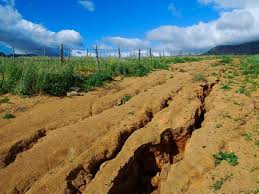
Several factors influence the severity and rate of soil erosion caused by water. These include:
1. Precipitation: Precipitation is the primary agent of water erosion. Its amount, intensity, and frequency determine the erosion magnitude. High-intensity rain increases runoff and soil loss.
Warm temperatures can reduce erosion by increasing evapotranspiration. Humidity affects soil moisture, while wind enhances soil drying and indirectly affects erosion risk.
2. Vegetative Cover: Vegetation reduces erosion by absorbing the energy of raindrops, slowing runoff, and increasing soil infiltration. Plant height, canopy structure, and surface residue influence how effectively vegetation protects soil.
Dense, short vegetation such as grasses is more effective than sparse, tall plants. Thicker canopy and litter layers improve splash erosion control.
3. Topography: Steep and long slopes increase erosion risks. Topography affects runoff speed and water transport. Convex slopes erode more easily than concave ones. Sloping areas are prone to rill, gully, and stream channel erosion, with steep terrains especially vulnerable to mudflows and landslides.
4. Soil Properties: Soil texture, structure, organic matter, and porosity all influence erodibility. Soils with finer particles, high compaction, or poor structure are more prone to erosion.
Aggregated soils resist erosion better, while unstable aggregates are easily detached. Moisture content also affects how much rainwater soil can absorb.
Read Also: How to Grow, Use and Care for Woolly Sedge Grass (Carex pellita)
Major Soil Properties Influencing Soil Erosion at Field Scale
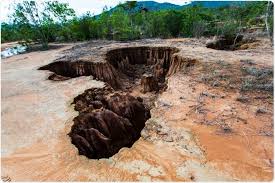
1. Particle Size Distribution: The exact sizes of sand particles in sandy loams are important in assessing erosion risk. Finer particles like silt and fine sand are more easily eroded than larger ones.
Particle size also determines soil erodibility using the Wischmeier and Smith (1978) K-factor, which represents soil’s resistance to detachment and transport.
2. Soil Organic Carbon (SOC): Organic carbon binds particles into stable aggregates, improving soil structure and resistance to erosion. Organic matter increases water retention, reduces compaction, and supports infiltration. Coarse soils are more vulnerable to SOC loss. A decline in SOC lowers soil quality and increases erosion risk.
3. Bulk Density (BD): Compaction from machinery increases BD, reducing pore space, limiting root growth, and lowering infiltration. Higher BD results in more surface runoff and a greater risk of erosion. In sandy soils, BD ranges from 1.6 to 1.9 ton/m³, while clayey soils range from 1.2 to 1.5 ton/m³. Arable soils generally have higher BD than natural land.
4. Aggregate Stability: This refers to how well soil particles remain bonded under stress. Stable aggregates promote infiltration and reduce runoff. Practices such as organic amendment, reduced tillage, and liming enhance aggregate stability.
Factors influencing aggregation include texture, clay mineralogy, SOM, and cations like Fe³⁺, Al³⁺, Mg²⁺, and Ca²⁺. Ca²⁺ is especially effective at stabilising soil compared to Mg²⁺. Al and Fe oxides also strengthen soil structure by increasing permeability, porosity, and hydraulic conductivity.
This article outlined the three major processes of soil erosion detachment, transport, and deposition and identified key factors of water erosion, including precipitation, vegetation, topography, and soil characteristics.
Soil erosion starts when raindrops dislodge soil particles, which are then transported and eventually deposited in new areas, often altering soil structure and degrading field productivity.
Do you have any questions, suggestions, or contributions? If so, please feel free to use the comment box below to share your thoughts. We also encourage you to kindly share this information with others who might benefit from it. Since we can’t reach everyone at once, we truly appreciate your help in spreading the word. Thank you so much for your support and for sharing!