


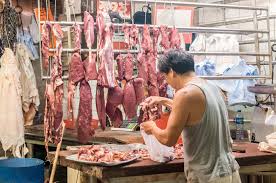
When meat-processing operations are carried out within a facility specifically built and maintained for meat processing, sources of contamination can be much more easily and adequately controlled. The following requirements are considered essential to good sanitary preparation of meat and meat products.
Read Also: Economic Importance, Uses, and By-Products of Watermelon Axils
Building Specifications and Equipment for Meat Processing Facilities
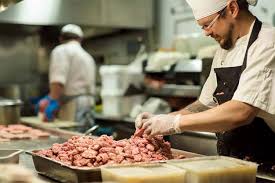
1. Building Specifications for Hygienic Meat Processing
i. Floors: Brick, tile, smooth concrete, or other impervious, waterproof materials are suitable for floors. In some areas, wooden floors will suffice if they are tight, smooth, in good repair, and properly maintained. Wooden floors are not suitable in areas where slaughtering or curing takes place and meat juices and moisture collect.
ii. Drains: To carry away waste liquids, there should be sufficient drains of the proper size that are correctly located, trapped, and vented. All floors should be sloped toward the drains. Generally, for adequate waste disposal, one drain is needed for each 18m² of floor space in slaughtering areas, and one drain for each 46m² in processing and other areas.
iii. Walls: Glazed tile, smooth cement plaster, and rustproof metal panels are all acceptable for walls in processing and refrigerated areas because they can all be effectively cleaned and sanitized. Other materials are also acceptable if they can be satisfactorily cleaned. In no instance should walls be made of materials that absorb moisture or other liquids.
iv. Ceilings: Ceilings must be tight, smooth, and free from any scaling that may fall into the meat products, and should also be of moisture-resistant materials.
v. Doors and Doorways: All doorways, through which the product must pass, whether suspended on rails or lying on hand trucks, should be wide enough to ensure that the meats never touch the doorways, risking contamination. Wooden doors and doorways should be covered with metal with tightly soldered seams.
vi. Water Supply: Whether from individually owned and controlled sources such as wells or streams or from a municipal system, the water supply must be potable, and abundant cold and hot water must be distributed to all parts of the operation.
vii. Lighting: In all areas where products are critically examined during sanitary control or for cleanliness, 50-foot candles of light should be provided. For adequate visibility, 20-foot candles of light should be provided wherever any processing occurs.
In all other areas, such as dry storage, there should be sufficient light to keep the area orderly and sanitary. All light bulbs should be covered with unbreakable material to prevent broken pieces from falling into the product.
viii. Refrigeration: The main purpose of refrigeration is to cool the meat down after slaughter and to maintain it in a chilled state for shorter or longer storage periods and for cutting and further processing. If frozen storage is provided and utilized, it should be maintained at the lowest possible temperature for maximum shelf-life. Minus 18°C to minus 12°C is satisfactory freezer storage; however, large quantities of product must either be quick-frozen prior to storage or thinly spread out to facilitate freezing.
It is also recommended that all rooms where meat is processed, except in the slaughter and cooler storage areas, should be maintained at a temperature of about 12°C.
In facilities where no refrigeration or cooling is furnished in processing areas, the handling of meat products is possible if all equipment contacting the products is thoroughly cleaned and sanitized from time to time (recommended every four hours).
Frequent cleaning is necessary because in warmer temperatures bacteria multiply rapidly and the risk of product contamination increases.
2. Meat Processing Equipment for Sanitary Operations
The equipment needed for converting livestock into meat products need not be elaborate and expensive. The amount of equipment will depend on the slaughtering and processing procedures employed. If possible, all equipment should be made of stainless steel or plastic, be rust-resistant, and easily cleaned and sanitized.
All equipment should be constructed of stainless steel, galvanized steel, aluminum, or approved plastic. Wooden tables are not acceptable because wood absorbs meat juices and fats and cannot be thoroughly cleaned.
Hardwood cutting boards maintained smooth and free from checks and cracks may be used. Cutting tables covered with other than hard plastic are not acceptable for contact with meat. All other equipment should be of the type that can be taken apart and thoroughly cleaned.
Any stationary equipment must be located far enough from walls to permit proper cleaning around and under it. In all areas, there should be conveniently located foot-pedal or knee-operated wash-basins with hot and cold water, soap, and disposable towels.
In slaughtering areas, lavatories should be convenient to the dressing operations. Hot-water containers, either electric or steam-heated to 82°C, should be available for sanitizing tools contaminated with diseased material or other filth during dressing.
Rails must be located high enough to prevent meat from touching the floor. For beef carcasses, the minimum height for rails should be 3.4 meters, while 2.4 meters is sufficiently high for small livestock such as goats, hogs, and sheep. Rails should also be far enough away from fixed objects and walls to avoid contact.
Read Also: Economic Importance, Uses, and By-Products of Watermelon Axils
Basic Hygiene Practices in Meat Processing Establishments
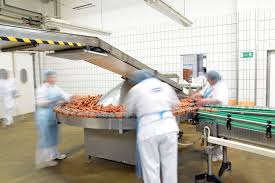
There are two basic aspects of hygiene necessary in meat establishments, such as personal hygiene and general cleaning.
1. Personal Hygiene Standards for Meat Handlers
Probably as important as anything in the production of clean, wholesome, unspoiled products is the attitude of the workers toward cleanliness. Personnel with clean hands, clothing, and good hygienic practices are absolutely essential to the production of high-quality meat.
All clothing should be clean, in good repair, and made of washable material. Street clothing should be covered with coats or gowns while handling exposed product. White or light-colored clothing is most desirable, and garments that become soiled or contaminated should be changed when necessary.
All persons working with exposed meat products should have their hair covered, either completely covered with a clean cap or hat or confined by a hairnet to prevent hair falling into products. Safety devices such as aprons, wrist guards, and mesh gloves must be made of impervious material, clean, and in good repair.
At no time should leather aprons, wrist guards, or other devices be worn unless clean, washable coverings are used over them. Light-colored rubber or plastic gloves may be worn by product handlers only if clean and in good repair.
No person working with meat should wear any kind of jewelry, badges, or buttons that may come loose and be accidentally included in the product. Shoes and boots should be worn at all times and should be appropriate for the operations being conducted.
They should also be made of impervious materials. Any aprons, knives, and footwear that become contaminated during operations should be routinely cleaned in areas or facilities provided for that purpose.
No cloth twine, belts, or other similar materials should be used to cover implement handles or used in other places where they may harbor filth and serve as a ready source of product contamination.
All unsanitary practices should be avoided by meat handlers. No one should smoke or use tobacco in areas where edible products and ingredients are handled, prepared, or stored, or where equipment and utensils are cleaned.
When handling edible products, scratching the head, placing fingers in or around the nose or mouth, sneezing, or coughing on the product should never occur. Workers must also guard against contaminating products from localized infections or sores.
Workers can contaminate carcasses and meat through handling, coughing, and sneezing. This may cause rapid spoilage of the meat or, more seriously, food poisoning. Coughs and sneezes are a particularly effective way of transmitting bacteria to meat.
Transfer of fecal matter, either of animal or human origin, to the meat is particularly hazardous. Most contamination on the hands of workers in slaughter floors with fecal matter comes from the hides and fleeces. Hands should be washed frequently to remove all visible soiling. Stainless-steel sinks without plugs should be conveniently accessible to all workers.
Water should be supplied at approximately 43°C to a simple tap which is foot- or knee-operated. Liquid disinfectant soap and paper towels should be available. Particular attention should be paid to cleaning under the fingernails.
Hands should also be thoroughly washed after using the toilet, smoking, coughing or sneezing, handling money, garbage, or soiled or infected material. All precautions should be taken to prevent product contamination by visitors or other persons who are simply passing through the work area.
2. General Cleaning Procedures for Meat Facilities
The floors should be kept clear of all debris, such as hooves and horns, in slaughter halls or other inedible parts or fat and meat particles in cutting, processing, and by-product handling areas, and must be frequently washed down. At the end of each day, a thorough cleaning program should be followed.
All matter should be removed from floors, platforms, gullies, etc., followed by a thorough hosing down of walls, floors, and all surfaces to loosen dirt. Finally, a strong cleaning solution should be applied and left for a while before being rinsed off.
A thorough inspection should be made afterward, and any areas remaining soiled should be cleaned again. In order to maintain the cleanest possible products, a standard cleaning routine of the equipment should be established. Initially, all large pieces of refuse material should be scraped or swept together and disposed of.
Follow-up should include scrubbing of the equipment using brushes and a soap or detergent and a complete sanitizing with hot water at 82°C and an approved chlorine or iodine rinse. Finally, a coating of light mineral oil can be applied to metal equipment, particularly that not fabricated of stainless steel, to prevent rust.
Regulations for Meat Quality and Carcass Refrigeration
1. Regulations for Meat Quality Assurance
The aim of regulation for meat is to achieve quality assurance on the meat for the safety of consumers of the product.
The regulations imposed a prohibition on any person freezing any carcass meat which was unfit for human consumption or specified offal in a slaughterhouse or any carcass meat or specified offal in a knacker’s yard unless that meat had been sterilized or stained. There were two exemptions from this prohibition:
- In the case of any meat which was intended to be removed under the authority of a movement permit, from the slaughterhouse or knacker’s yard to a destination referred to in the regulation of the country or local authority.
- In the case of any meat from a carcass infested with Cysticercus bovis which was frozen in accordance with relevant meat inspection provisions.
2. Regulations for Refrigeration of Meat Carcasses
Carcasses should go into the cooler as soon as possible and should be as dry as possible. The object of refrigeration is to retard bacterial growth and extend the shelf-life. Chilling meat post-mortem from 40°C down to 4°C and keeping it cold will give a shelf-life of up to three weeks, provided high standards of hygiene were observed during slaughter and dressing.
Carcasses must be placed in the cooler immediately after weighing. They must hang on rails and never touch the floor. After several hours, the outside of a carcass will feel cool to the touch, but the important temperature is that deep inside the carcass.
This must be measured with a probe thermometer (not glass) and used as a guide to the efficiency of the cooling.
The rate of cooling at the deepest point will vary according to many factors, including the efficiency of the cooler, the load, carcass size, and fatness. As a general guide, a deep muscle temperature of 6-7°C should be achieved in 28 to 36 hours for beef, 12 to 16 hours for pigs, and 24 to 30 hours for sheep carcasses.
Failure to bring down the internal temperature quickly will result in rapid multiplication of bacteria deep in the meat, resulting in off-odors and bone-taint.
High air speeds are needed for rapid cooling, but these will lead to increased weight losses due to evaporation unless the relative humidity (RH) is also high. However, if the air is near to saturation point (100 percent RH), then condensation will occur on the carcass surface, favoring mold and bacteria growth.
A compromise between the two problems seems to be an RH of about 90 percent with an air speed of about 0.5 m/second. Condensation will also occur if warm carcasses are put in a cooler partially filled with cold carcasses.
The cooler should not be overloaded beyond the maximum load specified by the manufacturers, and spaces should be left between carcasses for the cold air to circulate.
Otherwise, cooling will be inefficient, and the carcass surface will remain wet, favoring rapid bacterial growth forming slime. Once filled, a cooler should be closed, and the door opened as little as possible to avoid sudden rises in temperature.
When emptied, it should be thoroughly washed before refilling. Personnel handling carcasses during loading and unloading operations should follow the strictest rules regarding their personal hygiene and clothing and should handle carcasses as little as possible.
Do you have any questions, suggestions, or contributions? If so, please feel free to use the comment box below to share your thoughts. We also encourage you to kindly share this information with others who might benefit from it. Since we can’t reach everyone at once, we truly appreciate your help in spreading the word. Thank you so much for your support and for sharing!