


The objective of population improvement is to increase the frequency of favorable alleles. This is accomplished by intermating only the superior individuals, which provides a wide array of different types from which the selection of favorable ones can be practiced, while the unfavorable ones are eliminated. The change produced by selection is the interest namely, the change in the population mean.
Read Also: Simple Analysis for a Successful Snail Farming Business
Definition and Calculation of Genetic Advance (GA) in Selection

Selection is the process by which certain individuals are allowed to contribute more towards progeny at the expense of others. The well-accepted features of selection are:
1. Selection is effective only if heritable variation is present.
2. Selection does not act on the gene itself but on the genotype through the phenotype, ultimately changing the frequency of genes and genotypes.
3. Selection does not create new genes or genotypes but influences their relative frequency in the progeny.
To calculate genetic advance (progress) after selection has been practiced in a population, the following parameters are required:
K-value: This is the selection differential. These values are usually provided in a table, such as in the book by Allard (see below).
Vph: Phenotypic variance for the trait under study.
h²: Heritability (narrow-sense estimate).
Selection Differential Values K
The K-value is determined based on the proportion of the population selected. Below are the K-values for different percentages:
| Proportion of Population Selected | Percentages | K-values |
|---|---|---|
| 1% | 0.1 | 2.64 |
| 2% | 0.2 | 2.42 |
| 5% | 0.5 | 2.06 |
| 10% | 0.10 | 1.06 |
| 20% | 0.20 | 1.40 |
| 30% | 0.30 | 1.16 |
Note: As the proportion of the population selected increases, the K-value decreases.
Genetic Advance (GA) = K√Vph × h²
Working Example to Calculate Genetic Advance
Suppose a plant breeder starts with a population with a mean height (𝑥̅) of 8” tall. His goal is to increase the mean height. From the population, the breeder calculates heritability to be 0.17 (17%) with a phenotypic variance of 2 inches. The breeder decides to select the top 10% of 100 individual plants.
The genetic advance is calculated as follows:
GA = K√Vph × h²
For 10% selection from 100 individual plants, the K-value is 1.76.
GA = 1.76√2 × 0.17
GA = 1.76 × 1.41 × 0.17 = 0.422
The breeder would make progress, increasing the height by 0.422 inches. The next generation should have a mean height of 8.422” (i.e., 8” + 0.422”).
What percentage improvement would this be?
0.422 × 100 = 5.3% improvement
8.0
Genetic advance is usually expressed in percentages or actual numbers.
Read Also: Best Green Waste Disposal Methods
Improving Genetic Advance in Plant Breeding
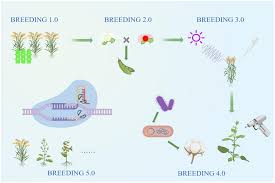
How can a breeder improve the genetic advance? This can be achieved by:
1. Reducing the proportion of individual selection, which increases the K-value.
Using the same data, but changing the selected proportion to 5%, the K-value becomes 2.06.
For 5% selection, the GA will be:
GA = 2.06√2 × 0.17*
GA = 2.06 × 1.41 × 0.17 = 0.494 (approximately 0.50)
2. Increasing heritability.
i. To increase heritability, reduce environmental influences by evaluating the plants in multiple locations and years.
ii. Using the same data, but assuming heritability to be 0.20, the new GA will be:
GA = K√Vph × 0.20
GA = 2.06 × 1.41 × 0.20 = 0.58
Genetic advance is a useful tool to guide a plant breeder in their breeding program. It helps in making informed decisions to improve population traits effectively.
Do you have any questions, suggestions, or contributions? If so, please feel free to use the comment box below to share your thoughts. We also encourage you to kindly share this information with others who might benefit from it. Since we can’t reach everyone at once, we truly appreciate your help in spreading the word. Thank you so much for your support and for sharing!