


Every operator must provide adequate facilities for the collection of inedible meat products. The registration of blueprints for plant facilities is required for both edible and inedible areas of the registered establishment.
All blueprints for registered establishments, including those for facilities required for the collection, storage, and disposal of inedible meat products, must be registered by the Chief, Plants and Equipment of the Meat and Poultry Products Division.
Designing a Slaughterhouse for Meat Processing
The following instructions should be adhered to while designing a slaughterhouse:
A registered establishment should be designed in such a way that, starting from the slaughter of the animals and considering that the inedible waste products and inedible meat products are progressively removed from the carcass.
As the carcass is being dressed, heavily contaminated portions such as hair, hide, feathers, etc., are removed, and the carcass is moved to progressively cleaner areas. As they are separated from the carcass, the inedible products shall be moved to the inedible section of the plant.
There shall be no direction reversal of inedible meat products. Unless otherwise indicated, separate receiving, shipping, freezer, and cooler, if necessary, must be provided for inedible meat products.
Read Also: Cold Weather Poultry Diseases and How to Manage them
Maintaining Sanitary Conditions in Meat Processing
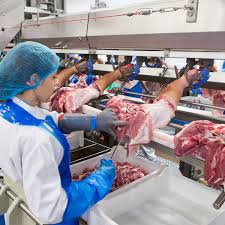
Sanitary conditions must be maintained at all times throughout the inedible section of the establishment. A daily cleanup shall be carried out, and immediate effective action shall be taken if unsanitary conditions develop. An effective insect and rodent control program shall be maintained in the inedible section of the registered establishment.
This program should be similar to the program in effect in the edible section of the establishment. Plant employees working exclusively in the inedible section of the establishment shall have welfare facilities separate from employees working in the edible section of the registered establishment.
If it is absolutely necessary that an employee working in the inedible section of the plant carries out work in the edible section, then that employee shall be required to completely change his protective clothing and thoroughly wash his hands before commencing work in the edible section of the establishment.
Within the inedible section of the establishment, the raw material handling area shall be separate from the section where the sterilized inedible material is handled. Proper segregation must be maintained between the different categories of inedible meat products.
When adequate segregation is not maintained between condemned meat products, all inedible meat products must be treated as condemned meat products requiring sterilization. Adequate facilities to render or denature the inedible meat product, as applicable, must be provided.
The shipping containers for meat products destined for animal food or for medical purposes shall be labeled in accordance with subsection 94(2) of the Meat Inspection Regulation, 1990. The establishment ventilation shall be such that the air flow is, under no circumstance, directed from the inedible to the edible section.
An effective system of odor control shall be provided in the inedible section of the registered establishment. Due to the high price of protein material, the destruction of condemned meat products by incineration is no longer of great importance.
Operators wishing to incinerate condemned meat products may do so, on condition that the operator provides incineration facilities approved by the local authorities and by the Meat and Poultry Products Division.
Registered establishments that receive inedible oils, fats, bones, or meat scraps shipped directly from a retail store, restaurant, or public institution, as provided for in subsection 44(2) of the Meat Inspection Regulations, 1990, shall provide receiving facilities directly to the inedible section of the establishment premises.
Receipt of such products through the edible receiving area is not acceptable. The receipt of dead animals for rendering in a registered establishment (other than those dying en route to a registered establishment) is only permitted with special permission from the Director, Meat and Poultry Products Division, under section 45 of the Meat Inspection Regulations, 1990.
Such permission is only given when such receipt does not create any unsanitary condition on the establishment premises and when such disposal is in the public interest. Dry or wet rendering methods may be employed. The destruction of viable pathogens is important in breaking the chain of infection.
The heating process shall destroy all Salmonella present in the raw material. It is also important that no recontamination of the sterilized rendered product takes place. All reasonable precautions must be taken to prevent reintroduction of Salmonella and other pathogens through insects, rodents, birds, and other animals.
Inedible tallow and other inedible fats may be shipped, appropriately identified, for industrial use. Separate storage tanks, pumps, and pipelines shall be used for the handling of inedible fats.
Shipping areas for sterilized inedible meat products shall not be used for the receipt of raw materials for rendering. They shall be well protected to prevent recontamination. Sterilized and bagged inedible meat products shall be appropriately marked when shipped from the registered establishment.
Duties of Inspectors in Meat Processing
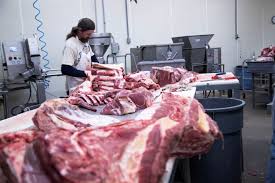
The duties of the inspector are numerous, as outlined in the separation of inedible meat products (condemned products) and in the control measures required for condemned products.
1. Separation of Inedible Meat Products (Condemned Products)
Inspectors are responsible for ensuring that the operator carries out his responsibility. Generally, of all the inedible meat products in a registered establishment, condemned meat products require the closest supervision. The reason for this is obvious.
Condemned meat products could be accidentally or fraudulently added to meat products approved for human consumption. Some condemned meat products could also spread disease to humans and animals if not handled and disposed of in a sanitary manner.
It is the operator’s responsibility to dispose of condemned meat products as prescribed in section 54 of the Meat Inspection Regulations, 1990. Condemned meat products include carcasses and portions of carcasses which, upon inspection or reinspection, are found to be affected by disease or an abnormal condition that renders them unfit for human food.
It further includes animals condemned on antemortem inspection, carcasses of animals that died en route to the registered slaughter establishment, and carcasses of animals that died in the yard or a livestock holding pen of the registered slaughter establishment.
Whenever applicable, a separate room or area shall be provided for the skinning of condemned carcasses and their preparation for rendering. Under no circumstance shall the skinning, evisceration, and other preparation of animals condemned on antemortem inspection, or found dead carcasses, be allowed on the killing floor.
Such condemned food animals or found dead carcasses shall be directly conveyed from the livestock yards or pens to the inedible section of the registered slaughter establishment. The collection and conveyance of condemned carcasses, organs, and portions of carcasses or any other condemned meat product from the killing floor and processing area shall be done in a sanitary manner.
Any contact of condemned meat products with carcasses being dressed or approved meat products shall be prevented. All equipment having been in contact with condemned meat products shall be cleaned and sanitized as required before reuse.
Plant personnel and inspectors handling condemned meat products shall wash their hands and clean and sanitize their work clothing and equipment as required. Containers used for condemned meat products shall be distinctly marked “Condemned,” and containers used for animal food products shall be marked “Animal Food.”
They should preferably be of a color that distinguishes them from containers used for edible meat products. In addition to sanitary considerations, it is essential that condemned material be maintained under rigid inspection control until disposed of as per section 54 of the Meat Inspection Regulations, 1990.
2. Control Measures for Condemned Meat Products
The control measures will include one or several of the following:
- Product is mixed with intestines or an accepted denaturing agent and crushed or ground in a continuous and non-reversible mechanical conveying system which empties directly to a melter or a conveyance acceptable to the inspector in charge for transportation to another registered establishment or authorized inedible rendering plant for sterilization.
- Product is freely slashed, crushed, or ground and mixed or sprayed with an accepted denaturant. The denaturant shall be reasonably well distributed to ensure that all condemned meat products are denatured. Product is shipped in containers marked with the words “Condemned” to another registered establishment or an authorized inedible rendering plant for sterilization.
- In the case of a carcass that has not been dressed, the denaturant may be applied by injecting it into portions of the carcass to the extent necessary to preclude its use for human or animal food purposes.
- Canned meat products may be disposed of by crushing and receiving prior approval from the Regional Director, Meat Hygiene.
Operators may harvest or salvage certain condemned meat products for animal food with the consent of an official veterinarian. These products may be intended for feeds for fish, pets, zoo animals, and fur animals. Condemned meat products may be used for animal food provided:
- They are derived from carcasses, portions, or organs that are not affected with a disease transmissible to the above-mentioned animals.
- They are derived from carcasses, portions, or organs that are not affected with a disease that is a potential cause of zoonoses for handlers of this material.
- They are derived from carcasses, portions, or organs where lesions or conditions mentioned in the above points are removed.
In the case of partial condemnation, i.e., condemnation of portions or organs, such consultation is not necessary provided the condemned meat products have been trimmed to make them free of transmissible pathogens.
Operators wishing to engage in the harvesting or salvaging of meat products for animal food must provide adequate facilities for the separation, chilling, packing, marking, storage, and denaturing of the product.
Denaturing is required to clearly distinguish such meat products from those prepared and approved for human consumption. To be considered properly denatured, charcoal or another accepted denaturing agent will have to be added to the meat product.
Meat products shall be cut into pieces small enough to carry out effective denaturing. The denaturing shall be carried out in the inedible poultry carcasses; poultry intestines may be ground up with carcasses instead of charcoal or other accepted denaturing agents.
With the consent of an official veterinarian, operators may harvest or salvage certain condemned meat products for medicinal purposes. In situations where a specific need is identified to use such products for medicinal purposes, a request shall be made to the Chief, Epidemiology Agri-Food Safety Division.
The request shall include all pertinent information (meat products to be salvaged, process use, salvaging process, etc.). In the case of meat products judged by an official veterinarian to be unacceptable for rendering due to dangerous residues or for other reasons, they may be disposed of in accordance with local environmental requirements.
Condemned meat products derived from a food animal affected with a reportable disease shall be destroyed pursuant to subsection 48(1) of the Health of Animals Act.
Handling Non-Condemned Meat Products
Operators wishing to engage in the harvesting or salvaging of meat products for animal food must provide adequate facilities for the separation, chilling, packing, marking, storage, and denaturing of the product, as required. Denaturing is required to clearly distinguish such organs and portions approved for animal food from those prepared and approved for human consumption.
The denaturing shall be carried out in the inedible products area of the establishment. Organs or portions shall be denatured with charcoal or another agent accepted by the Agri-Food Safety Division for that purpose.
An exception to the use of an approved denaturant may be made in the case of spleens, lungs, udders, uncleaned gastrointestinal tracts, and poultry heads and feet.
Animal food livers directly delivered from a registered establishment to a fish hatchery operated by the federal or provincial government may be shipped without being denatured.
Animal food products derived from non-condemned meat products in containers, fully marked, may be frozen and stored in a freezer used for freezing and storage of packaged, fully marked meat products for human consumption. Such meat products for animal food may also be shipped from the edible shipping area.
The freezing, storage, and shipment of these fully packaged and marked animal foods shall only be allowed if they are kept apart from meat products approved for human consumption and provided such handling does not create any lowering of the standards of sanitation.
Animal food products may be received from other registered establishments for freezing, storage, and shipping in the frozen state provided they are packaged, identified for use as animal food, and their handling does not pose any sanitary problems.
All handling of inedible products harvested or salvaged for animal food shall be carried out away from edible products and as much as physically and operationally possible in a section of the establishment used only for that purpose.
Operators may harvest or salvage inedible meat products for medicinal purposes on their premises. Operators wishing to engage in the harvesting or salvaging of such meat products must provide adequate facilities for the separation, chilling, packing, marking, and storage of the product.
Inedible meat products destined for medicinal purposes in containers, fully marked, may be frozen and stored in a freezer used for freezing and storage of packaged, fully marked meat products for human consumption. Such meat products may also be shipped from the edible shipping area.
The freezing, storage, and shipment of these fully packaged and marked products for medicinal purposes shall only be allowed if they are kept apart from meat products approved for human consumption and provided such handling does not create any lowering of the standards of sanitation.
Collection of Bovine Fetal Blood for Pharmaceutical or Research Purposes
Guidelines for the collection of bovine fetal blood for pharmaceutical or research purposes have been established. The collection of bovine fetal blood for the above usage is permitted in a registered establishment where the process and handling are carried out in a manner that does not interfere with plant sanitation or unnecessarily create potential infection to employees.
Adequate protection is to be provided to employees by management. All proposals are to be forwarded to the Chief, Plants and Equipment Manager, with detailed plans, through the regional office to ensure that facilities are satisfactory to carry out the operations in a satisfactory manner.
Read Also: Layers or Broilers which One is More Profitable in Poultry Farming? Find Out!
Facility Requirements for Meat Processing
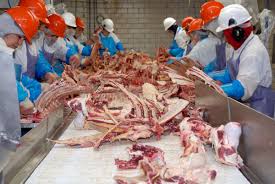
The following requirements shall be met for the facilities:
- The access area to and from the collection room should avoid backtracking and preclude cross-contamination.
- When a container is used, it must be watertight and properly identified.
The fetuses are to be derived from carcasses in accordance with client specifications but must exclude those derived from animals that reacted to the official test for brucellosis. This is to reduce the health risk in regard to human contacts during handling. Uteri containing the fetuses must be conveyed intact to a suitable room or area in the inedible section of the establishment.
The collection room or area must have accepted room surface materials, satisfactory drainage, and lighting. A rust-resistant metal table with drainage is required for bleeding with an adjacent knife sanitizer. A suitable handwashing station is to be provided along with soap, towels, and disinfectant solution for personal hygiene.
A hot and cold water outlet is required for room cleanup. Inedible meat products that are treated by the operator as condemned meat products shall be collected and disposed of in a sanitary manner.
Although inspectional control over this type of inedible meat product is not as critical as it is in the case of other condemned products, an orderly handling is still important. Such products can be a source of contamination if handled improperly.
This type of inedible meat product should be conveyed via the shortest possible route to the appropriate section of the inedible products area of the registered establishment to be disposed of in keeping with section 54 of the Meat Inspection Regulations, 1990.
An appropriate disposal effort should be made by plant management to prevent unnecessary accumulation of such products anywhere in the edible section of the establishment. Products that are by their nature not edible.
The collection and disposal of inedible products in this category shall be carried out in a sanitary manner. These products shall be taken forthwith to the appropriate section of the inedible products area in a manner that prevents contamination of any edible meat product.
Disposal of Inedible Meat Products
1. Conditions for Shipping Condemned Meat Products for Sterilization
Manure, paunch, and viscera contents shall be disposed of in a manner that will not create a sanitary problem on the premises of the registered slaughter establishment. Storage of such wastes in the vicinity of the registered establishment is not acceptable.
i. Facilities for Shipment: General construction requirements for registered establishments apply also for condemned meat product holding rooms and shipping areas. Hot and cold water for cleanup purposes and for handwashing facilities must be available.
ii. Frequency of Shipment: Generally, it is understood that a daily pickup service of condemned meat products is provided. Special permission for less frequent pickup service may be given by the Regional Director, Meat Hygiene, if refrigeration is provided in the room where the condemned meat products are stored.
iii. Containers for Shipment: Bulk containers or barrels used for shipment of denatured condemned meat products, from one registered establishment to another registered establishment or to an authorized inedible rendering plant, shall be impervious, in good repair, and shall be returned in a clean condition. They shall be marked with the word “Condemned.”
iv. Sanitation: A daily cleanup of the condemned product holding room shall be carried out. In addition, whenever unsanitary conditions develop due to a spill of product or for any other reason, management shall arrange for an immediate cleanup.
2. Conditions for Receiving Condemned and Other Inedible Meat Products for Sterilization
i. Receiving Area: A separate receiving area for inedible meat products must be set aside in the inedible section of the registered establishment. Structural facilities of the inedible section of the receiving registered establishment shall be such that the receipt of these additional inedible meat products originating in another registered establishment can be carried out.
ii. Receipt of Dead Animals: The receipt, handling, and disposal of dead animals other than those dead on arrival or those that died on the establishment premises requires special permission from the Director of the Meat and Poultry Products Division, as per section 45 of the Meat Inspection Regulations, 1990. Such permission is only given under extenuating circumstances.
iii. Sanitary Requirements: The receiving area for condemned and other inedible meat products must be separate from any area where edible meat products are prepared, stored, shipped, or received. The receipt of the above-described inedible meat products shall not interfere with sanitary standards in the registered establishment.
Sanitary facilities for the cleaning and sanitizing of containers and vehicles transporting inedible meat products must be available. Containers and vehicles returned to other registered establishments must be clean and sanitary.
3. Authorization Procedures for Inedible Rendering Plants
Authorization procedures should be observed. Requests for authorization of inedible rendering plants shall be made to the Regional Director, Meat Hygiene. Premises meeting requirements are listed as plants authorized to receive condemned meat products for sterilization.
Authorized inedible rendering plants are not registered under the Meat Inspection Act and are therefore not considered registered establishments.
After receipt of a request for authorization of an existing plant, the following steps are followed:
- The Regional Director requests a complete initial survey of the premises of the rendering plants to determine the acceptability of the layout of the premises.
- A copy of the inspecting officer’s report is forwarded to the management of the rendering plant. This report should describe construction details, equipment layout, and operation of the existing plant. The report should further outline the improvements and changes required for authorization of the premises.
- If management decides to make the required improvements, then it shall submit three copies of the building blueprints and equipment layout, together with three copies of the plot plan. The blueprints shall be accompanied by specifications of construction of floors, walls, and ceilings, details of drainage, water supply, welfare facilities, and all other relevant information. If the Regional Director is satisfied with the proposed changes, then he should forward the blueprints and relevant information together with his recommendation to the Chief, Plants and Equipment of the Meat and Poultry Products Division for evaluation and approval.
- After review of the plans and completion of the renovations, the Regional Director, Meat Hygiene, of the Region in which the inedible rendering plant is located will arrange for a final plant inspection. If renovations have been carried out satisfactorily, the Regional Director will recommend authorization of the inedible rendering plant to the Director of the Meat and Poultry Products Division.
In all instances, inedible rendering plants must comply with all federal, provincial, and municipal requirements before authorization is given by the Director of the Meat and Poultry Products Division.
4. Structural, Equipment, and Operational Requirements for Inedible Rendering Plants
An authorized inedible rendering plant shall be of solid construction, with interior finishes of smooth, hard, and impervious materials capable of being cleaned. The flow of product shall be such as to preclude any backtracking or intermingling of raw and cooked product.
The receiving dock area shall be hard-surfaced, have suitable drainage, and lead directly to the cooker charging area. The cooker discharge, percolator, press, grinders, and other equipment in the finished product area shall be entirely separate from the charging and other raw material handling areas.
Each melter and cooker shall be provided with an automatic temperature-recording device. The shipping area for sterilized product shall be separate and apart from any raw product receiving area.
All floors shall be of concrete, tile, or other approved construction, adequately sloped and drained. Adequate facilities for the washing and sanitizing of vehicles and containers shall be provided. Containers and vehicles returned shall be clean. Satisfactory employee welfare facilities shall be provided.
Such facilities shall include washrooms, showers, toilets, cloakrooms, and lunchrooms if employees consume food on the plant premises. The facilities shall be adequately ventilated, provided with potable water and artificial light.
Management is responsible for providing employees with protective clothing and having it laundered regularly. Employees shall frequently change their protective clothing. Plant premises shall have adequate ventilation and be equipped with condensers to control odors.
An adequate program of insect and rodent control shall be carried out on the plant premises. Any sterilized product not shipped in bulk containers shall be appropriately identified. The hide storage room shall be separate and apart from the processing section of the plant.
A good janitorial service shall be maintained throughout the plant, and processing areas shall be regularly cleaned and sanitized. It is essential that a supply of cold and hot water be available.
Suitable disposal facilities for paunch contents shall be available. Management shall be responsible for the provision of watertight bulk containers or other containers for the pickup of condemned and other inedible meat products.
Leaking containers presented for pickup of condemned and other inedible meat products in registered establishments shall be rejected by inspectors. Inspectors shall have unlimited access to the plant premises and shall have access to a telephone (for local or collect calls), washroom, toilet, and permission to use a desk to write reports, as required.
A filing cabinet or drawer that can be provided with a departmental lock shall be reserved for the use of the inspector. Management shall keep records of condemned meat products received for sterilization from registered establishments. Those records shall be available for the inspector’s review, as required.
5. Preparation of Products at Authorized Inedible Rendering Plants
- Inedible protein residue such as meat meal, bone meal, blood meal, feather meal.
- Inedible tallow and other inedible fats.
- Animal hides and skins.
- Animal food.
It should be noted that the Meat and Poultry Products Division permits the salvage of animal food from dead animals and other inedible meat products in authorized inedible rendering plants, provided such salvage is allowed under provincial legislation. Such salvage, however, should be carried out in separate rooms acceptable for that purpose.
Under no circumstance shall it be permitted that any animal food products be salvaged from condemned, denatured carcasses or portions to be sterilized shipped from a registered establishment.
These meat products shall be rendered sterile. Animal food salvaged in an authorized outside inedible rendering plant shall be denatured and labeled in the same manner as in registered establishments.
Do you have any questions, suggestions, or contributions? If so, please feel free to use the comment box below to share your thoughts. We also encourage you to kindly share this information with others who might benefit from it. Since we can’t reach everyone at once, we truly appreciate your help in spreading the word. Thank you so much for your support and for sharing!