


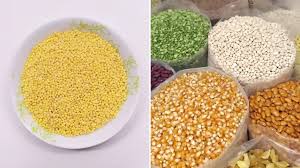
Eighty percent of the dry matter of cereals consists of carbohydrates, present in two forms: insoluble fiber (cellulose) and soluble carbohydrates. Cereals contain 6–12 percent protein, which is deficient in lysine, though among cereals, some proteins are of better quality than others.
Fats are present to the extent of 1–2 percent in wheat and rice and 3 percent in maize. Most cereals are poor sources of calcium and iron. Whole grain cereals are an important source of B vitamins in the diet. Key cereals in West Africa and Nigeria include millet, sorghum, maize, and rice.
Wheat-based products like bread are popular in West Africa, but most wheat flour is imported. In the previous article, the structure and composition of the meat, fish, poultry, and legume food class were discussed, noting their high protein content.
This article explores the cereal food class, including maize, rice, and sorghum, detailing their structure, nutritional composition, and food applications.
Read Also: 6 Ways to Enhance Egg Production and Maximize Profits on Poultry Layers
Structure and Nutritional Composition of Maize
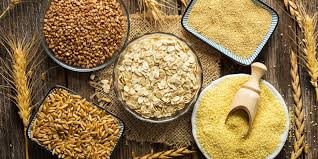
1. Structure of Maize Grain
The maize grain largely consists of the endosperm, which is rich in starch (71%). Both the embryo and endosperm contain proteins, but the germ proteins are superior in quality and quantity.
2. Nutritional Composition of Maize
Maize is the most widely grown staple food crop in sub-Saharan Africa, occupying more than 33 million hectares each year. The maize kernel is an edible and nutritive part of the plant. It contains vitamin C, vitamin E, vitamin K, vitamin B1 (thiamine), vitamin B2 (niacin), vitamin B3 (riboflavin), vitamin B5 (pantothenic acid), vitamin B6 (pyridoxine), folic acid, selenium, N-p-coumaryl tryptamine, and N-ferrulyl tryptamine.
Potassium is a major nutrient, significant due to its deficiency in the average human diet. Roasted maize kernels are also used as a coffee substitute (Breadley, 1992). Maize germ contains about 45–50% oil, used in cooking and salads, obtained through the wet milling process. The composition per 100 g of edible maize is shown below:
| Constituent | Amount |
|---|---|
| Carbohydrate | 71.88 g |
| Protein | 8.84 g |
| Fat | 4.57 g |
| Fiber | 2.15 g |
| Ash | 2.33 g |
| Moisture | 10.23 g |
| Phosphorus | 348 mg |
| Sodium | 15.9 mg |
| Sulfur | 114 mg |
| Riboflavin | 0.10 mg |
| Calcium | 10 mg |
| Iron | 2.3 mg |
| Potassium | 286 mg |
| Thiamine | 0.42 mg |
| Vitamin C | 0.12 mg |
| Magnesium | 139 mg |
| Copper | 0.14 mg |
Structure and Nutritional Composition of Rice
1. Structure of Rice Grain
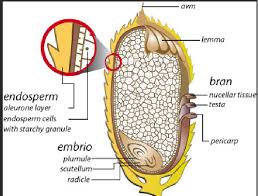
The mature rice grain is harvested as a covered grain (rough rice or paddy), in which the caryopsis (brown rice) is enclosed by a tough siliceous hull (husk). The caryopsis is enveloped by the hull, composed of two “modified” leaves (lemmae): the palea (dorsal) and the larger lemma (ventral).
Inside the hull, covering the endosperm and embryo, are three distinct layers of crushed cells forming the caryopsis coat: the pericarp, seed coat (tegmen), and nucellus. The aleurone layer, the outermost layer of the endosperm, differs in morphology and function from the starchy endosperm.
The embryo (germ) is extremely small and located at the ventral side at the base of the grain. The starchy endosperm is divided into two regions: (1) the subaleurone layer, consisting of the two outermost cells beneath the aleurone layer; and (2) the central region, comprising the rest of the starchy endosperm. Dehulling separates the hull from the brown rice or caryopsis.
The ability of the palea and lemma to hook together without gaps varies among rice varieties. A tight hull provides storage protection but may make dehulling more difficult.
Abrasive milling removes the outer maternal tissues, producing milled or polished white rice, with by-products rice bran and polish.
The bran contains more pericarp, seed coat, nucellus, aleurone layer, and germ than the polish, which contains relatively more starchy endosperm. The bran is darker than the polish. Usually, 10% by weight of brown rice is removed during milling.
2. Nutritional Composition of Rice
Brown rice contains slightly higher protein than milled or polished rice due to the higher protein content in the bran. Crude fat, crude ash, crude fiber, and total dietary fiber are also higher in brown rice, concentrated in the bran fraction.
Brown rice contains higher levels of vitamins and minerals than milled or polished rice. The higher fat content of brown rice makes it more susceptible to rancidity, negatively affecting taste and odor. The nutritional composition of different rice fractions is shown below:
| Rice Fraction | Crude Protein (g N x 5.95) | Crude Fat (g) | Crude Fiber (g) | Crude Ash (g) | Available Carbohydrates (g) | Neutral Detergent Fiber (g) | Energy Content (kJ) | Energy Content (kcal) | Density (g/ml) | Bulk Density (g/ml) |
|---|---|---|---|---|---|---|---|---|---|---|
| Rough Rice | 5.8–7.7 | 1.5–2.3 | 7.2–10.4 | 2.9–5.2 | 64–73 | 16.4–19.2 | 1580 | 378 | 1.17–1.23 | 0.56–0.64 |
| Brown Rice | 7.1–8.3 | 1.6–2.8 | 0.6–1.0 | 1.0–1.5 | 73–87 | 2.9–3.9 | 1520–1610 | 363–385 | 1.31 | 0.68 |
| Milled Rice | 6.3–7.1 | 0.3–0.5 | 0.2–0.5 | 0.3–0.8 | 77–89 | 0.7–2.3 | 1460–1560 | 349–373 | 1.44–1.46 | 0.78–0.85 |
| Rice Bran | 11.3–14.9 | 15.0–19.7 | 7.0–11.4 | 6.6–9.9 | 34–62 | 24–29 | 1670–1990 | 399–476 | 1.16–1.29 | 0.20–0.40 |
| Rice Hull | 2.0–2.8 | 0.3–0.8 | 34.5–45.9 | 13.2–21.0 | 22–34 | 66–74 | 1110–1390 | 265–332 | 0.67–0.74 | 0.10–0.16 |
The vitamin and mineral content of rough rice and its milling fractions at 14 percent moisture is shown below:
| Rice Fraction | Thiamine (mg) | Riboflavin (mg) | Niacin (mg) | α-Tocopherol (mg) | Calcium (mg) | Phosphorus (g) | Phytin P (g) | Iron (mg) | Zinc (mg) |
|---|---|---|---|---|---|---|---|---|---|
| Rough Rice | 0.26–0.33 | 0.06–0.11 | 2.9–5.6 | 0.90–2.00 | 10–80 | 0.17–0.39 | 0.18–0.21 | 1.4–6.0 | 1.7–3.1 |
| Brown Rice | 0.29–0.61 | 0.04–0.14 | 3.5–5.3 | 0.90–2.50 | 10–50 | 0.17–0.43 | 0.13–0.27 | 0.2–5.2 | 0.6–2.8 |
| Milled Rice | 0.02–0.11 | 0.02–0.06 | 1.3–2.4 | 0.25–0.30 | 10–30 | 0.08–0.15 | 0.02–0.07 | 0.2–2.8 | 0.6–2.3 |
| Rice Bran | 1.20–2.40 | 0.18–0.43 | 26.7–49.9 | 2.60–13.3 | 30–120 | 1.1–2.5 | 0.9–2.2 | 8.6–43.0 | 4.3–25.8 |
| Rice Hull | 0.09–0.21 | 0.05–0.07 | 1.6–4.2 | 0 | 60–130 | 0.03–0.07 | 0 | 3.9–9.5 | 0.9–4.0 |
Read Also: Daily Poultry Feed Requirements for each Stage
Structure and Nutritional Composition of Sorghum
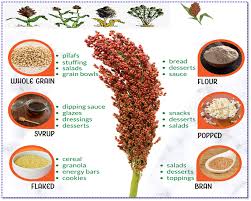
Structure of Sorghum Grain
Sorghum [Sorghum bicolor (L.) Moench] is an indigenous crop to Africa and remains a basic staple food for many rural communities.
It is the fifth most important cereal crop globally after rice, wheat, corn, and barley, serving as the main cereal food for over 750 million people in semi-arid tropical regions of Africa, Asia, and Latin America. The sorghum grain, like other cereal grains, has an endosperm comprising mainly starch.
3. Nutritional Composition of Sorghum
The composition of sorghum grain is generally similar to that of corn, except for a lower oil content. The grain contains 8–12% protein, 65–76% starch, and approximately 2% fiber.
The germ, a rich source of oil (28% of the germ), also has high levels of protein (19%) and ash (10%). Sorghum grain is known for its hardness compared to other food grains, attributed to a higher content of the protein prolamin (3.6–5.1%). The lysine content ranges from 1.06–3.64%.
Food Applications of Cereals
1. Main Meals Using Cereals
i. Tuwo: A local delicacy in Northern Nigeria, tuwo is made from various cereals, including wheat, millet, fonio, rice, maize, and sorghum, depending on the producer’s choice. It is a solid food formed into balls or “swallows” and eaten with sauce.
ii. Sorghum Ball Production (“Fura”): Fura is a staple food for the Fulanis and Hausas. Sorghum or its twin grain, millet, is the primary cereal used for fura production. In tropical Africa, cereal grains are milled and used to produce thick porridges known by various names across the continent.
In West Africa, particularly Nigeria, Ghana, and Burkina Faso, one such thick porridge is called “fura.”
iii. Gruel Production: Maize and sorghum are used for gruel production or breakfast meals, such as pap, “ogi,” or “akamu,” which are consumed with desired snacks for adequate nourishment.
4. Local Cereal-Based Beverages
i. Burukutu Beer: Burukutu is a traditional cereal-based fermented beverage, known as Techoukoutou in Benin or Togo, Dolo in Burkina Faso, Pito in Ghana, Burukutu or Otika in Nigeria, Bilibili in Chad, Mtama in Tanzania, and Kigage in Rwanda. Manufacturing processes vary and depend on geographical location.
ii. Kunu or Kunun-Zaki: A non-alcoholic, non-carbonated, refreshing cereal beverage popular in Northern Nigeria and increasingly consumed in the South. It serves as a breakfast drink, appetizer, and weaning food. Kunu is a nutritious drink produced from cereal grains such as millet, sorghum, maize, and rice.
Cereals, including maize, rice, and sorghum, are vital staples in West Africa and globally, providing significant carbohydrate content (primarily starch) along with proteins, fats, and essential vitamins and minerals.
Their structural components, such as the endosperm, germ, and bran, contribute to their nutritional profiles and applications. Maize is rich in starch and oil, rice varies in nutrient content based on milling, and sorghum is valued for its hardness and nutritional similarity to maize.
These cereals are used in diverse food applications, from solid meals like tuwo and fura to beverages like burukutu and kunu, highlighting their importance in agricultural and dietary systems.
Do you have any questions, suggestions, or contributions? If so, please feel free to use the comment box below to share your thoughts. We also encourage you to kindly share this information with others who might benefit from it. Since we can’t reach everyone at once, we truly appreciate your help in spreading the word. Thank you so much for your support and for sharing!