


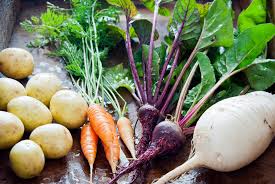
Root and tuber crops, such as yam, cassava, potato, and sweet potato, are vital food crops for direct human consumption in Africa. Grown across diverse agro-ecologies, from highland densely populated regions to lowland areas prone to droughts or floods, these crops account for approximately 95% of Africa’s root and tuber production, yielding over 240 million tons annually on 23 million hectares.
Like cereals, root and tuber crops are high in carbohydrates but contain more moisture. This article explores the structure, nutritional composition, and food applications of root and tuber crops, including cassava, yam, sweet potato, and edible aroids.
Read Also: 15 Health Benefits of Southwest Spice Blend
Structure of Cassava Tuber
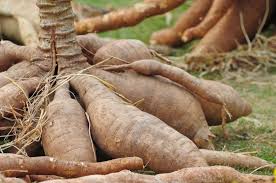
Cassava, a critical global food crop, had an annual production of approximately 276 million metric tons in 2013, with Nigeria (~19%), Thailand (~11%), Indonesia (~9%), Brazil (~8%), and the Democratic Republic of Congo (~6%) as top producers.
It supports the livelihoods of at least 300 million people, with 90% of Africa’s cassava used as a staple food, providing calories for ~500 million people and constituting ~37% of their dietary energy requirements.
The edible portion, a starchy root, matures within 8 to 24 months, varying by cultivar and climate. A mature cassava root ranges from 15 to 100 cm in length and 0.5 to 2.0 kg in weight, depending on variety and growing conditions.
It is circular in cross-section, fattest at the proximal end, and tapers gently toward the distal end. A transverse section reveals three principal areas:
i. Periderm: The outermost layer, composed mostly of dead cork cells that seal the root’s surface. Only a few cell layers thick, the periderm sloughs off as the root grows, with new cork forming from inner layers.
ii. Cortex: A 1 to 2 mm thick layer beneath the periderm.
iii. Starchy Flesh: The central portion, comprising parenchyma cells packed with starch grains.
Nutritional Composition and Uses of Cassava
Cassava contains about 1% protein and 30–35% amyloses and amylopectins on a dry weight basis, making it a predominantly starchy food.
Despite criticism for low and poor-quality protein, cassava produces more carbohydrate weight per unit area than other staple crops under comparable agro-climatic conditions. The edible starchy flesh constitutes 80–90% of the root. Its nutritional composition is:
| Constituent | Percentage |
|---|---|
| Water | 62% |
| Carbohydrate | 35% |
| Protein | 1–2% |
| Fibre | 1–2% |
| Fat | 3% |
| Minerals | 1% |
Cassava roots and leaves contain cyanides in two forms: glycosides (linamarin and lotaustraline, “bound”) and non-glycosides (hydrogen cyanide and cyanohydride, “free”), with free cyanide comprising 8–12% of total tuber cyanide.
Due to potential toxicity, cassava for food use requires processing to remove cyanide-containing substances. Food applications include:
i. Bioethanol Production: Cassava serves as a raw material for bioethanol.
ii. Cassava Starch: Used as binders and thickeners in food and pharmaceutical industries.
iii. Glucose Syrup: Derived from cassava starch.
iv. High-Quality Cassava Flour: Used as composite flour in the bakery industry.
Types, Structure, and Composition of Yams
1. Types of Yams
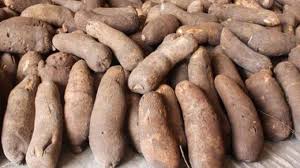
Approximately 96% of global yam production originates from West Africa, with Nigeria contributing 71%, Côte d’Ivoire 8.1%, Benin 4.3%, and Ghana 3.5%.
In humid tropical West African countries, yams are highly valued and integrated into social, cultural, economic, and religious practices, reflecting their ancient use. While many yam species exist in the humid tropics, edible yams derive from about ten species, with the most economically important being:
i. White Yam (Dioscorea rotundata Poir.): Native to Africa, it is the most widely grown and preferred species. The tuber is roughly cylindrical, with smooth, brown skin and white, firm flesh. Numerous cultivars vary in production and post-harvest characteristics.
ii. Yellow Yam (Dioscorea cayenensis Lam.): Named for its yellow flesh due to carotenoids, it is native to West Africa, similar to white yam but with firmer, less grooved skin, a longer vegetation period, and shorter dormancy.
iii. Water Yam (Dioscorea alata L.): Originating from Southeast Asia, it is the most widely spread species globally and second in popularity in Africa. Its tuber shape varies, with white, watery flesh.
iv. Bitter Yam (Dioscorea dumetorum): Also called trifoliate yam, it is native to Africa, with wild cultivars. Its tubers have a bitter flavor and harden if not cooked soon after harvest, with some wild cultivars being highly poisonous.
2. Structure of Yam Tuber
A transverse section of a mature yam tuber consists of four concentric layers:
i. Corky Periderm: The outer layer, a thick barrier of cork cells, often cracked, preventing water loss and pathogen invasion.
ii. Cortex: A layer of thin-walled cells beneath the cork, containing minimal starch.
iii. Meristematic Layer: Composed of elongated, thin-walled cells beneath the cortex, where sprouts initiate.
iv. Ground Tissue: The central portion, made of thick-walled starchy cells with vascular bundles throughout.
3. Nutritional Composition of Yam
Like cassava, yam tubers are primarily water and carbohydrates, with low protein and other nutrients. The nutritional composition varies by species:
| Variety | Moisture Content (%) | Carbohydrate (%) | Fats (%) | Crude Protein (%) |
|---|---|---|---|---|
| D. alata | 65–73 | 22–29 | 0.1–0.3 | 1.1–2.8 |
| D. rotundata | 58–80 | 15–23 | 0.1–0.2 | 1.1–2.0 |
| D. cayenensis | 58–80 | 15–23 | 0.1–0.2 | 1.1–2.0 |
| D. esculenta | 67–81 | 17–25 | 0.1–0.3 | 1.3–1.9 |
| D. bulbifera | 63–67 | 27–33 | 0.1 | 1.1–1.5 |
Uses of Yam
Yam tubers are peeled and consumed after boiling, frying, or roasting, often with palm oil or sauce. Boiled yam can be pounded into yam fufu, a dish relished with local soups in Nigeria.
Yam flour, reconstituted in boiling water, forms a dark, stiff dough called amala among the Yoruba. Instant yam flour, made from precooked yam cubes, rapidly reconstitutes into dough resembling traditional pounded yam.
Types, Structure, and Composition of Sweet Potato
1. Types of Sweet Potato
Sweet potato (Ipomoea batatas L.) has significant unrealized potential, capable of producing high yields of dry matter per unit area under diverse agro-climates and farming systems. Numerous cultivars vary in size, shape, color, storage life, nutritional content, and processing suitability.
A single plant may produce 40 to 50 tubers, ranging from a few to 30 cm in length, spindle-shaped or spherical, and weighing 100 g to 1 kg. Tubers may have smooth or irregular surfaces, with skin and flesh colors ranging from white to cream, yellow, orange, pink, or deep purple.
Read Also: The Health Benefits of Using Accent Seasoning on your Cooking
2. Nutritional Composition of Sweet Potato

Like other tubers, sweet potatoes are primarily water and carbohydrates, with the following nutritional composition:
| Constituent | Percent or (mg/100g) |
|---|---|
| Moisture | 50–81 |
| Protein | 1.0–2.4 |
| Fat | 1.8–6.4 |
| Starch | 8.0–29 |
| Non-starch Carbohydrates | 0.5–7.5 |
| Reducing Sugar | 0.5–7.5 |
| Ash | 0.9–1.4 |
| Carotene (average) | 4 mg/100g |
| Thiamine | 0.10 mg/100g |
| Ascorbic Acid | 25 mg/100g |
| Riboflavin | 0.06 mg/100g |
3. Uses of Sweet Potatoes
Sweet potato tubers are fried, boiled, or roasted and eaten with sauces.
Structure and Composition of Edible Aroids
1. Types and Structure of Edible Aroids
The most important edible aroids are Colocasia esculenta (taro) and Xanthosoma sagittifolium (tania). Their structure includes corms, similar to tubers, with a starchy central portion and protective outer layers.
2. Nutritional Composition of Cocoyam
The nutritional composition of taro and tania is:
| Constituent | Taro (%) | Tania (%) |
|---|---|---|
| Moisture | 63–85 | 70–77 |
| Carbohydrates | 13–29 | 17–26 |
| Protein | 1.2–3.0 | 1.3–3.7 |
| Fat | 0.16–1.18 | 0.2–0.4 |
| Crude Fibre | 0.60–1.18 | 0.6–1.9 |
| Ash | 0.60–1.3 | 0.6–1.3 |
3. Food Uses of Cocoyam
Traditional cooking methods for cocoyam include boiling, baking, roasting, or frying, often combined with other ingredients to create delicacies. In southeastern Nigeria, cocoyam is processed into dried chips called achicha.
This involves boiling corms overnight, peeling, cutting into cubes, sun-drying, and smoking over a fireplace. Due to extensive drying and smoking, achicha chips have a long shelf life and are consumed during planting seasons when other tubers are scarce, typically mixed with cooked beans or pigeon pea.
Do you have any questions, suggestions, or contributions? If so, please feel free to use the comment box below to share your thoughts. We also encourage you to kindly share this information with others who might benefit from it. Since we can’t reach everyone at once, we truly appreciate your help in spreading the word. Thank you so much for your support and for sharing!