


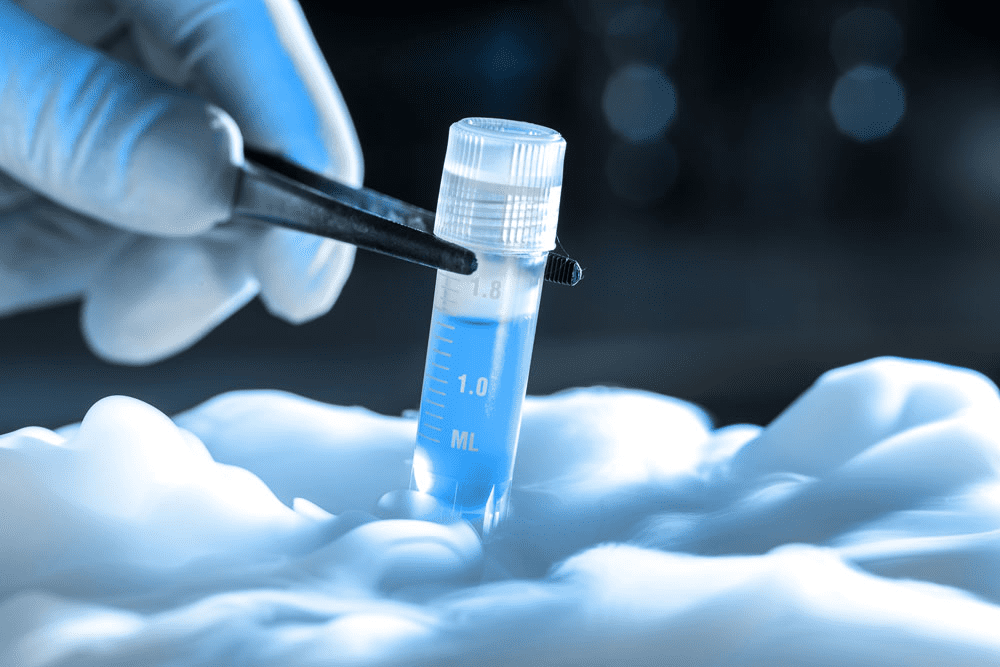
The pertinent reason for using the semen of genetically superior males to inseminate a larger number of females than is naturally possible is the ability to preserve and store their sperm cells successfully until required.
The sperm cell is held in a frozen, motionless state till it is thawed. The preservation process entails slowing down the metabolic rate of the spermatozoa. The preservation process can thus achieved by either cooling down the sperm cell or by adding a chemical to inhibit the sperm cell metabolism.
The process also entails the addition of the following substances which have different functions during cooling or freezing;
| Diluents | Function |
| Glucose | The supply of energy source to sperm cell |
| Egg yolk, milk | For maintenance of the integrity of the sperm cell |
| Milk | For the prevention of ‘cold shock’ during cooling |
| Glycerol or erythritol | To prevent the crystalisation of the cellular water as this could occur due to frozen storage. |
An Overview of the Storage Duration of Semen of Different Livestock
Semen of different classes of livestock species can be extended and stored successfully at 5oC for 1-4 days. Fresh semen of sheep, swine, and poultry has been used for AI but not in cattle. The fresh semen of stallions does not maintain integrity beyond 24 hours and boar semen beyond 48 hours.
The sperm cells can be kept in a frozen state in a motionless condition until it is exposed to heat. This frozen semen is currently used for AI in goats, fish, and cattle.
Read Also Can you Feed Dead Animals to Catfishes
The Methods Which Can Be Used For Semen Storage
The common method of storing semen is in liquid nitrogen. Liquid nitrogen is the fourth coldest substance in existence. It has a temperature of -196 oC or -32 oF. Various methods are being employed to preserve the integrity of sperm cells but the commonest is either rapid re-warming of frozen sperm cells instead of slow re-warming or the thawing of frozen semen in iced water for 8-10 minutes before use.
The following are the common ways of storing semen for AI; short-term and long-term storage.
1. Short term
This is usually for a short period varying from a few hours to a few days. The integrity of the sperm cell is lost with an increase in storage time leading to low viability. There are three methods for liquid storage of semen. They include;
1. Ambient temperature storage of semen.
2. Chilled storage of semen at 5 oC.
Flow dialysis: This could be either by continuous but time-consuming replacement of the buffer surrounding the dialysis bag containing the semen or a complete replacement of the fluid used for dialysis every 24 hours.
2. Long term
Long-term storage of semen is by deep freezing. This is achieved by cooling it to 5oC and keeping the cooled semen in an appropriate storage medium rather than frozen in liquid nitrogen. The advantage of the long-term storage of semen is that the sperm cells retain their fertility for years.

Read Also Best Quantity of Ruminant Animals to Start Your Farm
Types of Storage of Frozen Semen
The following are the types of storage of frozen semen;
1. Ampoules of about 0.5-1 ml capacity are made of glass or straw materials.
2. Pellets: The semen stored in pellets is thawed in a physiological saline solution (0.9% concentration)
3. Straws: Long straws of 2½ -5” in length can hold frozen semen of 0.25-0.5 ml volume.
4. Shell freezing: This method results in the highest percentage of live sperm cells than the previous processes.
The dead and abnormal sperm cells can also be removed from frozen semen by passing the semen through glass fiber.
This prevents the incidence of premature abortion in the female who has been artificially inseminated with abnormal or dead sperm cells which has resulted in fertilization. Another advantage of this method is that it increases the viability of the sperm cells and ensures a higher conception rate.
5. Lyophilization of semen: the technique employs the use of a vacuum to change some of the moisture to a vapor state by passing the liquid form so that the semen so treated may lose about 90-95 percent of its moisture so that less space is required for storage.
A major disadvantage of this method is that only 5-15 percent of motile sperm cells are recovered when the semen is extended which results in a poor conception rate.
The factors that affect the viability of sperm cells during preservation
These are the determinants of the survival of sperm cells which are being preserved for AI. These factors when considered will ensure that viable spermatozoa are present after thawing in the future and fertilization of the female ovum (ova) will occur.
They include;
1. The quality of the diluents used
2. The storage duration
3. The storage method employed
4. The quality of the ejaculated semen before storage
It is possible to preserve and store the semen of genetically superior male livestock artificially and for a longer duration outside their bodies. This can be achieved by slowing down the metabolic process of the sperm cells, however suitable diluents are needed to ensure the survival of viable spermatozoa.
Semen of livestock can be stored until needed. Preservation of sperm cells can be achieved by slowing down the metabolic rate of the cells. Suitable diluents should be added before storage to supply energy to the sperm cells and prevent the crystallization of cellular water and cold shock during cooling.
The semen of different livestock can endure varying durations of short-term storage. There are short-term and long-term methods of storage. Factors such as storage duration, the integrity of the semen before collection, type of diluents, etc. need to be considered before embarking on preservation because it can affect fertility when the spermatozoa is inseminated in the future.