


Consumption of unclean food can cause gastrointestinal diseases. The quantity of bacterial population in food indicates the quality of food. The Ministry of Public Health, Thailand, has specified the acceptable numbers of bacteria in various kinds of food.
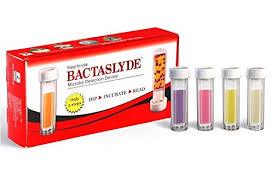
At present, the number of bacteria in food is still found to exceed the standard. Therefore, the Department of Medical Sciences has developed a test kit for determining bacterial count in food, which can be used outside the laboratory and provides results within 24 hours.
Health Impact of Bacterial Contamination
Food with an excess amount of bacteria may indicate contamination by food-poisoning bacteria, which can cause diarrhea, nausea, vomiting, fever, headache, or even death.
Target Samples for Testing
Food under preparation, raw food, ready-to-eat food, milk and milk products, ice cream, sauce, infant food, instant food, vended food, street food, food in restaurants, schools, etc.
Tools Included in the Test Kit
- 12 Sachets of test paper (in black envelope)
- 48 Sterile syringes
- 12 Sterile plastic bags
- Reagent 1, 2, 3, and 4; 12 bottles each
- 1 Bag of cotton balls with alcohol
- 1 Bottle of disinfectant
- 1 Sheet of test kit manual
Read Also: The Importance and Uses of Hay
Grouping of Food for Testing

Group 1: Regulated Foods
Sterilized or UHT: fresh milk, recombined milk, fat-modified milk, flavored milk, dairy products, modified milk for infants, infant food, and supplementary food for infants.
Non-sweetened: condensed milk.
For food in Group 1, follow all test procedures except steps 5-7.
Group 2: Powdered or Pasteurized Foods
Powdered or pasteurized: whole milk, recombined milk, fat-modified milk, flavored milk, dairy products, modified milk for infants, supplementary food for infants, infant food, cream, and ice cream.
i. Sweetened: condensed milk.
ii. Instant food: noodles, vermicelli.
Sauce: chili sauce, tomato sauce, and papaya sauce.
For food in Group 2, follow all test procedures.
Group 3: Liquid and Seasoning Foods
Liquid: ice cream.
Seasoning powder of instant food: noodles, vermicelli.
For food in Group 3, follow all test procedures.
Group 4: Ready-to-Cook and Raw Foods
Ready-to-cook food, raw food, street food, vended food, food stalls, food in restaurants, schools, etc.
For food in Group 4, follow all test procedures.
Other foods can request details from the Department of Medical Sciences.
Testing Procedure
- Use a cotton ball soaked with alcohol to rub both hands, spoon, scissors, and the food container at the opening area.
- Use a lighter to flame the cutting part of the scissors, hold it to cool down, and cut the opening area of the container. Flame the spoon and hold it to cool down.
- Weigh 11 grams of food in a sterile plastic bag.
- Pour all Reagent 1 into the plastic bag. Tightly close and vigorously shake at least 25 times. Draw 1 ml of solution using a syringe.
- Inject the solution into the Reagent 2 bottle. Vigorously shake at least 25 times. Draw 1 ml of solution using a new syringe.
- Inject the solution into the Reagent 3 bottle. Vigorously shake at least 25 times. Draw 1 ml of solution using a new syringe.
- Inject the solution into the Reagent 4 bottle. Vigorously shake at least 25 times. Draw 1 ml of solution using a new syringe.
- Touch the tip of the syringe to the test paper in the sachet and inject all the solution.
- Gently remove air from the test paper sachet. Tightly close the sachet. Keep the test paper in the dark at room temperature for 24 hours.
Evaluation of Results
Count the number of red spots on the test paper and interpret the results as per the following table:
| Types of Food | No. of Red Spots | Interpretation | Bacterial Count in 1 gm of Food |
|---|---|---|---|
| Sterilized: fresh milk, fat-modified milk, recombined milk, flavored milk, dairy products, modified milk for infants, infant food | 0 | ✓ | – |
| 1 or > 1 | × | No. of red spots × 10 | |
| Sterilized: supplementary food for infants, non-sweetened condensed milk | 0–1 | ✓ | – |
| > 1 | × | No. of red spots × 10 | |
| UHT: food in Groups 1, 2, 3 | 0–1 | ✓ | – |
| > 1 | × | No. of red spots × 10 | |
| Pasteurized: food in Group 1 at the factory, powdered food in Group 2, sweetened food in Group 4, instant noodles, sauce (chili, tomato, papaya) | 0–1 | ✓ | – |
| > 1 | × | No. of red spots × 10,000 | |
| Instant: rice, vermicelli, glass vermicelli | 0–3 | ✓ | – |
| > 3 | × | No. of red spots × 10,000 | |
| Pasteurized: food in Group 1 when out of factory until expiry date | 0–5 | ✓ | – |
| > 5 | × | No. of red spots × 10,000 | |
| Powdered: food in Group 3 (no boiling needed) | 0–5 | ✓ | – |
| > 5 | × | No. of red spots × 10,000 | |
| Powdered: food in Group 3 (needs boiling), food in Group 1, cream, ice cream | 0–10 | ✓ | – |
| > 10 | × | No. of red spots × 10,000 | |
| Condiments of instant noodles and vermicelli | 0–5 | ✓ | – |
| > 5 | × | No. of red spots × 100,000 | |
| Ice cream (liquid) | 0–6 | ✓ | – |
| > 6 | × | No. of red spots × 100,000 | |
| Ready-to-eat food: street food, vended food, food stalls, food in restaurants, schools, etc. | 0 | ✓ | – |
| 1 or > 1 | × | No. of red spots × 1,000,000 | |
| Ready-to-cook food, raw food | 0–9 | ✓ | – |
| > 10 | × | No. of red spots × 1,000,000 |
Note:
= more than, ✓ = pass (good quality), × = not pass (poor quality)
Foods in Groups 1–11 are interpreted according to food regulations of the Ministry of Public Health, Thailand.
Foods in Groups 12–13 are interpreted according to food guidelines of the Department of Medical Sciences.Read Also: Grasshoppers: Description, Damages Caused, Control and Preventive Measures
Procedure After Testing

Pour disinfectant into the test paper sachet, about one-third of the sachet, to destroy microorganisms. Tightly close and discard.
Precautions for Safe Use
- Keep the kit out of reach of children.
- Do not contact disinfectant. Wash immediately if it contacts any part of the body.
- Beware of using the lighter; do not use it close to the cotton ball with alcohol.
Storage and Shelf Life
- Keep test paper (in black envelope), sterile syringes, plastic bags, and bottles of Reagents 1–4 in a refrigerator for 3 months.
- Tightly close the bottle of alcohol at all times to prevent evaporation.
Frequently Asked Questions (FAQs)
- What is the purpose of the bacterial count test kit?
The test kit determines the bacterial count in food to assess its quality and safety, helping to identify potential contamination by food-poisoning bacteria. - Which types of food can be tested with this kit?
The kit can test food under preparation, raw food, ready-to-eat food, milk and milk products, ice cream, sauces, infant food, instant food, vended food, street food, and food from restaurants and schools. - How long does it take to get results from the test kit?
Results are available within 24 hours after completing the test procedure. - What is the sensitivity of the test kit?
The test kit can detect as few as 10 colonies or 10 bacterial cells per gram of food. - How should the test kit be stored?
Store the test paper, sterile syringes, plastic bags, and reagent bottles in a refrigerator for up to 3 months. Keep the alcohol bottle tightly closed to prevent evaporation. - What precautions should be taken when using the test kit?
Keep the kit away from children, avoid contact with the disinfectant, and use the lighter carefully, ensuring it is not near the alcohol-soaked cotton ball. - How should the test paper be disposed of after testing?
Pour disinfectant into the test paper sachet (about one-third full), tightly close it, and discard it to destroy microorganisms.
Do you have any questions, suggestions, or contributions? If so, please feel free to use the comment box below to share your thoughts. We also encourage you to kindly share this information with others who might benefit from it. Since we can’t reach everyone at once, we truly appreciate your help in spreading the word. Thank you so much for your support and for sharing!