


To achieve maximum benefit from fertilizers, it is most essential to apply them at the right time and in the right place. The amount and timing of nutrient uptake depends on various factors, such as crop variety, planting date, crop rotation, soil and weather conditions.
For good agricultural practices, the farmer chooses the timing and the quantity in such a way that as much as possible of the nutrients is used by the plants. For optimum crop use efficiency and minimum potential for environmental pollution, the farmer must apply the nutrients as near to the time the crop needs them.
This is particularly important for mobile nutrients such as nitrogen, which can easily be leached out of the soil profile, if they are not taken up by the plant roots.
1. Time of Applying Nitrogen Fertilizers
Since nitrogen is required throughout the growth period and nitrogenous fertilizer are lost through leaching, it is better not to apply too much nitrogen at one time.
The split application of nitrogen throughout the growing period will ensure greater efficiency and plants would not suffer from nitrogen deficiency.
2. Phosphorus Fertilizers
This element is required in greater quantities during the early growth period and as all phosphorus fertilizers become available to growing plant slowly, it is always recommended that the entire quantity of phosphorus fertilizers be applied in single doze before sowing or planting.
🌿 Go Organic on Your Farm: Instead of harmful chemical pesticides and fertilisers, try our organic farming products — including neem oil spray, bio-pesticides, natural plant treatments, organic seeds and seedlings, suckers, and many more organic products that are safe for your health, your family, your soil and your harvest. Shop Now →
3. Potassium Fertilizers
This element is absorbed right up to the harvest stage but it becomes available slowly. It is therefore always advisable to apply the entire quantity of potassium at sowing time.
Read Also : Guide on Calculating the Rate of Fertilizer to Be Applied
Methods of Fertilizer Application
The method of application of fertilizers (organic manure or mineral fertilizers) is an essential component of good agricultural practices. A fast start and continued nutrition is essential for sustained maximum profit.
It is important to place some of the fertilizer where it will intercept the roots of the young plant and to place the bulk of the nutrients deeper in the soil.
🔧 Free Farm Tool Available: Use our free Agric4Profits Farm Tools to calculate your farm profits, formulate feeds, identify pests and diseases on both your crops and animal farms, plan your planting and harvesting season, including many more farm tasks to get free expert advice and recommendations — completely free, no registration required. Access Free Tools →
Nitrogenous fertilizers are easily soluble in water and have mobility, so they can be applied on the soil surface.
Phosphorus fertilizers moves slowly from the point of placement, it should be placed closer to the plant roots. To reduce phosphate fixation, phosphorus fertilizers should be so placed that they come into minimum contact with the soil particles and are close to the plant roots.
Potassium fertiliser moves slowly in the soil, they should also be placed near the root zone.
Based on these principles, the following methods are used to apply fertilisers;
1. Broadcasting
The fertilizer is spread over the entire soil surface to be fertilized with the objective of distributing the whole quantity of fertilizer evenly and uniformly and incorporating it in the plough layer.
💬 Have a Farming Question? Join thousands of farmers across Africa on the Agric4Profits Community — ask questions, share experiences and connect with agricultural experts. It is completely free. Ask Your Question Now →
It is used mostly on dense crops not planted in rows or in dense rows and on grassland. It is also used when fertilizer should be incorporated into the soil after application to be effective (phosphate fertilizers), or to avoid evaporation losses of nitrogen (urea, diammonium phosphate). Incorporation through tilling or ploughing-in is also recommended to increase the fertility level of the entire plough layer.
Whether the fertiliser is broadcast by hand or with fertiliser spreading equipment, the spreading should be as uniform as possible.
2. Row or band placement
This refers to the application of fertilizers into the soil close to the seed or plant and is employed when relatively small quantities of fertilizers are to be applied.
When fertilizers are placed along with, or close to the seed or plant in bands or pockets, the roots of the young plants are assured of an adequate supply of nutrients and this promotes rapid early growth. This method of placement also reduces the fixation of phosphorus and potassium.
When seeds or plants are sown close together in a row, the fertilizer is put in continuous band on one or both sides of the row. This method of application is referred to as row placement, and is used for potatoes, maize, tobacco, cotton, sugar cane, etc.
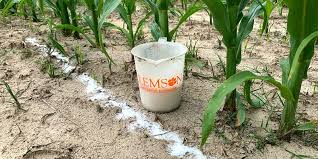
Where crops are cultivated by hand and planted in hills, the recommended grams of fertilizer are placed in the row or planting hole, under, or beside the seed, and covered with soil, this is known as hill placement. Great care has to be taken such that no fertiliser is placed either too close to the seed or to the germinating plant to avoid toxicity.
3. Top dressing
Top-dressing (broadcasting the fertiliser on standing crop) is mainly used for small and large grain crops and for crops such as forage, wheat and barley.
Top dressing of additional nitrogen is done when:
A single application of the total nitrogen needed at sowing might lead to losses through leaching and run-off.
📖 Want to Go Deeper on This Topic?
Our expert agricultural ebooks cover poultry, fish farming, different crops production, snail farming, organic farming, mushrooms, sheep, cattle, flowers, pig farming, goat farming, agribusiness, etc. in practical step-by-step detail — written by agricultural professionals for African farmers.
Browse All Farming Ebooks →Or where crops show a special need for nitrogen at certain stages of growth.
Top dressing of potassium, which does not move in the soil to the same extent as nitrogen, might be recommended on light soils, i.e. applying the total amount divided into a basal dressing and top-dressing.
Phosphate hardly moves in the soil at all. Hence, it is usually applied before or at sowing or planting time (basal application), preferably in combination with potassium and part of the nitrogen.
Side dressing: this is also another form of top dressing where fertiliser is spread between the rows or around the plants. Maize, cotton, sugar cane, trees and other perennial crops are normally side-dressed.
4. Foliar application of fertilizer
Foliar application refers to the spraying of the leaves of growing plants with suitable fertiliser solutions. It is used mainly to correct micronutrient deficiencies.
To minimize the risk of leaf scorch, the recommended concentration has to be respected and spraying should preferably be done on cloudy days and in the early morning or late afternoon.
5. Direct application into the soil
With the help of some special equipment, anhydrous ammonia (liquid fertilizer) and nitrogen solutions can be applied directly into the soil.
There is very little plant injury or wastage of ammonium if the material is applied about 10cm below the seed, and the soil is moist.
6. Application through irrigation water
Straight or mixed fertilizers which are easily soluble in water are allowed to dissolve in the irrigation stream. The nutrients are thus carried into the soil in solution. The fertilizers most commonly applied through irrigation water are nitrogenous fertilizers.
Read Also : Benefits of a Growing Business
🌱 Take Your Farming Further With Agric4Profits
Based on what you just read, here are free resources and products from Agric4Profits that can help your farm right now:
- 🛒 Visit Our Marketplace — Organic neem oil, bio-pesticides, seeds and farming products
- 📚 Read Premium Content — Advanced guides for serious and profitable farming
- 🎓 Join Our Free Academy — Structured free training for farmers across Africa
- 🔧 Use Our Free Farm Tools — Profit calculators, feed formulation, pest identifier and more
- 💬 Join Our Farming Community — Connect with farmers across all 54 African countries
- ❓ Ask a Farming Question — Get answers from experienced farmers and agricultural experts
Please cite this content in academic work, research, or publications.