


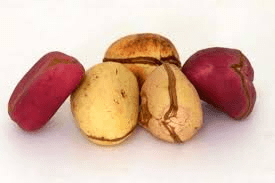
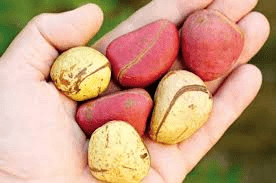
Cola/Kola Testa, commonly known as the kola nut, is a seed extracted from the fruit of the kola tree (genus Cola), native to tropical West Africa. The kola tree, which belongs to the Sterculiaceae family, is well-known for its large, glossy leaves and its distinctive nut, which has significant cultural and economic importance in the region.
The kola nut is recognized for its stimulant properties, primarily due to its high caffeine content. It is used traditionally in many West African cultures in social and religious ceremonies, symbolizing hospitality and community. The nut itself is a hard, brown seed encased in a reddish-brown husk, and is divided into several segments or lobes. Each segment contains a small, hard, white seed that is the actual kola nut.
Chemically, the kola nut contains several bioactive compounds, the most notable of which are caffeine, theobromine, and kolanin. Caffeine, a central nervous system stimulant, is present in relatively high amounts and is responsible for the nut’s stimulating effects. It can enhance alertness, improve mood, and increase energy levels. Theobromine, also found in the kola nut, is a compound similar to caffeine but with milder effects.
It acts as a bronchodilator and vasodilator, promoting relaxation and improved blood flow. Kolanin, though less well-known, is another active compound that contributes to the nut’s effects, although its exact role is less understood.
The stimulant properties of kola nuts have historically made them valuable in both traditional medicine and as an ingredient in various beverages. In traditional medicine, the nuts are often chewed to alleviate fatigue, improve digestion, and even treat headaches. In modern times, kola nuts have been incorporated into soft drinks and energy beverages, most notably in cola drinks, where their flavor and stimulating effects are utilized.
The characteristic taste of cola beverages, which includes a blend of sweet, bitter, and slightly spicy notes, is partly derived from the kola nut, though many commercial drinks now use synthetic flavorings.
Beyond their stimulating effects, kola nuts play a significant role in cultural practices. In West Africa, they are used in rituals and ceremonies to invoke blessings, establish agreements, and show respect to guests. The presentation and offering of kola nuts during these ceremonies is a gesture of goodwill and is deeply ingrained in the social fabric of many communities.
The cultivation of kola trees requires a tropical climate with well-drained, fertile soils. The trees are typically grown in small-scale farms and can take several years to start producing fruit. The fruit itself is a large, pod-like structure that contains multiple kola nuts. Harvesting involves carefully opening the pods and extracting the nuts, which are then dried and processed.
In recent years, the commercialization of kola nuts has faced challenges due to environmental and economic factors. The sustainability of kola nut farming is under scrutiny as deforestation and climate change impact the regions where these trees are grown. Efforts are being made to improve cultivation practices and ensure that the production of kola nuts remains sustainable and economically viable for the local communities that depend on it.
The kola nut is a fascinating example of how a natural product can have profound cultural, economic, and scientific significance. Its stimulant properties, combined with its role in traditional practices and modern beverages, highlight its importance in both historical and contemporary contexts.
The Economic Importance and Uses of Cola/Kola Testa
1. Seed Protection: The testa is the outer layer of the seed that provides protection from physical damage, pests, and environmental conditions, ensuring successful germination.
2. Seed Quality: The quality and integrity of the testa impact seed viability and germination rates, which are crucial for crop production.
3. Botanical Research: The testa is studied to understand seed anatomy, development, and dormancy mechanisms, aiding scientific and agricultural research.
4. Crop Improvement: Insights into the testa help in developing seeds with better protective features and improved germination rates.
5. Traditional Medicine: In some cultures, the testa is used in traditional medicine for its potential health benefits.
6. Nutritional Studies: The testa is analyzed for its nutritional content, contributing to research on potential health benefits.
7. Biofuel Production: The testa can be processed into biomass for biofuel production, providing an alternative energy source.
8. Craft Materials: Dried testa can be used in crafting and making decorative items.
9. Soil Improvement: Testa residues can be used in composting to improve soil quality and fertility.
10. Erosion Control: The organic matter from testa residues contributes to soil stabilization and erosion control.
11. Environmental Impact: The testa supports environmental conservation by being part of natural recycling processes in ecosystems.
12. Research and Development: The testa is used in research to develop new agricultural technologies and improve seed production methods.
13. Educational Purposes: Cola testa is used in educational settings to teach about seed anatomy, plant growth, and germination.
14. Pest Control: The testa can be used in developing natural pest control methods by attracting beneficial insects or repelling pests.
15. Animal Feed: Seed testa residues, after processing, can be used as feed for livestock.
16. Waste Management: The testa contributes to waste management practices through recycling and composting processes.
17. Economic Value: The use of cola testa in various industries adds economic value to cola crop production.
18. Seed Banking: Testa is important in seed banking efforts to preserve seed quality and genetic diversity.
Read Also: The Blackberry Leaves: Economic Importance, Uses, and By-Products
The Products and By-products That Can Be Derived From Cola/Kola Testa
1. Seed Protection: Testa protects the seed during storage and germination.
2. Craft Materials: Dried testa is used in crafting and decorative items.
3. Biofuel: Testa can be processed into biomass for biofuel production.
4. Nutritional Products: Analysis of testa for potential nutritional benefits.
5. Traditional Medicine Preparations: Testa used in some traditional remedies.
6. Soil Improvement: Testa residues used in composting to enhance soil fertility.
7. Erosion Control Materials: Organic matter from testa helps stabilize soil and prevent erosion.
8. Educational Materials: Used in teaching about seed anatomy and germination processes.
9. Animal Feed: Residues used as feed for livestock after processing.
10. Research Samples: Testa used in research for developing new agricultural technologies.
11. Waste Management: Testa contributes to recycling and composting efforts.
12. Pest Control: Potential use in natural pest control methods.
13. Environmental Conservation: Part of natural recycling processes in ecosystems.
Read Also: Benefits and Uses of Peanut Grass, and Where To Find Them
Frequently Asked Questions (FAQ’s) About Cola/Kola Testa
1. What is cola/kola testa?
Cola/kola testa is the outer protective layer of the seed that shields the inner seed from damage and environmental conditions.
2. How does cola/kola testa contribute to seed protection?
The testa protects the seed from physical damage, pests, and environmental conditions, aiding successful germination.
3. Can cola/kola testa be used in biofuel production?
Yes, testa can be processed into biomass for biofuel production.
4. How is cola/kola testa used in traditional medicine?
In some cultures, testa is used for its potential therapeutic properties in traditional remedies.
5. What role does cola/kola testa play in crop improvement?
Understanding the testa helps in developing seeds with better protective features and improved germination rates.
6. Can cola/kola testa be used in crafting?
Yes, dried testa is used in making decorative items and crafts.
7. How does cola/kola testa benefit soil and erosion control?
Testa residues contribute to soil improvement and stabilization by adding organic matter.
8. Is cola/kola testa used in educational settings?
Yes, it is used to teach about seed anatomy, plant growth, and germination processes.
9. What environmental benefits does cola/kola testa provide?
Testa supports environmental conservation through its role in natural recycling and composting processes.
10. How does cola/kola testa add economic value?
Testa adds value through its use in various industries, including crafting, biofuel production, and traditional medicine.
Read Also: Sheep 101: Wool Production Complete Guide