


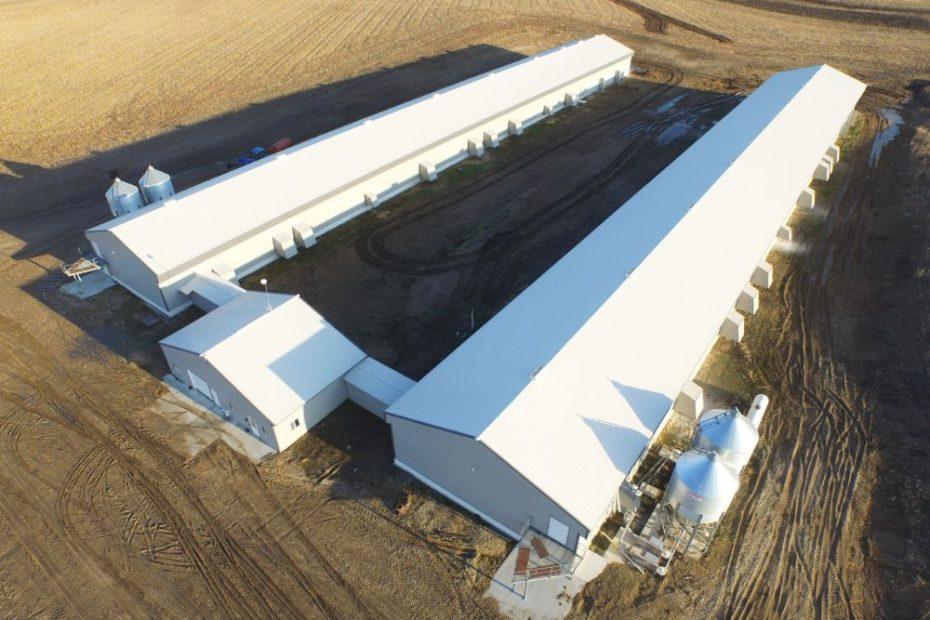
Building a well-designed poultry house is one of the most critical steps toward ensuring healthy and productive birds. Many farmers lose money not because they choose the wrong breed or feed, but because their housing fails to protect birds from environmental stress, disease, and predators.
In tropical regions, where high temperatures, humidity, and seasonal rains can affect poultry performance, proper housing design becomes even more important. A poorly ventilated house in the tropics can kill an entire flock within days. A floor that floods during the rainy season brings disease that spreads faster than you can treat it. These are not theoretical problems. They happen regularly to farmers who cut corners on housing.
A poultry house must provide protection, comfort, and adequate ventilation to minimize disease outbreaks and maximize egg and meat production. The structure you build determines whether your birds thrive or barely survive. It affects feed conversion rates, mortality levels, and ultimately your profit margins.
For poultry farmers constructing poultry houses under tropical environmental conditions, certain requirements must be met if the house is to provide an adequate environment. These are not optional features or nice-to-have additions. They are essential elements that separate successful operations from failing ones.
The good news is that building a proper poultry house does not require exotic materials or complicated engineering. What it requires is attention to specific design principles that have been proven to work in tropical conditions. Get these fundamentals right, and your birds will be healthier, grow faster, and produce more eggs or meat per kilogram of feed consumed.
This article explores the top five features every poultry farmer should prioritize when constructing poultry buildings under tropical environmental conditions. Each feature is explained in practical terms with specific measurements and design recommendations you can implement immediately.
1. Foundation of the House
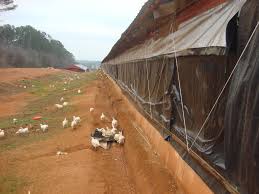
The foundation of a poultry house determines the overall strength and durability of the structure. A weak foundation leads to cracking walls, sagging roofs, and eventual collapse. This is not a place to save money.
A. Depth and Construction
A solid foundation should be dug to a depth of 0.5 to 0.7 meters, depending on the soil type. Sandy soils need deeper foundations than clay soils. Once dug, a 10 cm layer of concrete should be poured to form the base for laying blocks.
The concrete layer provides a stable, level surface that prevents differential settling. Differential settling is when one part of the building sinks more than another, causing cracks and structural problems.
B. Termite Protection
To prevent termite infestations, applying an anti-termite chemical treatment such as Solarium is highly recommended. Termites can destroy wooden support structures within months, especially in tropical climates where termite activity is year-round.
Treat the soil before pouring concrete and treat any wooden elements before installation. This two-layer approach gives maximum protection against termite damage.
C. Supporting Pillars
When constructing open-sided poultry houses, it is essential to make provisions for supporting pillars at intervals. These pillars help stabilize the roof and maintain the integrity of the structure.
Without adequate pillar support, the roof can sag over time, creating pockets where water collects. This water eventually leaks into the house, wetting litter and creating disease conditions.
2. Floor of the House
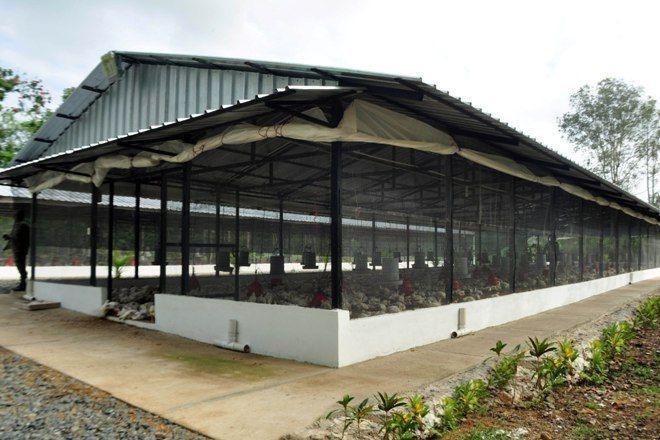
The floor of a poultry house plays a vital role in maintaining hygiene, controlling pests, and ensuring comfort for the birds. A strong, well-constructed concrete floor is considered the best option, particularly for farmers using the deep litter system of poultry management.
A. Concrete Floor Benefits
A concrete floor is mandatory for a deep litter system of management, especially when the soil is very dense and can absorb and transfer moisture from the lower subsoil. Concrete blocks moisture transfer, prevents dampness, and makes cleaning much easier.
Concrete floors also make disinfection more effective. You can wash and scrub concrete. You cannot properly disinfect bare earth or sand floors.
B. Height Requirements
The floor should be raised at least 30 cm above ground level to prevent flooding or dampness during the rainy season. In areas with heavy rainfall or poor drainage, raise it even higher.
Raising the floor serves multiple purposes. It prevents water from entering during floods. It reduces moisture transfer from the ground. And it makes the house less accessible to rats and other pests that typically stay close to ground level.
C. Alternative Flooring
In areas where concrete is unavailable, rammed laterite with sand filling may be used, but raising the floor remains essential. Even with alternative materials, the principle stays the same. Keep the floor dry, keep it above flood level, and make it as smooth and easy to clean as possible.
The floor should be cemented to make it easy to clean and wash. Concrete floor control rat problems in poultry houses. Rats cannot tunnel through solid concrete, but they can easily burrow under dirt or sand floors.
Read Also: Different Types of Poultry Equipment and their Uses
3. Width of the House
The width of a poultry house determines how well natural ventilation will function. This is critical in tropical climates where heat stress kills birds or reduces production dramatically.
A. Maximum Width Recommendation
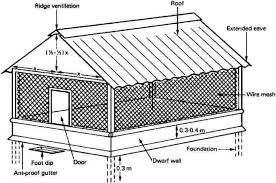
For open-sided houses, the ideal width from front to back should not exceed 10 meters, or 36 feet. This allows for proper cross-ventilation, which is essential in tropical climates where birds are prone to heat stress.
Beyond 10 meters, natural airflow cannot effectively reach the center of the house. Birds in the middle suffer from heat stress even when birds near the walls are comfortable.
B. Ventilation Considerations
If the house is built wider than this, natural airflow may be insufficient, especially during the dry season. In such cases, artificial ventilation such as ceiling fans or air conditioning must be installed to keep the environment comfortable for the birds.
Artificial ventilation adds to your operating costs and creates dependence on electricity. In areas with unreliable power supply, this can be disastrous. It is better to design the house correctly from the start than to rely on mechanical ventilation to fix a design problem.
C. Impact on Bird Health
Proper width ensures that birds remain healthy, active, and productive. Birds that are constantly heat-stressed eat less, grow more slowly, and produce fewer eggs. In severe cases, they simply die from hyperthermia.
The 10-meter width limit is not arbitrary. It comes from decades of practical experience in tropical poultry farming. Follow it.
4. Length of the House
Unlike width, the length of a poultry house is flexible and can be adjusted based on available land. A poultry house may be almost of any convenient length.
A. Terrain Considerations
The terrain on which the house is to be built often determines the length. A maximum length of 120 meters is acceptable for most operations.
Longer houses create management challenges. It takes more time to walk from one end to the other. In emergencies, this time can matter. But for most farmers, length is less critical than width.
B. Equipment Compatibility
If you plan to install automatic feeding equipment, it is important to check the manufacturer’s specifications. The feeder’s chain length and gear system will determine the maximum allowable length of the poultry building.
Many automatic feeders are designed for houses up to 100 meters long. Going beyond this requires custom equipment or multiple feeder systems, both of which increase costs.
C. Optimal Design
Designing the right length ensures smooth operation of feeding systems while maximizing space utilization. Consider your current flock size and planned expansion when determining length. Building too long initially wastes money. Building too short forces expensive expansion later.
5. Wall of the House
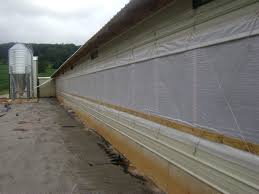
The walls may be built up with cement or mud blocks. The walls can vary from full walls with windows to almost no wall at all, meaning dwarf walls.
A. Open-Sided Design
For open-sided poultry houses, walls are usually built up to 0.8 to 1 meter (one-third of total wall height), with the upper part covered using half-inch chicken wire mesh. This design allows proper airflow while keeping predators out.
The mesh must be sturdy enough to resist determined predators like dogs and large snakes. Cheap mesh that tears easily is a false economy. Replace torn mesh immediately.
B. Pillar Spacing
Wooden or concrete-reinforced pillars should be placed at 1.3 to 1.6 meters apart to support the roof. Closer spacing provides better support but uses more materials. Wider spacing saves money but risks structural failure.
For heavy roofs or in areas with strong winds, err on the side of closer spacing. For light roofs in sheltered areas, wider spacing works fine.
C. Brooding Adaptations
For chick brooding, the open sides of poultry houses can be temporarily covered with plastic sheets to retain warmth and protect young birds during their early weeks. The same open-sided house suitable for adult birds may be adapted for brooding chicks by covering the open sides with plastic sheets to conserve heat for the young birds during these first few weeks of life.
Remove the plastic as chicks grow and develop their own temperature regulation. Young chicks need warmth. Older birds need ventilation.
D. Cage System Modifications
In cage systems for growers or layers, wall heights may be slightly reduced to allow better airflow and accessibility. If battery cages are to be used for growers or layers, the solid walls should be less than 0.8m.
Lower walls in cage systems work because the birds are elevated off the ground. The cages themselves provide some protection from ground-level predators.
Summary on Top 5 Features of Poultry Houses/Buildings
| Feature | Key Requirements | Purpose |
|---|---|---|
| Foundation Depth | 0.5 to 0.7 meters depending on soil type | Provides structural stability and prevents settling |
| Foundation Concrete Layer | 10 cm thick concrete base | Creates stable, level surface for block laying |
| Termite Protection | Anti-termite chemical treatment (e.g., Solarium) | Prevents termite damage to wooden support structures |
| Supporting Pillars | At intervals for open-sided houses | Stabilizes roof and maintains structural integrity |
| Floor Material | Concrete (preferred) or rammed laterite with sand filling | Maintains hygiene, controls pests, enables easy cleaning |
| Floor Height | Minimum 30 cm above ground level | Prevents flooding, dampness, and moisture transfer |
| Floor Function | Smooth, easy to clean, rat-proof | Facilitates disinfection and prevents pest entry |
| House Width | Maximum 10 meters (36 feet) for open-sided houses | Ensures proper cross-ventilation and prevents heat stress |
| Artificial Ventilation | Required if width exceeds 10 meters | Maintains comfortable environment when natural airflow insufficient |
| House Length | Flexible, maximum 120 meters acceptable | Determined by terrain and equipment specifications |
| Equipment Considerations | Check automatic feeder specifications for maximum length | Ensures compatibility with feeding systems |
| Wall Height (Open-Sided) | 0.8 to 1 meter solid, remainder with half-inch chicken wire mesh | Allows airflow while keeping predators out |
| Wall Height (Cage Systems) | Less than 0.8m solid walls | Improves airflow and accessibility for caged birds |
| Pillar Spacing | 1.3 to 1.6 meters apart | Provides adequate roof support |
| Brooding Adaptation | Temporary plastic sheet covering on open sides | Retains warmth for young chicks during first weeks |
| Wall Materials | Cement or mud blocks | Provides structural support and weather protection |
Frequently Asked Questions About Features of Poultry Houses/Buildings
1. What is the minimum foundation depth for a poultry house?
The foundation should be dug to a depth of 0.5 to 0.7 meters, depending on your soil type. Sandy soils require deeper foundations than clay soils. After digging, pour a 10 cm layer of concrete to create a stable base for laying blocks. This depth and concrete layer prevent settling and cracking.
2. Why must the floor be raised above ground level?
The floor should be raised at least 30 cm above ground level to prevent flooding during the rainy season, reduce moisture transfer from the ground, and make the house less accessible to rats and pests. A raised floor stays dry, which prevents disease outbreaks caused by damp litter and wet conditions.
3. What is the maximum recommended width for a poultry house in tropical climates?
For open-sided houses, the maximum width should not exceed 10 meters (36 feet). This width allows proper cross-ventilation essential in tropical climates. Beyond 10 meters, natural airflow cannot reach the center effectively, causing heat stress in birds. If you build wider, you must install artificial ventilation.
4. Can I build a poultry house longer than 120 meters?
While 120 meters is the acceptable maximum, you can build longer if necessary. However, longer houses create management challenges and may require custom equipment for automatic feeding systems. Most automatic feeders are designed for houses up to 100 meters long. Check equipment specifications before deciding on length.
5. What type of flooring is best for poultry houses?
Concrete flooring is the best option, especially for deep litter systems. Concrete blocks moisture transfer, prevents rat tunneling, and makes cleaning and disinfection much easier. In areas where concrete is unavailable, rammed laterite with sand filling can work, but the floor must still be raised and made as smooth as possible.
6. How high should the solid walls be in an open-sided poultry house?
For open-sided houses, build solid walls up to 0.8 to 1 meter high (approximately one-third of total wall height). The upper portion should be covered with half-inch chicken wire mesh. This design allows proper airflow while keeping predators out. For cage systems, walls can be slightly lower, less than 0.8m.
7. Why is termite protection important in poultry house foundations?
Termites can destroy wooden support structures within months in tropical climates where termite activity is year-round. Apply anti-termite chemical treatment like Solarium to the soil before pouring concrete and to all wooden elements before installation. This prevents structural damage that could lead to building collapse.
8. How far apart should supporting pillars be placed?
Wooden or concrete-reinforced pillars should be placed 1.3 to 1.6 meters apart to adequately support the roof. Closer spacing provides better support but uses more materials. For heavy roofs or windy areas, use closer spacing. For light roofs in sheltered locations, wider spacing is acceptable.
9. Can the same poultry house be used for both chicks and adult birds?
Yes. An open-sided house designed for adult birds can be adapted for brooding chicks by temporarily covering the open sides with plastic sheets. This retains warmth for young chicks during their first few weeks when they cannot regulate their own temperature. Remove the plastic as chicks grow and develop temperature regulation.
10. What happens if I build the house wider than 10 meters without artificial ventilation?
Birds in the center of the house will suffer from heat stress because natural airflow cannot reach them effectively. Heat-stressed birds eat less, grow more slowly, produce fewer eggs, and in severe cases die from hyperthermia. Either limit width to 10 meters or install ceiling fans, exhaust fans, or air conditioning to ensure adequate ventilation.
Do you have any questions, suggestions, or contributions? If so, please feel free to use the comment box below to share your thoughts. We also encourage you to kindly share this information with others who might benefit from it. Since we can’t reach everyone at once, we truly appreciate your help in spreading the word. Thank you very much for your support and for sharing!
Read Also: Comprehensive Farm Startup Guide