


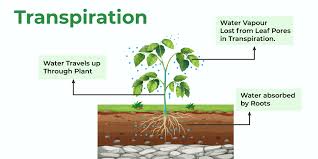
Living plant tissues can contain up to 95% water. Besides being essential for life, water has several specific roles within the plant. Water acts as an excellent solvent, dissolving many organic and inorganic substances, which facilitates their transport throughout the plant.
The properties of water also aid in buffering temperature changes, allowing plants to operate under more stable conditions.
Hydrostatic pressure in plant tissue, due to water content, plays a significant role in maintaining plant form, movement, leaf display, and growth. Additionally, water participates in vital chemical reactions, including hydrolysis and photosynthesis.
However, about 98% of the water that enters the plant roots is lost through evaporation from the shoot system. This evaporative loss, known as transpiration, is crucial for transporting substances within the plant and for cooling the leaves.
The following sections explore the pathways of water movement from the soil through the plant to the atmosphere and the forces driving water flow.
Read Also: How to Grow, Use and Care for Whiteedge Flatsedge Grass (Cyperus flavicomus)
Transpiration and Its Effects on Plants
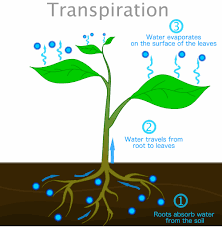
Transpiration involves the loss of water vapor through the stomata of plants. This process cools plants during hot weather, as water moves from the roots and stem upwards, being “pulled” into the leaves.
When water availability decreases, dehydrated mesophyll cells release abscisic acid, a plant hormone that causes stomatal pores to close, reducing water loss. This process helps balance water retention during gas exchange.
The Soil-Plant Atmosphere Continuum (SPAC) and Water Potential
The SPAC represents the continuous pathway of water movement from the soil, through the plant, and into the atmosphere. Water movement within this system occurs through two processes:
1. Diffusion: The net movement of substances from one point to another due to the random motion of molecules or ions.
2. Mass flow:—The movement of groups of ions or molecules in one direction driven by a hydrostatic pressure gradient.
Water potential, denoted by “Ψ” (Psi), measures a system’s capacity to release water. It determines how water moves from areas of high water potential to areas of low water potential. In the SPAC, water potential is typically high in the soil and low in the atmosphere, creating a gradient that drives water movement.
Water Uptake from Soil
Water in large soil pores drains easily due to gravity and is not available to plants. As plants absorb water, uptake becomes more difficult as soil dries and conductance decreases.
Clay soils, with smaller capillary pores, hold water more strongly, facilitating more effective uptake. The Root Hair Zone (2–20 cm from the root tip) is where maximum water uptake occurs. Older roots, though less effective at absorbing water, still contribute due to their larger overall presence.
Mycorrhizal fungi form symbiotic relationships with plant roots, enhancing water and nutrient uptake by increasing surface area in exchange for carbohydrates from the plant.
Plant Available Water
At Field Capacity (FC), soil holds the maximum amount of water against gravity, while at the Permanent Wilting Point (PWP), the soil is too dry for the plant to extract water.
The difference between FC and PWP determines the plant-available water, with clay and organic soils having higher levels compared to sandy soils. Knowing this helps in irrigation planning, crop modeling, and predicting yields.
Read Also: How To Grow, Use and Care For Threeawn Grass (Aristida Spp.)
Water Flow Pathways in Plants
Water flows through two main pathways in plants:
1. Apoplastic pathway—Water moves through free spaces (apoplast) along cell walls and intercellular spaces.
2. Symplastic pathway—Water flows through the cytoplasm and plasmodesmata (minute connections between cells).
Resistance to flow is greater in the symplastic pathway due to restrictions imposed by the plasma membrane.
Water Flow Across Root Cortex
Water moves from the soil across the root epidermal layer and cortex to the xylem. It travels through both apoplastic and symplastic pathways. The apoplastic pathway is blocked at the endodermis by the Casparian strip, forcing water into the symplast before proceeding further.
Driving Forces for Water Flow from Roots to Leaves
Water movement from roots to leaves is driven by root pressure and transpiration pull.
1. Root pressure: This force is most significant in smaller plants during periods of low transpiration. Root pressure results from the active uptake of ions into the root xylem, causing passive water uptake through osmosis.
2. Transpiration pull: Explained by the Cohesion-Adhesion Theory, transpiration pull results from the water potential gradient between leaves and the atmosphere. As water evaporates from leaf surfaces, water is drawn from the xylem vessels to replace it. Strong cohesion between water molecules and adhesion to xylem walls maintain the integrity of the water columns in the plant.
Evapotranspiration and Atmospheric Influences on Transpiration
Evapotranspiration refers to the combined loss of water from soil evaporation and plant transpiration. About 10% of atmospheric moisture comes from plant transpiration. The following factors influence transpiration rates:
1. Temperature: Higher temperatures increase transpiration, especially during the growing season.
2. Relative humidity: High humidity reduces transpiration, as water evaporates more easily into dry air.
3. Wind and air movement: Wind replaces saturated air near leaves with drier air, increasing transpiration.
4. Soil moisture availability:Lack of moisture leads to reduced transpiration and potential senescence in plants.
5. Plant type:Plants in arid regions, such as cacti, transpire less water than plants in wetter climates.
This article has discussed the principles of transpiration, the SPAC, water uptake, plant available water, water flow pathways in plants, water movement across the root cortex, and driving forces for water movement from roots to leaves. It also covers evapotranspiration and the atmospheric factors affecting transpiration.
Do you have any questions, suggestions, or contributions? If so, please feel free to use the comment box below to share your thoughts. We also encourage you to kindly share this information with others who might benefit from it. Since we can’t reach everyone at once, we truly appreciate your help in spreading the word. Thank you so much for your support and for sharing!