


The key to maximizing irrigation efforts is uniformity of the spread of water across the area of the farm under cropping. The producer of the water, who stands as the farmer, has a lot of control over how much water to supply and when to apply it but the irrigation system determines uniformity.
Deciding which irrigation systems is best for your operation requires knowledge of equipment, system design, plant species, growth stage, root structure, soil composition, and land formation.
To this end in view, to choose an irrigation method, the farmer must know the advantages and disadvantages of the various methods. He or she must know which method suits the local conditions best.
Unfortunately, in many cases there is no single best solution: all methods have their advantages and disadvantages. Testing of the various methods - under the prevailing local conditions - provides the best basis for a sound choice of irrigation method.
Iwena (2018), and report on Irrigation-Principles and Practices stated that there are basically different types of irrigation system tied with their various advantages and disadvantages. The author and report also importantly stated that numerous subclasses exist within each of these basic types as they are detailed below.
These include: Flooding irrigation; surface irrigation; sprinkler irrigation; drip/trickle irrigation; subsurface irrigation; furrow irrigation; manual irrigation.
🌿 Go Organic on Your Farm: Instead of harmful chemical pesticides and fertilisers, try our organic farming products — including neem oil spray, bio-pesticides, natural plant treatments, organic seeds and seedlings, suckers, and many more organic products that are safe for your health, your family, your soil and your harvest. Shop Now →
1. Flooding Irrigation System
Flooding system is a system of irrigation that allows a wide spread of water from a particular source. The system is operated in two major different ways. These ways are; wild flooding and controlled flooding.
a. Wild flooding is a method of irrigation that involves turning or pumping the water onto natural slopes without much control or prior preparation. The system involves a usual waste of water, and unless the land is naturally smooth, the resulting irrigation will be quite uneven.
Wild flooding is used mainly for pastures and fields of native hay on steep slopes where abundant water is available and crop values do not warrant more expensive preparations.
b. Controlled flooding on the other hand involves the use of borders, checks, or basins. It is relatively inexpensive because it requires minimum of preparation.
🔧 Free Farm Tool Available: Use our free Agric4Profits Farm Tools to calculate your farm profits, formulate feeds, identify pests and diseases on both your crops and animal farms, plan your planting and harvesting season, including many more farm tasks to get free expert advice and recommendations — completely free, no registration required. Access Free Tools →
Water is brought to the field in permanent ditches and distributed across the field in smaller ditches spaced to conform to the topography and rate of flow.
As shown in the figure below Water is brought to the field in permanent ditches and distributed across the field in smaller ditches spaced to conform to the topography of the soil and rate of flow.
Under ideal conditions, the ditch spacing and flow rate should be such that the water will just infiltrate in the time it is flowing across the field
The use of flooding method of irrigation generally involves a divide of the field / paddock into portions or bays separated by parallel ridges/border checks. Water flows down the paddock's slope as a sheet guided by ridges.
On steeply sloping lands, ridges are more closely spaced and may be curved to follow the contour of the land. Border systems are suited to orchards and vineyards, and for pastures and grain crops. The water is channeled to the area occupied by the crops and it is in that same location that percolation of the water takes place.
💬 Have a Farming Question? Join thousands of farmers across Africa on the Agric4Profits Community — ask questions, share experiences and connect with agricultural experts. It is completely free. Ask Your Question Now →

2. Surface irrigation System
In surface irrigation, water is allowed to move over and across the land to be irrigated. Surface irrigation involves the construction of ditches or channels on the surface of the soil. It is the channels that carry water to the farm. The water may be supplied to paddocks through the channels.
Supply of water takes place as long as the farmer wishes. The system is used to supply close planted crops like onion, rice, carrot etc. A necessary condition is that the soil should be a clay-loamy soil which may not permit quick drainage of the water into the soil. This system permits excess loss of water.
3. Sprinkler irrigation System
This is a popular method of or supplying water to the field/farm. Sprinkler irrigation is the use of sprinkler in the supply of water to the field.
The system operates in such a way that pipes carry some amount of water to the fields and then sprays it directly over the crops with high-pressure sprinklers. The sprinklers are of different types and that determines their usage. We have;
a. Center-pivot sprinkler systems: A center-pivot sprinkler is a self-propelled system in which a single pipeline supported by a row of mobile towers is suspended 2 to 4 meters above ground.
Water is pumped into the central pipe and as the towers rotate slowly around the pivot point, a large circular area is irrigated.
Sprinkler nozzles mounted on or suspended from the pipeline distribute water under pressure as the pipeline rotates.
The nozzles are graduated small to large so that the faster moving outer circle receives the same amount of water as the slower moving inside. Below shows Centre-pivot sprinkler system
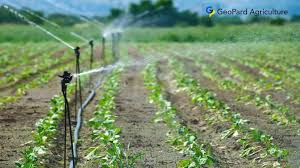
b. Hand move sprinkler systems: Hand move sprinkler systems are a series of lightweight pipeline sections that are moved manually for successive irrigations.
📖 Want to Go Deeper on This Topic?
Our expert agricultural ebooks cover poultry, fish farming, different crops production, snail farming, organic farming, mushrooms, sheep, cattle, flowers, pig farming, goat farming, agribusiness, etc. in practical step-by-step detail — written by agricultural professionals for African farmers.
Browse All Farming Ebooks →Pipes carrying water are connected to a water source and the pipes could be carried with the hand. On the sprinkling end, there may be the sprinkling device that helps to sprinkle the water.
Labor requirements are higher than for all other sprinklers. This is because the human power must be available to be carrying and directing the pipes
Read Also : Proper Irrigation and Drainage Guide
c. Solid set / fixed sprinkler systems: Solid set /fixed refers to a stationary sprinkler system. Water- supply pipelines are generally fixed (usually below the soil surface) and sprinkler nozzles are elevated above the surface.
Solid-set systems are commonly used in orchards and vineyards for frost protection and crop cooling. Solid-set systems are also widely used on turf and in landscaping
d. Travelling gun sprinkler systems: Travelling gun systems use a large sprinkler mounted on a wheel or trailer, fed by a flexible rubber hose.
The sprinkler is self-propelled while applying water, travelling in a lane guided by a cable. The system requires high operating pressures for the flow of water not to be interrupted.
e. Side-rollwheel-movesystems:Side-roll wheel-move systems have large-diameter wheels mounted on a pipeline, enabling the line to be rolled as a unit to successive positions across the field.
Crop type is an important consideration for this system since the pipeline is roughly 1 (one) meter above the ground. The benefit of this system is that you can control the amounts of water.
This is displayed below:
4. Drip/trickle Irrigation
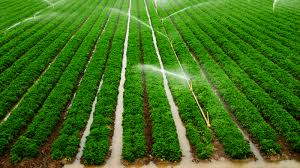
With this type, the drip lines take water near the root zone of plants and release it drop by drop. Going by the way it operates, this method is the most water-efficient of irrigation.
Find below the figure that shows how it works;
Advantages of the Drip/trickle Irrigation
Increased water use efficiency since water expels in droplets.
Better crop yield because there is hardly any form of excess or under-water application.
Uniform and better quality of the produce.
Efficient and economic use of fertilizer is assured because leaching is guided against.
Less weed growth since water drops exactly at the point where the root is.
Minimum damage to the soil structure as it helps to guide against soil erosion.
Avoidance of leaf burn due to saline soil.
More preferred to use in area with undulating soil and slow permeable soil.
Low energy requirement (i.e.) labour saving as it does not require man to move along with it.
High uniformity suitable for atomization.
The disadvantages of the Drip/trickle irrigation are as follows:
Clogging of drippers may occur and when it does, water can hardly flow and then the system is truncated.
Chemical precipitation may occur in the pipes since water movement in the pipes is very slow.
Salt accumulation may as well occur at the points where dropping of the water takes place.

5. Subsurface Irrigation System
This is another method or irrigation where by the irrigation practice takes place under the surface of the soil. The system involves the laying of perforated pipes under the surface of the soil.
In practice, as water is supplied through the pipes, it begins to come out through the pores and thereby irrigating the soil. The figure below shows sub-surface irrigation system.
Advantages of Subsurface Irrigation
Subsurface irrigation is such that the operation does not interrupt with the farm operations.
Subsurface irrigation results in a minimum loss of water via evaporation;
Surface wastage of water is very minimal or brought to the barest minimum.
The system requires little field preparation and labour.
Disadvantages of Subsurface irrigation
The system is more expensive to construct and maintain.
There are cases where there could be blockage of the pores and this might not be easily detected by the farmer or manager
The system requires some level of improved technical knowhow.
It may be difficult for the farmer to know the quantity of water to use in operation, thus resulting to over or under-water usage
6. Furrow Irrigation System
This system comprises a series of small, shallow channels used to guide water down a slope across a paddock. Furrows can also be described as a narrow ditch between rows of plants. Furrows are generally straight, but may also be curved to follow the contour of the land, especially on steeply sloping land.
This method is typically used to grow row crops or bed between the furrows, spaced from 1 meter apart. Actually, the spacing of furrows are determined by the spacing of the crops.
Small furrows have been used to grow forage crops. Furrows do vary from 3 – 12 inches deep and may be as long as 1500ft long. The figure below shows the furrow irrigation system.
Read Also : Concept, Definition and Principles of Irrigation Farming

Advantages of Furrow Irrigation System
Only a small area of the soil is wetted during the process of irrigating the soil.
Evaporation is correspondily reduced. That is to say the system helps to minimize water loss.
The water quantity that is needed to irrigate a field can be easily predicted and known.
The system requires some level of technicalities.
The system can be seen to be more expensive to construct at least when compared to flood irrigation system.
Much water is required to flow the system.
The system cannot be operated inland with hilly or sloppy topography. In other words, the system is quite choosy in land consideration.
6. Manual Irrigation
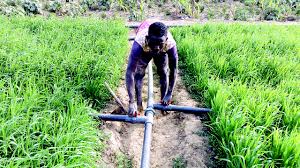
This is the type of conventional system of irrigation that takes place in our backyard gardens of farms. This type uses buckets or watering cans to convey water from where it is plenty or from its source to the point or plants /crops it is to be applied on.
The system involves the use of reliable source of water and human labour. Find below the figure of how manual labour operates:

Advantages of Manual Irrigation System
Manual irrigation system does not require technical skill to operate it.
Water is very much economically used.
Evaporation is greatly minimized.
Leaching (loss of nutrients through washing down the soil) is greatly reduced.
It is a cheap method of irrigation practice to carryout.
Disadvantages of manual irrigation system
The method cannot be used to irrigate a large area of farm.
It involves the direct and too much involvement of human labour
Due to man’s nature, irrigating the farm may not be properly carried out.
In the event of pest outbreak, the system cannot be used.
The quantity of water applied per stand may not be in commensuration of the plant needs, such may be the case where tree crops are to be irrigated.
Challenges of Irrigation Farming
Irrigation farming is faced with some challenges. These challenges according to Iwena (2018) make the irrigation system chosen by farmers not to function to its peak or expectations.
It is as well makes any chosen irrigation system adopted for practice by the farmer(s) not to function to its full potentials. Notably, some of the challenges are:
Availability of ridges: The ridges formed which are supposed to channel water from source to the farm sometimes posed as obstruction to the functioning of the irrigation system.
The ridges sometimes interfere with the movement of implements needed for the functioning of the irrigation system. As many as the areas occupied by ridges and field channels go a far way in the disruption of the system. The method impedes surface drainage.
Labour shortage: The labour requirement is of two folds. They are the skilled and unskilled labour required for the construction and operation of the irrigation system.
The skilled Engineers or technicians as well as the unskilled workers are unavailable. Their unavailability pose a serious challenge to those who would have wanted to construct an irrigation facility in their farms.
Type of crop planted: The type of crop that is being planted is another factor that render challenges to irrigation farming. There are some types of crops and cropping system that do not allow particular irrigation system to be constructed in the farmers plot and so discourages the farmer from carrying out the system.
Unsuitability to some crops: There are some types of crops that do not do well in irrigated farms. Such crops are not suitable for irrigation use because they are sensitive to wet soil conditions around the stem.
Chance of backflow into water source: There are instances where the water that is being pumped may experience a backflow. This condition may arise due to a technical issue, and once not detected on time may end up resulting to damages to the crops that were supposed to be irrigated.
Insoluble fertilizers are not suitable: There are some types of fertilizers that are not suitable for the use of irrigation practice. Such fertilizer include super phosphate. In this instance, the use of irrigation does not help matter in dissolving the fertilizer for the uptake of plants roots.
Corrosive effect of fertilizer: There are some instances where corrosion of the tube or pipe supplying water may become corroded. In a gradual process if not checked, it will lead to the destruction of the pipe and a collapse of the system.
Destruction of the pipe line: In some cases, fertilizers like phosphate may get precipitated in the pipe line and dripper due to pH reaction and this will lead to serious effect such as destruction of the system6. High cost
Malfunctioning of the irrigation system: While irrigation has provided a number of important benefits, some potential drawbacks are imminent. Such drawbacks may include over watering or under-watering of the farm. In any of the cases, there effects that emanates from it. These are expressed in details below:
Under-watering may result in:
Loss in market value through yield reduction.
Reduction in fruit size and quality.
Over-Watering may result in:
Unwanted vegetative growth.
Losses of valuable water to the water-table.
Irrigation water travelling over soil can cause erosion. The excessive displacement of the top soil can also affect soil fertility (and hence crop yields), it may also clog drainage ditches and streams (silting), harm aquatic habitats, foul waters used for recreational activities, and increases the need for water treatments.
Irrigation can cause pesticides, pathogens and weeds to spread during irrigation.
Cause runoff.
Increased operational costs (labour, pumping, cost of water).
Leaching of nutrients (eg. salt, phosphorus) may lead to algal growth, salinity and nitrate build ups (poisoning) elsewhere in the catchment.
Downgraded product quality and reduced yield.
Higher operational costs for the producer (hence, reduced profits).
Pressure on water resources with the Increasing demand for water use by urban dwellers.
In summary, this article explained the different types of irrigation system that are prevalent in our farms. The study also found that different conditions actually influence the different types of irrigation systems in our farms.
The types were discussed about in details, though some of them also have sub systems under them. What is paramount is that different conditions suit different types of irrigation systems. The unit revealed some of the limitations or challenges plaguing the construction and use of irrigation systems in our farms.
This article unraveled the different types of irrigation systems that are prevalent in our farms. The sub-types of the major systems were also studied. The factors affecting the functioning of the different irrigation systems were also disclosed.
FAQs on Types, Methods, and Challenges of Irrigation Farming
1. What is drip (trickle) irrigation and what makes it efficient?
Drip or trickle irrigation delivers water drop by drop directly into the root zones of plants, making it the most water-efficient method of irrigation. It enhances crop yield, ensures uniform produce quality, reduces weeds, minimizes soil erosion, avoids saline burn on leaves, and conserves energy through labor savings.
2. What are the disadvantages of drip irrigation?
Primary drawbacks include the clogging of drippers, chemical precipitation within pipes due to slow water flow, and salt accumulation at drip points.
3. What is subsurface irrigation and what are its benefits?
Subsurface irrigation involves laying perforated pipes beneath the soil surface, delivering water directly into the root zone. Its advantages include minimal evaporation loss, consistent water delivery without disrupting field activities, and lower labor and preparation requirements.
4. What challenges are associated with subsurface irrigation?
The system is costly to construct and maintain, prone to pore blockages that are difficult to detect, demands a certain level of technical expertise, and makes it hard to estimate the correct volume of water required—resulting in risk of under- or over-watering.
5. Beyond drip and subsurface methods, what other irrigation practices are commonly used and what general issues do they face?
Though not detailed in the Agric4Profits article, irrigation systems such as surface (flood, furrow, basin), sprinkler, and center-pivot are widely employed. Common challenges across these methods include high initial and operational costs, water wastage, soil degradation, environmental impacts like salinization and groundwater depletion, inequitable water distribution, and demands for technical know-how.
6. What broader economic and environmental challenges does irrigation farming face?
Irrigation farming often involves substantial upfront investment and ongoing maintenance, which can be a barrier for smallholder farmers. Environmental issues such as waterlogging, soil salinity, and groundwater depletion are prevalent, as is dependence on energy for pumping systems. Moreover, weak policy frameworks, poor governance, and climate variability further complicate adoption and management of irrigation infrastructure.
Read Also : The Role of Livestock Farming in a Sustainable Food System
🌱 Take Your Farming Further With Agric4Profits
Based on what you just read, here are free resources and products from Agric4Profits that can help your farm right now:
- 🛒 Visit Our Marketplace — Organic neem oil, bio-pesticides, seeds and farming products
- 📚 Read Premium Content — Advanced guides for serious and profitable farming
- 🎓 Join Our Free Academy — Structured free training for farmers across Africa
- 🔧 Use Our Free Farm Tools — Profit calculators, feed formulation, pest identifier and more
- 💬 Join Our Farming Community — Connect with farmers across all 54 African countries
- ❓ Ask a Farming Question — Get answers from experienced farmers and agricultural experts
Please cite this content in academic work, research, or publications.