


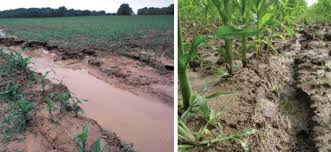
There are several components of soil erosion caused by water. These are commonly categorized into inter-rill, rain-splash, rill, sheet, and gully erosion.
Inter-Rill Erosion in Agricultural Lands
When runoff begins, it quickly forms tiny rills, while the runoff flowing between these rills is referred to as inter-rill or sheet erosion. This form of erosion is primarily caused by shallow water flow.
Some soil particles are carried away in thin sheets of runoff, while others concentrate within small rills. Inter-rill erosion is the most prevalent type of soil erosion.
Together, splash and inter-rill erosion account for about 70% of total soil erosion, occurring simultaneously. Splash erosion is dominant at the onset. Inter-rill erosion is influenced by particle detachment, rainfall intensity, and field slope.
Rain-Splash Erosion and Its Role in Soil Loss
The kinetic energy of raindrops triggers erosion upon striking the soil surface. Large soil aggregates are broken apart, and smaller particles are splashed several tens of centimetres.
Particles splashed downhill travel farther than those moving uphill, resulting in a net downslope movement of soil. Rain-splash erosion is particularly severe on steep slopes without vegetation.
Dense vegetation can intercept raindrop energy, offering protection, though in forests, interception might increase raindrop erosivity due to drop size. Soil resistance also influences erosion.
Soils rich in organic matter, with moderate clay and calcium, form stable aggregates, while silty and sandy soils disperse more easily. In extreme cases, rain-splash erosion can cause soil loss 50 to 90 times greater than runoff losses.
Read Also: Considerations in Constructing a Poultry House
Sheet Erosion on Cultivated Slopes
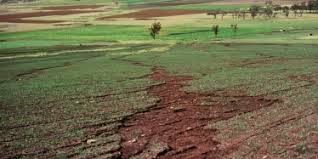
When rainfall intensity exceeds the soil’s infiltration capacity, water accumulates and flows downslope in a thin, irregular sheet (Fig. 1). As water moves, its depth and velocity increase, and erosion occurs once the shear force of the water overcomes soil resistance.
Erosion intensifies with slope steepness and then may reduce or deposit sediment on gentler footslopes. Water movement is not uniform; it forms tiny fast-moving threads that shift across the slope. These micro-channels, combined with rainsplash, cause the majority of soil transport.
Rill Erosion and Damage to Agricultural Fields
Surface irregularities and slope variations cause overland flow to concentrate, forming rills (small channels) (Fig. 2). Runoff concentration in these rills increases soil removal efficiency and intensity.
Rill erosion is more prominent on short, steep slopes, while inter-rill erosion dominates on long, gentle inclines. Rills deepen until reaching a less erodible soil layer, after which they widen by lateral erosion. If the subsoil is also erodible, these rills evolve into gullies.
Gully Erosion and Its Agricultural Consequences
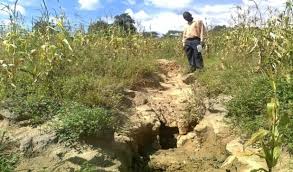
Gullies are larger erosion channels that cannot be removed through regular tillage (Fig. 3). Gully erosion forms V- or U-shaped channels, at least 0.3 m in width and depth. Gullies develop when runoff converges at low points on a field, producing concentrated flow erosion.
On undulating fields, runoff collects in natural swales and flows as channelized water, often removing entire soil profiles locally. As gullies expand, they transport more sediment and reduce topsoil depth when filled with nearby soil. Though gullies contribute only 1–2% of total soil loss, their localized damage is often severe.
Gully formation involves multiple mechanisms and is less frequent than rill formation, but where gullies do occur, they can erode more soil.
Gully depth can range from 0.5 to 30 m, and erosion is non-selective in terms of particle size. Soil is also lost through mass movement, such as rotational and transitional landslides, typically occurring on steep (>20°) slopes with little vegetation and fluctuating water tables. Though localized, landslides cause significant downslope soil losses.
Types of Gully Erosion in Agricultural Land
There are two main types of gully erosion:
1. Ephemeral Gullies: These are shallow and can be corrected by routine tillage. However, if not properly controlled, they often reappear in the same location.
2. Permanent Gullies: These are too deep or wide to be fixed through normal tillage. They may divide fields, disrupt machinery traffic, and require expensive reclamation measures. Even when ephemeral gullies are repaired, the eroded soil is permanently lost.
Read Also: Cold Weather Poultry Diseases and How to Manage them
Relationship Between Soil Erosion and Agricultural Productivity
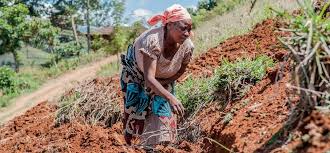
The link between soil erosion and agricultural productivity is complex and depends on multiple factors. Erosion changes soil properties, directly affecting crop growth.
It reduces rooting depth, fertility, organic matter, and plant-available water. Over time, this leads to a decline in yield potential.
The impact may take years to become noticeable. Erosion not only affects the soil but also alters the microclimate, further affecting plant growth.
On soils with poor subsoil and shallow rooting depth, crop yield drops sharply as surface soil erodes. Fertilizer alone cannot compensate for lost topsoil. Mismanagement of soil accelerates irreversible degradation of the resource base.
In many cases, technological inputs such as fertilizers mask symptoms of erosion. But the longer erosion goes unaddressed, the harder it becomes to restore soil productivity.
In the tropics, most soil nutrients are concentrated in the thin surface layer. The subsoil is often infertile and unsuitable for root growth. Even in humid zones, drought negatively affects crops on eroded tropical soils.
In such soils, productivity declines faster and with less soil loss compared to temperate soils. However, not all tropical soils are equally vulnerable. Younger soils like Andisols and Inceptisols are more fertile and resistant, while Alfisols, Ultisols, and Oxisols which are older and more leached suffer greater yield loss from erosion.
Erosion reduces productivity to varying degrees depending on soil profile, crop type, soil management, and local microclimate. On soils with favorable subsoil, erosion may reduce nutrients like nitrogen but does not always cause significant yield decline. In such cases, fertilizer can offset much of the loss.
However, quantifying erosion’s effect on crop yield is difficult due to factors like crop differences, soil variability, topography, and weather fluctuations. The complex interaction of these factors makes it hard to isolate erosion’s impact on yields.
This article has discussed the types of soil erosion relevant to agriculture, including inter-rill erosion, rain-splash erosion, sheet erosion, rill erosion, and gully erosion.
It also identified ephemeral and permanent gullies and explained how soil erosion affects agricultural productivity through changes in soil depth, fertility, water retention, and the microclimate.
Do you have any questions, suggestions, or contributions? If so, please feel free to use the comment box below to share your thoughts. We also encourage you to kindly share this information with others who might benefit from it. Since we can’t reach everyone at once, we truly appreciate your help in spreading the word. Thank you so much for your support and for sharing!