


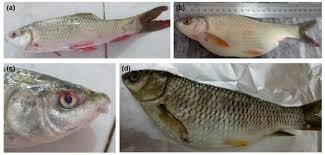
The most common parasites of fish are protozoa. These include species found on external surfaces and species found in specific organs. Most protozoa have direct life cycles, but the myxosporidia require an invertebrate intermediate host. There are two main types of protozoan ciliated and flagellated protozoa.
Ciliated protozoa are among the most common external parasites of fish. Most ciliates have a simple life cycle and divide by binary fission. Ciliates can be motile, attached, or found within the epithelium. The most well-known organism in the latter group is Ichthyophthirius multifiliis, which has a more complex life cycle than the other ciliates.
Ichthyobodo (Costia) spp. are some of the most common and smallest (~15 × 5 µm) flagellated protozoan parasites of the skin and gills. They are flattened, pear-shaped organisms with two flagella of unequal lengths. Ichthyobodo moves in a jerky, spiral pattern, and free-swimming organisms are fairly easy to identify in direct smear preparations.
Once attached, the organism can be difficult to see and is often missed by the novice, but movement typical of a flickering flame is characteristic.
Read Also: 12 Medicinal Health Benefits Of Renealmia alpinia (Pink cone ginger)
Protozoan Diseases and Their Control

1. Ichthyophthiriasis (Ich)
Ich is a common name for the parasite Ichthyophthirius multifiliis and the disease that it causes. The parasite is capable of killing large numbers of fish in a short period of time. Early diagnosis and treatment are essential for controlling Ich and reducing fish losses. Prevention of this disease is, of course, the best method of avoiding fish mortalities.
The white spot disease, or ichthyophthiriasis, is a common disease of freshwater fish. Affected fishes exhibit minute white nodular spots on the skin, fins, and gills and are restless. The most common symptom of freshwater ich (Ichthyophthirius multifiliis) is the presence of small white spots (trophonts) on the body. These “white spots” are actually thickened masses of protective mucus that have covered the attacking protozoan in an attempt to dispel it.
Additional symptoms include rapid breathing, cloudy eyes, possible fin deterioration, and flashing. The life cycle of ich includes a host organism and the environment. The trophont is the encysted feeding stage of the parasite, which enlarges, breaks through the epithelium, and eventually settles on the bottom of the aquarium.
When on the bottom of the aquarium, the organism, now referred to as a tomont, begins to undergo mitosis (cell division) and produces hundreds of ciliated theronts. If the theronts encounter a host fish, they will attach, penetrate, and enlarge, appearing to the aquarist as white spots.
The most common form of freshwater fish disease is ichthyophthiriasis or “Ich,” an affliction characterized by small, white pustules resembling pimples or grains of salt, which concentrate mostly on the fish’s fins.
Regrettably, Ich is much easier to diagnose than it is to treat. Ich is essentially a form of parasite that attaches itself to the outer body of a fish in the form of pustules. Eventually, the pustules expand and drop off, floating to the bottom of the aquarium where they dig into the gravel or rock and multiply. If left untreated, the parasites will multiply enough to reattach themselves to every fish in the tank.
i. Identification of Ich
Fish infected with Ich may have white specks on their skin as though they were sprinkled with salt. Because of this appearance, Ich is sometimes called white spot disease. The skin of the fish may also look bumpy. Mature forms of the parasite are large (up to 1 mm or 1/32 inch across) and can be seen without magnification.
Ich often causes fish to have large amounts of mucus sloughing off of their skin, which may resemble fungus when viewed from a distance in the water. Many times, however, the only indication of Ich’s presence may be dead and dying fish. In some cases, the parasite may be present only on the gills and not on the skin.
Fish with Ich may be observed making quick rubbing or scratching movements on objects or on the pond bottom. This behavior is sometimes called flashing because of the quick and sudden exposure of the fish’s light-colored belly as it rolls during erratic movements. Trout have been observed flashing at the water surface, appearing as though they are striking at insects.
In the final disease stages, Ich-infected fish also may appear lethargic and sometimes gather around inflowing water. Infected fish usually refuse to eat. Under the microscope, Ich appears as a sphere that changes shape and moves around in a rolling motion, using tiny hairs called cilia that totally cover the parasite. Its method of motility is often compared to that of an amoeba. The center of the adult organism has a C-shaped nucleus.
The small infective stages do not have the C-shaped nucleus, and they move rigidly in the water, as opposed to the fluid, rolling movement of the adult. In advanced stages of infection, Ich is found burrowed under the mucus and top layer of cells (epithelium) in the fish’s gills or skin.
After burrowing, Ich is very hard to treat because of the protective layer of mucus and host cells covering the parasite. Prompt treatment is important to help prevent the establishment of an advanced infection.
ii. Life Cycle of Ichthyophthirius Multifiliis
A = Trophozoites in the host’s skin
B = Trophont leaving the host
C = Mature trophont with hundreds of maturing tomites
D = Release of tomites that penetrate the skin of the host fish
A = The cycle continues.
iii. Treatment of Ich
Because not all stages in the life cycle of Ich are affected by treatments, multiple treatments must be administered to catch individual Ich organisms in the vulnerable stages of their life cycle. For example, on the first day when a chemical is added to the water to kill Ich, only a certain percentage of Ich organisms will be susceptible to the chemical.
Two days later, many of the surviving Ich organisms embedded in the skin will be entering the vulnerable stage of their life cycle, and chemical treatment on this day will kill these susceptible organisms. To catch all the Ich organisms in a treatable stage, from three to seven treatments may be needed depending on water temperature.
This parasite can be controlled by hourly bath treatments for 7 days in a 2-5% NaCl solution. Pond treatment involves the application of 15-25 mg/L formalin. Malachite green and formaldehyde do not penetrate and kill the trophonts but instead prevent the motile trophonts from reinfecting the fish.
Treatment effectiveness should be evaluated by a fish health professional after the third treatment to determine whether to continue with the treatment schedule. Mortality rates should be observed, and samples of fish from the infected pond should be examined for Ich under a microscope.
iv. Preventing Ich
Ich is a very common disease, and if it appears, the entire tank will need treatment. Therefore, it is much easier to prevent Ich than to treat it. The following suggestions can help prevent Ich:
- Only purchase healthy fish that are free of all signs of disease. Never buy fish from a tank that contains a dead or diseased fish.
- Always quarantine new fish for a minimum of two weeks before introducing them into your tank.
- Never buy plants from a tank that contains fish unless properly quarantined.
- Purchase fish from a direct source to reduce stress from shipping and handling.
- Isolate any fish showing signs of Ich and treat them in a quarantine tank.
- Avoid fluctuations in water parameters such as temperature, pH, or ammonia levels, as they can stress fish and lead to Ich outbreaks.
- Feed a variety of high-quality foods to maintain fish health and resistance.
- Do not overstock tanks, as overcrowding increases stress and the risk of disease.
- Maintain excellent water quality by performing regular water changes.
While Ich may be the most common disease in aquarium fish, it can be managed effectively by following preventive measures and promptly treating infected fish.
Read Also: 16 Medicinal Health Benefits Of Scleromitrion diffusum (Spreading Diamond Flower)
Protozoan and Helminthic Diseases in Aquaculture: Identification, Treatment, and Control

Aquaculture systems often face various parasitic challenges that can negatively impact fish health, especially protozoan and helminthic parasites. Below are some common parasitic diseases, their causative agents, symptoms, and effective treatment options.
1. Trichodiniasis
Various life stages of Indian major carps (IMC) and catfish species are often affected by Trichodina, Tripartiella, and Trichodinella species. These urecolariid ciliates attach themselves to fish gills using an adhesive disc made of skeletal elements. This attachment results in gill damage, causing respiratory distress in fish.
Treatment:
i. Water quality improvement and reducing fish stocking density.
ii. Bath treatments with 2-3% sodium chloride (NaCl) or 50 mg/L potassium permanganate (KMnO₄).
iii. Pond treatment with 5 mg/L KMnO₄ or 25 mg/L formalin to control infestations.
2. Costiasis
Caused by heavy infestations of the Coastia (Ichthyobodo) genus, this disease affects the gills and external surfaces of freshwater fish. The parasites thrive at lower temperatures (around 25°C), leading to the formation of a greyish-white appearance on the body surface of affected fish.
Treatment:
i. Bath treatment with 2-3% NaCl or 50 mg/L KMnO₄.
ii. Pond treatment with 5 mg/L KMnO₄ or 5 mg/L formalin.
3. Myxosporean Disease
Myxosporean parasites, particularly of the genus Myxobolus, infect fish gills and kidneys. These parasites form cysts of varying sizes, damaging the gill’s respiratory surface and the kidney’s excretory tubules. Heavily infected juvenile fish may experience high mortality.
Diagnosis:
Identification of greyish cysts on gills, and microscopic examination revealing myxosporidian spores.
Treatment:
Effective treatments focus on prevention through proper water management and reducing stress in fish.
4. Helminthic Parasites
Dactylogyrosis and Gyrodactylosis. These diseases are caused by monogenetic trematodes, mainly Gyrodactylus (skin flukes) and Dactylogyrus (gill flukes). These parasites attach to the fish’s skin or gills using hooks, causing injuries that lead to mucus secretion, hemorrhages, and bacterial or fungal infections.
Treatment:
i. Alternate baths in a 1:2000 acetic acid solution followed by a bath in 2% NaCl solution.
ii. Dip treatment in a 5% solution followed by a bath in a 1:5000 formalin solution.
5. Black Spot Disease
Caused by the encysted metacercariae of digenetic trematodes, Diplostomatidae, this disease often affects carp fingerlings. Metacercariae can be found in different parts of the fish, including the skin, liver, eyes, and brain. The final hosts for these parasites are usually fish-eating birds.
Control:
While the disease is generally less harmful, proper pond management and avoiding bird activity near fish ponds can help reduce incidences.
6. Velvet Disease
Velvet, caused by Piscinoodinium protozoa, leads to the formation of small yellowish spots on the fish’s body. Affected fish may exhibit clamped fins, flashing movements, and rapid breathing, particularly when their gills are infested. The protozoan contains chlorophyll, allowing it to gain nutrients through photosynthesis, and hence, keeping the tank dark can inhibit its growth.
Treatment
i. Copper sulfate treatment is highly effective, but care should be taken not to overdose as it can be toxic to fish and aquatic invertebrates.
ii. Use of acriflavine-based products is another option but may lead to fertility issues in fish.
Prevention Strategies for Parasitic Diseases
Maintaining optimal water quality, ensuring appropriate stocking densities, and implementing strict quarantine measures for new fish are essential for controlling parasitic outbreaks. Regular pond and tank disinfection, along with using specific treatments for each disease, will help ensure fish health and productivity in aquaculture systems.
By understanding the various parasitic diseases in aquaculture and their effective treatments, fish farmers can take proactive measures to reduce the risk of large-scale fish losses due to these infections.
Do you have any questions, suggestions, or contributions? If so, please feel free to use the comment box below to share your thoughts. We also encourage you to kindly share this information with others who might benefit from it. Since we can’t reach everyone at once, we truly appreciate your help in spreading the word. Thank you so much for your support and for sharing!
Read Also: Complete Composting Guide for Beginners
Frequently Asked Questions
We will update this section soon.