


In arid and semi-arid regions where temperature levels are high, resulting in high evaporation of soil water, low soil moisture levels cannot sustain plant growth. In these regions, rainfall is insufficient for plant growth and only lasts a few months.
This causes plants to suffer drought periods, leading to poor growth and development, low yield, or even crop death. The rainfall amount is usually less than 500mm per year.
To sustain crop growth and maintain yield in these regions, irrigation water application is one of the soil and water management practices employed to improve and manage soil fertility. Irrigation, therefore, is the artificial application of water to the soil for the benefit of growing crops.
Read Also: Pests of Stored Products and Damages Caused
Definition of Irrigation in Crop Production

As mentioned in the introduction, irrigation is the artificial application of water to the soil for the benefit of growing crops or agricultural production. It is also the artificial application of water to overcome deficiencies in rainfall for growing crops.
Therefore, it is the determining factor in agricultural production in arid and semi-arid regions because low soil water content is a major constraint to increasing agricultural crop production.
Most irrigation water is pumped directly from a water source such as a river, creek, channel, drag line, well water (hole or underground water), dam, or borehole.
Significance of Irrigation in Farming
Proper application of water (irrigation) positively affects the entire growing process of crops from planting to harvest (maturity). The growing processes include preparation of the seedbed, germination, root growth and development, nutrient availability and uptake, quality of grain or fruiting (fruit development), and yield.
To maximize the benefits of irrigation, there must be uniformity in water application by the producer, knowing how much water to supply and when to apply.
Thus, the importance of irrigation in agriculture can be viewed from two main perspectives: its effect on soil and crops and its benefits to the producer. These are as follows:
Types of Irrigation Systems in Agriculture

The timing and quantity of water applied to the crop by the irrigator is called irrigation scheduling. This depends on the crop water requirement at different growth stages and climatic conditions. The various methods and ways of applying water are as follows:
- Helps the growth and maintenance of agricultural crops in dry areas with low rainfall average throughout the growing season.
- Used for cooling livestock and reducing dust circulation.
- For the disposal of sewage and in moving.
- Allows the producer to grow more and higher-quality crops and pasture.
- Provides the opportunity to grow crops all year round, thereby overcoming the problem of seasonal variability and drought.
- More animals are stocked, making grazing management tighter because they are assured of pasture supply throughout the season.
- Takes market incentives advantage for the production of unseasonal crops.
- Because of the constant or consistent supply of pasture, there is less reliance on hay and grasses (supplementary feeding).
- Improves the producers’ income because more crops are produced throughout the year, resulting in greater returns.
- Maintains the soil moisture level at field capacity.
1. Furrow Irrigation Systems
Water is applied to row crops in ditches made using tillage implements. It consists of small, shallow channels that guide or direct water down a slope across a paddock.
2. Flood or Border Check Irrigation Systems
These systems divide or separate the paddock into bays separated by parallel ridges or border checks. Water flows down the paddock’s slope as a sheet guided by the ridges.
3. Level Basin Irrigation Systems
This system differs from flood or border check in that the land slope is level, and the area ends are closed. A high volume of water is applied to achieve even, rapid ponding of the desired depth within basins.
4. Center-Pivot Sprinkler Systems
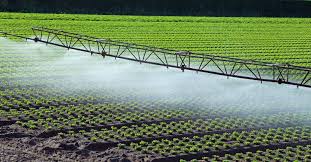
This is self-propelled. A single pipeline is supported by a row of mobile towers suspended 2–4 meters above ground. Water is pumped into the central pipe as the towers rotate slowly around the pivot, irrigating large circular areas.
5. Hand Move Sprinkler Systems
These consist of lightweight pipelines moved manually for successive irrigations. Lateral pipelines are connected to the mainline, which may be portable or buried.
6. Solid Set / Fixed Sprinkler Systems
This is a stationary sprinkler system. The water supply pipeline is fixed, and sprinkler nozzles are lifted above the surface. It is used mainly in orchards and vineyards for frost protection and crop cooling.
7. Traveling Gun Sprinkler Systems
Uses a larger sprinkler mounted on a wheel or trailer with a flexible rubber hose. It is self-propelled while applying water, moving in a cable-guided path requiring high pressures to operate.
8. Side-Roll Wheel Move Systems
These systems have large-diameter wheels mounted on a pipeline to enable the line to roll as a unit to successive positions across the field. Crop type is considered since the pipeline is about one meter above ground.
9. Linear or Lateral Move Systems
Similar to the center-pivot, except that the lateral line and towers move in a continuous straight path across the field.
10. Low-Flow Systems (Drip and Trickle)
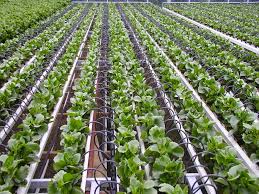
These use small-diameter tubes placed above or below the soil surface. Water is applied slowly to the soil through smooth holes or emitters.
11. Sub-Irrigation Systems
Water is applied in open ditches or tile lines until the water table is raised enough to wet the soil.
When choosing an irrigation system, several factors should be considered:
- Differences in soil type
- Differences in topography (varying topography)
- Power source availability
- Water availability and source
- Period or time of system installation
- Size of irrigation area
- Capacity of water storage on farm
- Labour availability and financial resources
Read Also: Collection, Handling, Storage and Pre-Treatment of Seeds
Benefits of Irrigation in Crop Production
Some of the benefits of using irrigation are:
- Prevents disease infestation and growth of weeds.
- Conserves water and time.
- Preserves soil structure and nutrients.
- Enhances farming flexibility.
- Enables the growth of more crops, like cash crops, that bring returns.
- Enhances groundwater storage.
- Improves crop yields, hence more income.
- Encourages fishery development.
- Protects from drought/famine.
Challenges of Irrigation in Agriculture
The main challenge in irrigation is knowing the crop water requirement at various growth stages and the climatic conditions. This helps avoid over- or under-watering using irrigation.
To prevent these issues, it is necessary to know how much water is available to the plant and how efficiently the plant can use it. Methods to measure this include:
- Plant observation
- Feel and appearance of soil
- Using soil moisture monitoring devices
- Estimating available water from weather data
The drawbacks of over- and
Over-Watering
- Excessive vegetative growth
- Water lost to the water table
- Enhances erosion, resulting in the displacement of topsoil, thereby affecting crop yield
- Encourages pathogen spread and the effect of pesticides and weed growth
- Encourages runoff
- Increases operational costs, such as labor and pumping costs
- Leads to leaching of nutrient elements, resulting in soil salinity
- Causes nitrate buildup, which poisons surface and underground water
- Reduces product quality and yield
- Increases operational costs
- Results in high demand due to water shortages for urban dwellers
In this article, irrigation, its importance, types, benefits, and associated challenges have been discussed. It can be concluded that irrigation greatly benefits the soil, crops, and the farmer, as soil fertility is enhanced, and more crops are grown year-round.
Do you have any questions, suggestions, or contributions? If so, please feel free to use the comment box below to share your thoughts. We also encourage you to kindly share this information with others who might benefit from it. Since we can’t reach everyone at once, we truly appreciate your help in spreading the word. Thank you so much for your support and for sharing!