


It is a common phenomenon for wines and other alcoholic drinks to be sold and served in any food service area. This article examines the term ‘dispense bar’ and the equipment found therein. Beverage control is essential.
All alcoholic drinks are usually served by a member of the service team, often known as a sommelier or wine butler, unless it is the custom for the food service waiter to serve their own customers with the wine and drinks they require.
In order to carry out efficiently the service of all forms of wine and drink requested, the bar should have available all the necessary equipment for making cocktails, decanting wine, serving wine correctly, making fruit cups, and so on.
Defining a Dispense Bar in Hospitality
The term ‘dispense bar’ refers to any bar situated within a food and beverage service area that dispenses wine or other alcoholic drinks to be served to a customer consuming a meal or using a lounge area.
However, in many establishments, because of the planning and layout, wine and other alcoholic drinks for consumption with a meal are sometimes dispensed from bars situated outside the food and beverage service area itself in other words, from one of the public bars.
All drinks dispensed must be checked for and controlled in some way. Beverage control is critical. All alcoholic drinks are usually served by a member of the service team, often known as a sommelier or wine butler, unless it is the custom for the food service waiter to serve their own customers with the wine and drinks they require.
Read Also: Goat Milk Production Complete Guide
Essential Equipment in a Dispense Bar
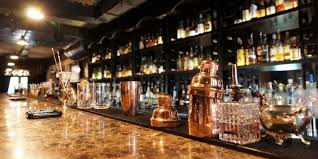
In order to carry out efficiently the service of all forms of wine and drink requested, the bar should have available all the necessary equipment for making cocktails, decanting wine, serving wine correctly, making fruit cups, and so on. The equipment should include the following items.
Primary Bar Equipment
1. Cocktail shaker: The ideal utensil for mixing ingredients that will not normally blend together well by stirring. A three-part utensil.
2. Boston shaker: Consists of two cones, one of which overlaps the other to seal in the ‘mix’. Made of stainless steel, glass, or plated silver. The mix is strained using a Hawthorn strainer.
3. Mixing glass: Like a glass jug without a handle, but has a lip. Used for mixing clear drinks which do not contain juices or cream.
4. Strainer: There are many types, the most popular being the Hawthorn. This is a flat spoon-shaped utensil with a spring coiled round its edge. It is used in conjunction with the cocktail shaker and mixing glass to hold back the ice after the drink is prepared. A special design is available for use with liquidizers and blenders.
5. Bar spoons: For use with the mixing glass when stirring cocktails. The flat ‘muddler’ end is used for crushing sugar and mint in certain drinks.
6. Bar liquidizer or blender: Used for making drinks that require pureed fruit.
7. Drink mixer: Used for drinks that do not need liquidizing, especially those containing cream or ice cream. If ice is required, use only crushed ice.
Additional Bar Equipment
Other items include:
- Assorted glasses
- Ice buckets and stands
- Wine baskets
- Water jugs
- Assorted bitters: peach, orange, angostura
- Cutting board and knife
- Coasters
- Refrigerator
- Cork extractor
- Soda siphons
- Coloured sugars
- Sink unit
- Glass washing machine
- Optics/spirit measures
- Wine measures
- Cooling trays
- Bottle opener
- Ice crushing machine
- Ice pick
- Ice making machine
- Drinking straws
- Cocktail sticks
- Carafes
- Wine and cocktail lists
- Glass cloths, napkins, and service cloths
- Small ice buckets and tongs
- Muslin and funnel
- Lemon squeezing machine
- Strainer and funnel
- Service salvers
- Wine knife and cigar cutter
- Bin
- Hot beverage maker
Food Items for Beverage Preparation
Examples include:
- Olives
- Worcestershire sauce
- Salt and pepper
- Nutmeg
- Angostura bitters
- Caster sugar
- Maraschino cherries
- Tabasco sauce
- Cinnamon
- Cloves
- Cube sugar
- Demerara sugar
Examples of Cocktail Bar Equipment
- Cocktail shaker
- Boston shaker
- Mixing glass with bar spoon
- Hawthorn strainer
- Jug strainer insert
- Mini whisk
- Straws
- Ice crusher
- Juice press
- Ice bucket and tongs
Examples of Additional Bar Equipment
- Bottle coaster
- Champagne star
- Wine bottle holder
- Vacu-pump
- Wine bottle openers
- Champagne bottle stoppers
- Wine funnel
- Wine bottle foil cutter
- Champagne cork strip
- Wine cork extractor
- Appetizer bowls and cocktail stick holder
- Measures on drip tray
- Cutting board and knife
- Cigar cutters
- Bottle stoppers
- Bottle pourer
- Crown cork opener
- Mini juice press
- Eggs
- Mini orange
- Coconut cream
- Cream
- Cucumber
- Lemon
- Lime
Read Also: Worm Infestation on Ruminant Animals: Symptoms and Treatment
Glassware Selection for Beverage Service
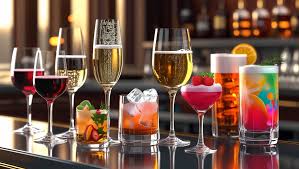
The choice of the right glass is a vital element if the cocktail is to be invitingly presented. Well-designed glassware combines elegance, strength, and stability, and should be fine-rimmed and of clear glass. All glassware should be clean and well-polished.
Planning and Designing a Dispense Bar
There are certain essentials necessary in the planning of every bar. They are factors that should be given prime consideration when planning for a fixed bar or when setting up a temporary bar for a particular function, as follows:
1. Strategic Bar Location
A major factor is the siting of the bar. The position should be chosen so that the bar achieves the greatest possible number of sales.
2. Adequate Bar Area Dimensions
The bar staff must be given sufficient area in which to work and move about. There should be a minimum of 1m (3ft 3in) from the back of the bar counter to the storage shelves and display cabinets at the rear of the bar.
3. Efficient Bar Layout
Very careful consideration must be given, in the initial planning, to the layout of the bar. Adequate storage must be provided, in the form of shelves, cupboards, and racks, for all the stock required and equipment listed. Everything should be easily to hand so that the bar staff do not have to move about more than necessary to provide easy and efficient service.
4. Plumbing and Power Requirements
It is essential to have hot and cold running water for glass washing. Power is necessary for the cooling trays, refrigerator, and ice-making machines.
5. Safety and Hygiene Standards
Great care must be observed to ensure that the materials used in the make-up of the bar are hygienic and safe. Flooring must be non-slip. The bar top should be of a material suited to the general décor that is hard-wearing, easily wiped down, and has no sharp edges.
The bar top should be of average working height – approximately 1m (3ft 3in) and a depth across the top from the bar to the service side of about 1.6m (20in).
In any dispense bar, all the equipment plays significant roles in determining good patronage. The planning, dimension, safety, and hygiene all have important roles in determining productivity. The basic definition of a dispense bar and the things commonly found in it have been well discussed.
Do you have any questions, suggestions, or contributions? If so, please feel free to use the comment box below to share your thoughts. We also encourage you to kindly share this information with others who might benefit from it. Since we can’t reach everyone at once, we truly appreciate your help in spreading the word. Thank you so much for your support and for sharing!