


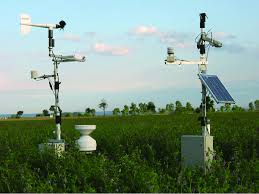
Observations of the physical and biological elements in the environment are essential in agricultural meteorology. Meteorological considerations are indispensable in assessing the performance of plants or animals because their growth is a result of the combined effect of genetic characteristics and their response to environment (nature).
Without quantitative data, agrometeorological planning, forecasting, research, and services by agrometeorologists cannot properly assist agricultural producers to survive and to meet the ever-increasing demands for food and agricultural by-products. Such data are also needed to assess the impacts of agricultural activities and processes on the environment and climate.
Read Also: Poultry Management during Winter Cold
Importance of Observing Climatic Elements in Agriculture
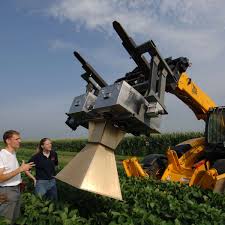
The physical elements of climate are observed in order to assist in the evaluation of actual and future land use potentials and of such constraints in agriculture as are caused by the environment. To meet these requirements, agricultural meteorology needs reliable, quantitative data on the relevant climatic elements.
Indispensable climatic elements in agricultural meteorology include those pertaining to geographical climatology and especially those permitting interpretation of physical processes in the lower layers of the atmosphere and the upper soil layers.
These include Temperature, Sunshine and Radiation, Wind, Clouds, Humidity, Rainfall, Soil temperature, and Soil moisture. Others include Dew, Fog, Open water evaporation, and Plant transpiration.
Temperature, Sunshine, and Radiation in Agricultural Processes
Temperature is the condition of a body which determines its ability to communicate heat to other bodies or to receive heat from them. For meteorological purposes, temperature is referred to the Celsius scale (degree centigrade).
0 degrees centigrade is the normal ice point; 100 degrees centigrade is the normal boiling point of water. The relationship to the absolute thermodynamic Kelvin scale is given by: T degrees Celsius + 273.15 = degrees Kelvin.
In agriculture, the spectral distribution of solar radiation, especially in photosynthesis assessments, is of great interest. Radiation fluxes to and from the earth’s surface are most important meteorological elements for heat and energy balance assessments.
Energy conversion from solar radiation mainly takes place on the surface of the soil and of plants. This phenomenon is of special interest in agricultural meteorology. The duration of sunshine (units: hr per day) allows for estimates of the energy available for physical and biological processes.
Rainfall and Dew Measurement for Crop Growth
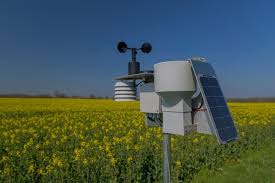
The amount of precipitation, rain, snow, ice, and dew which reaches the ground in a stated period is expressed as the depth to which it would cover a horizontal surface if there were no loss by evaporation, run-off, or infiltration, or if any part of the precipitation falling as snow or ice were melted (liquid equivalent).
As precipitation measurements should, as much as possible, be representative for a larger area, the choice of site, the form and exposure of the gauge, the prevention against loss by evaporation as well as the effects of wind and splashing are important points which have to be observed.
The amount of precipitation is measured in millimeters, the readings being made to the nearest 0.2 mm; 10 mm should read to 2% of the total. Depth of snow is given in centimeters. Ordinary rain gauges usually have the form of a collector above a funnel leading into a receiver.
Measurement of Dew in Arid Agricultural Zones
Dew, being essentially a nocturnal phenomenon and relatively small in amount, is nevertheless of much interest in arid zones. The amount of dew deposited on a given surface in a stated period is usually expressed in the same units as rainfall: mm depth of dew.
A direct method of measuring dew is to expose a weighted plate of hygroscopic material (gypsum, blotting paper) at sunset and re-weigh it after sunrise. This method requires accurate weighing and protection at sunrise to prevent evaporation.
Qualitative assessment of dew is obtained by exposing filter paper “sensors” with dew spots. When wetted by dew, the spots will spread to an extent which depends on both the duration and intensity of dewfall. Dew duration recorders operate to a far extent in the same way as the above-mentioned wetness recorders.
Read Also: Types and Recommended Duration for your Physical Activity
Wind Dynamics in Agricultural Meteorology
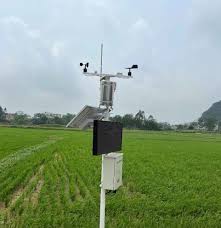
In agricultural meteorology, the effects of the kinetic energy transfer of wind to the plant/soil system as well as the effects of its mass transfer on the energy and water balance are of interest.
By its physical nature, two magnitudes are required when describing wind: its velocity and the direction from which it blows. Wind speed is usually indicated in: m/sec, km/h, or knots (= 1 nautical mile/h), but occasionally the non-linear Beaufort scale is used, which refers “forces” from 0 to 12 to the effects of wind on smoke, trees, or water surfaces.
The direction from which the wind blows is either given in accordance with the geographical directions (e.g., N, E, S, W) or in degrees: 1 to 360 (90 degrees = East, 180 degrees = South, 270 degrees = West, 360 degrees = North; 0 frequently stands for Calms). The Wind Vane (Direction) is a common instrument used in most weather stations.
An assembly of a vane plate (which can have many shapes) and a needle is mounted on a vertical axis, which allows it to revolve freely. As a result of the mechanical action of the wind on the vane, the needle will be turned in the direction from which the wind blows.
As the direction indicated by the vane oscillates around the equilibrium point of the airflow (which can change direction rapidly over time), big efforts have been undertaken to minimize this drawback by different designs.
The axis of the wind vane can be connected to a mechanical or electrical (contacts, potentiometer) device, which provides recording facilities and/or remote reading of the wind direction.
Advantages of Agrometeorological Observations
- To assist the management of agricultural activities—determining the time, extent, and manner of cultivation and other agricultural operations (sowing, harvesting, planting, application of biocides and herbicides, plowing, harrowing, rolling, irrigation, suppression of evaporation, design, construction, and repair of buildings for storage, animal husbandry, etc.) and different methods of conservation, industrial use, and transportation of agricultural products.
- To assess the performance of plants and animals in relation to climatic elements.
- To assess the impact of agricultural activities and processes on the environment and climate.
Disadvantages of Agrometeorological Observations
- Specialized and precision equipment are required for accuracy.
- Trained specialists are conditions for the management of a good weather station, which is costly.
- Interpretation of results may not necessarily follow the course of nature and so may be misleading.
Recommendations for Agrometeorological Practices
- It is recommended that research institutes and study centers (schools and colleges) should have functional weather stations to serve their immediate community.
- National annual weather forecasts should be taken seriously, while efforts should be made to have clientele weather forecasts and services.
- Weather stations and their component parts should be periodically maintained to ensure accuracy and precision.
Weather elements and their observations are essential to agriculture and the environment. Human behavior, especially farming operations, is driven by the changing weather elements.
The physical elements of climate are observed in order to assist in the evaluation of actual and future land use potentials and of such constraints in agriculture as are caused by the environment. It is in light of the above that each community and educational establishment should have a functional weather station.
Do you have any questions, suggestions, or contributions? If so, please feel free to use the comment box below to share your thoughts. We also encourage you to kindly share this information with others who might benefit from it. Since we can’t reach everyone at once, we truly appreciate your help in spreading the word. Thank you so much for your support and for sharing!