


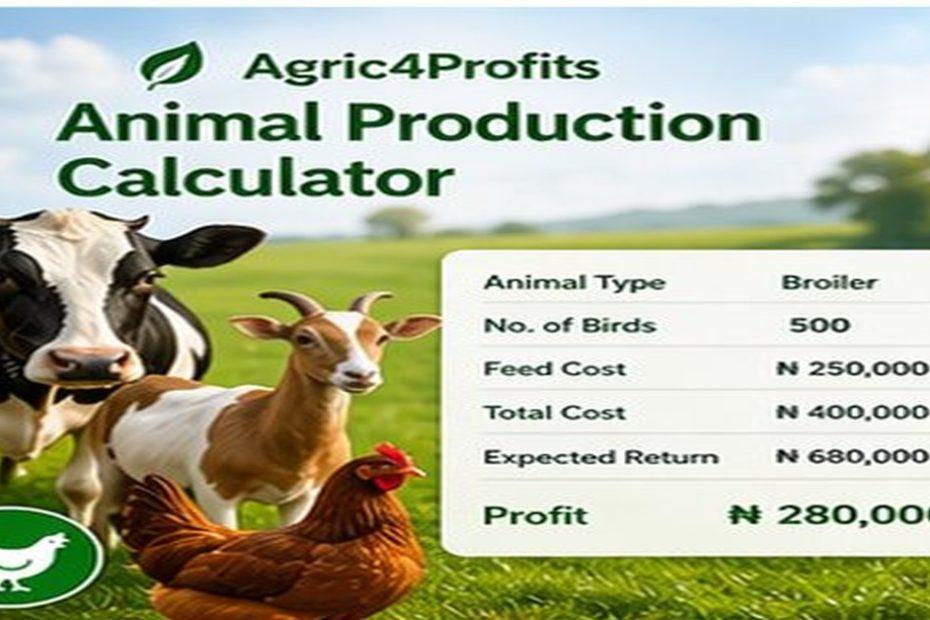
If you grow Bee (Apiary) in Botswana and you want to know exactly what you are making from your farm, you are in the right place. The free Agric4Profits Animal Production Calculator is right here on this page. No registration. No download. Just your real numbers.
At the end of your last production cycle on your Bee (Apiary) farm in Botswana, did you sit down and measure how your animals actually performed against what a well managed farm of the same type should be producing? Or did you count your animals, note what you sold, and move straight into the next cycle without looking at the numbers carefully?
Most smallholder Bee (Apiary) farmers in rural Botswana, those farming on a few plots or a hectare or two without access to formal farm management support, hardly benchmark their production performance against what is achievable. Not because they are not serious farmers. But because the benchmarks have not been easy to access and the tools to compare them have not been built for African smallholder conditions.
That is exactly what this free Animal Production Calculator is for. It does not matter how you farm, what methods you use, or how big your land is. This tool was built for Bee (Apiary) farmers in Botswana who want real answers based on their own real situation. And it will show you exactly where your Bee (Apiary) farm is performing well and where a small change could make a significant difference to your output.
Bee (Apiary) Farming in Botswana
Bee farming is more than just a livelihood; it is the heartbeat of many families and communities across Botswana. For a widow managing her small plot, the honey her bees produce not only sweetens her tea but also offers a means to send her children to school. In homes where employment opportunities are scarce, the joy of harvesting honey fills the kitchen with warmth and hope, creating a sense of identity and pride.
When you sit down for a meal, traditional dishes such as bogobe jwa lerotse, a porridge made richer with honey, or the festive seswaa, often accompanied by sweetened tea, tell stories of our culture. These beloved local flavors, enriched by bee products, bring families together, nourishing not just the body but also the spirit. The soothing taste of honey-infused drinks during gatherings adds depth to our celebrations and bonds us as a community.
🌿 Go Organic on Your Farm: Instead of harmful chemical pesticides and fertilisers, try our organic farming products — including neem oil spray, bio-pesticides, natural plant treatments, organic seeds and seedlings, suckers, and many more organic products that are safe for your health, your family, your soil and your harvest. Shop Now →
Looking beyond home kitchens, bee products have incredible value that extends into broader processing possibilities. From beeswax used in candles to propolis for health remedies, the value chain of bee farming is robust. There’s also potential in creating bee-derived products for animal feed and other commercial avenues that can uplift entire communities when pursued wisely.
Nutritionally, honey is a treasure trove filled with the natural sugars and antioxidants we need to thrive. It supports our health in vital ways, contributing to food security by providing energy and nutrients in areas where food scarcity can be a challenge. For many families, those small jars of honey are not a luxury but a crucial part of daily nourishment.
Economically, bee farming holds significant promise for smallholder farmers in Botswana. With proper management, a well-kept bee colony can yield substantial honey, making it an attractive source of income for households. The reality is that bees produce honey in a range that can comfortably support a family's needs when managed effectively.
Understanding the climate is crucial for successful bee farming. Botswana's rainfall patterns dictate when flowers bloom and when bees are most productive, aligning with the growing seasons. A farmer who knows when to expect rain and floral abundance can plan their bee farming activities to maximize both yield and profit.
🔧 Free Farm Tool Available: Use our free Agric4Profits Farm Tools to calculate your farm profits, formulate feeds, identify pests and diseases on both your crops and animal farms, plan your planting and harvesting season, including many more farm tasks to get free expert advice and recommendations — completely free, no registration required. Access Free Tools →
As the seasons change, so do market prices for honey. Farmers usually see lower prices during times of abundant supply following a good flowering season, while prices can climb as supplies dwindle. Awareness of these seasonal trends allows farmers to sell their honey at opportune times, ensuring better returns for their hard work.
The market chain for honey in Botswana provides a pathway directly connecting farmers to consumers, retailers, and local businesses. Developing relationships with cooperative societies and local markets can open doors to better pricing and stability. By understanding who seeks quality honey, farmers can position themselves advantageously, building a reputation for excellence.
One common mistake many bee farmers make is neglecting to monitor the health of their colonies closely. Bees thrive on careful management, and not recognizing early signs of illness can lead to declines in production. It’s essential to invest time in regularly inspecting hives and learning the telltale signs of trouble.
Farmers face various challenges in bee farming, from environmental changes affecting bee populations to pests invading hives. The journey of a bee farmer is often fraught with trials, but it is also filled with the resilience and love for nature that defines our culture. Acknowledging these challenges is the first step towards finding solutions together.
Every farmer should connect with local agricultural support through extension offices and cooperative societies. These resources can provide vital knowledge and guidance, fostering a spirit of collaboration among farmers to strengthen our community. Such support systems can be invaluable in overcoming challenges and celebrating successes.
💬 Have a Farming Question? Join thousands of farmers across Africa on the Agric4Profits Community — ask questions, share experiences and connect with agricultural experts. It is completely free. Ask Your Question Now →
These are not reasons to be discouraged. They are reasons to plan carefully, to track your costs and income honestly, and to use every tool available to make the most of what you grow. Which brings us to the calculator.
The Real Costs of Bee (Apiary) Farming in Botswana
Every Bee (Apiary) farming season begins with costs before a single income arrives. This is the reality of farming and it is not something to be afraid of. But it is something every farmer needs to understand clearly so that when the harvest comes, you know exactly how much you need to cover before you start making profit.
Here is what a typical Bee (Apiary) farming season in Botswana involves in terms of spending. Every cost depends on your own situation, your land and your methods.
| S/N | What Bee (Apiary) Farmers in Botswana Typically Spend On | Nature of the Cost |
|---|---|---|
| 1 | Bee colonies, whether purchased or sourced from fellow farmers | Acquiring your first bee colonies can be done through local suppliers or by connecting with experienced beekeepers. This initial investment is crucial, as your colonies will determine your honey production capacity and overall farm success. |
| 2 | Hives, whether handmade or commercially purchased | The type of hives you choose can influence your costs. Some farmers excel at building their own hives, while others find value in investing in ready-made options that may be more efficient. |
| 3 | Sugar and feeding materials, whether used sparingly or generously | These inputs can be a point of contention—some farmers choose to provide supplemental feeding during lean seasons, while others prefer to let their bees rely on natural forage. Understanding your bees' needs is key to this decision. |
| 4 | Protective gear, whether bought from a store or crafted at home | Investing in quality protective gear is essential for safety while tending to your bees. Some farmers find ways to make their own gear, while others opt for commercial products to ensure they are well protected. |
| 5 | Tools for hive management, whether repurposed from other tasks or specifically bought | Effective beekeeping requires specific tools, which some visionary farmers find from daily household items, while others prefer to invest in specialized gear to enhance their work. |
| 6 | Medications and treatments, whether sourced from local sources or designed for commercial use | All beekeepers must consider the health of their colonies, leading to some sourcing traditional remedies, while others invest in modern treatments. It’s all about finding what keeps your bees thriving. |
| 7 | Marketing, whether spread by word of mouth or through formal channels | This cost varies widely—some farmers build their businesses predominantly through personal connections, while others choose to develop a brand with marketing efforts that might come with higher expenses. |
| 8 | Transport, whether relying on a neighbor or paying for a haulage service | Getting your honey to market can be a challenge, with most farmers either organizing their own transport with friends and family or relying on commercial services to reach broader markets. |
Every item in that table depends on your own specific situation. A farmer who saves Bee (Apiary) from their last harvest and uses compost they made themselves from farm waste spends very differently from a farmer who purchases every input. The Animal Production Calculator works equally well for both. You enter what you actually spent and you get your own real result based on your own real farm.
What the Animal Production Calculator Does for Your Bee (Apiary) Farm
The Agric4Profits Animal Production Calculator is a free tool built specifically for African farmers. You put in your numbers and it gives you your result immediately. No waiting. No interpretation needed. Just clear honest numbers that show you exactly where your Bee (Apiary) farm stands financially.
Here is what the tool shows you:
- The total production cost of your bee farming operations, which helps you see where you stand financially and identify areas to improve. Understanding your overall costs can lead to better budgeting and resource allocation.
- Your expected income based on current market prices, allowing you to set realistic sales targets and align your production goals with market demands. This insight helps you maximize your efforts and secure a brighter financial future.
- The profitability of your honey production, which gives you a clear picture of what your efforts are yielding. Identifying profit margins helps you quickly discern whether your practices are sustainable or if adjustments are needed.
- The cost breakdown for each stage of honey production, which can guide you in managing your expenses effectively. This information allows you to focus on areas where costs can be minimized without sacrificing quality.
- The yield you can expect from your bee colonies based on your management practices, offering valuable insights into what is achievable under your specific conditions. Knowing your capabilities boosts confidence and aids in future planning.
- A comparative analysis of your production costs versus industry benchmarks, informing you about where you stand against peers. This understanding helps you gauge competitiveness and strive for improvement.
- The seasonal projections for pricing trends, enabling you to strategize the best times to sell your honey. This foresight can lead to improved timing in sales, securing better overall returns.
That break-even figure is the one that surprises most farmers the most. Many smallholder farmers sell their harvest without this number and as a result find themselves negotiating without a clear bottom line. Once you know your break-even point you know the minimum price you can accept and the minimum quantity you need to sell. That knowledge alone changes everything about how you approach the market.
How to Use the Animal Production Calculator for Your Bee (Apiary) Farm
You do not need to register. You do not need to download anything. It works right here on your phone or computer.
A. What You Enter
- Your animal type
- The number of animals in your system
- The production stage or age of your animals
- Your average daily production per animal
- Your production cycle length in days
- Your mortality rate as a percentage
B. What You Do
- Select your animal type from the dropdown
- Enter the number of animals
- Enter your production performance data
- Click Calculate
C. What You Will See
- Your total production output per cycle
- Your production per animal
- Your mortality-adjusted output
- How your farm compares to African benchmark performance
- Your performance rating — below, at, or above average
- An estimated revenue based on current market prices
Use the Animal Production Calculator Right Here (It Is Free)
The Agric4Profits Animal Production Calculator is below. Enter your real Bee (Apiary) farming figures and see your result right now on this page.
📖 Want to Go Deeper on This Topic?
Our expert agricultural ebooks cover poultry, fish farming, different crops production, snail farming, organic farming, mushrooms, sheep, cattle, flowers, pig farming, goat farming, agribusiness, etc. in practical step-by-step detail — written by agricultural professionals for African farmers.
Browse All Farming Ebooks →What the Tool Will Show You
A well managed Bee (Apiary) farm tracks production carefully so nothing is left to guessing. Enter your production figures into the calculator above to see how your farm compares to African benchmarks and where your biggest opportunities for improvement are.
Some farmers are pleasantly surprised to discover that they were doing better than they initially thought, inspiring newfound motivation in their practices. Others find that small adjustments in cost management could lead to significant improvements, opening doors to new opportunities for revenue and efficiencies. Either way, knowing your real numbers puts you in a position of strength. You stop guessing and start deciding.
Practical Tips for Bee (Apiary) Farmers in Botswana
1. Monitor your colonies regularly for signs of health: Consistent monitoring of your bee colonies is crucial for their productivity and longevity. Farmers who neglect this duty often watch their honey yields dwindle, while those who check on their colonies regularly can respond quickly to emerging issues and ensure a thriving hive.
2. Educate yourself about local flora: Understanding the native plants available for foraging can greatly enhance honey production. Ignorance of the floral calendar can leave some farmers wondering why their bees aren’t producing as expected, whereas those who leverage knowledge of when and where to find blooms can significantly boost honey yields.
3. Use organic methods as much as possible: Employing traditional and organic farming practices can improve your honey quality and marketability. Farmers who rely on chemical treatments may compromise the purity of their honey, while those who go natural often find a warm reception in local markets.
4. Join local beekeeping groups: Engaging with other bee farmers provides invaluable opportunities for knowledge exchange and support. Farmers who isolate themselves from community networks miss out on collaborative learning, while those who connect can share successes and challenges that enhance their craft.
5. Experiment with different hive types: Not all hives suit every farmer's needs or local conditions. Stubbornly sticking to one style may restrict potential honey production, while being flexible and exploring various hive designs may lead to a boost in yields and ease of management.
6. Track expenses and income closely: Keeping a precise record of costs will help you understand your financial position. Farmers who neglect this often find themselves confused about profitability, while those who diligently document their finances can make informed decisions that lead to improved returns.
7. Stay informed about market trends: Keeping up with changes in honey pricing will help you time your sales strategically. Those who are oblivious to market shifts may miss lucrative opportunities, while informed farmers can capitalize on favorable selling conditions.
8. Build relationships with local buyers: Establishing strong ties with buyers can enhance your market stability. Farmers who only reach out to buyers sporadically may miss out on consistent sales, while those who maintain good connections build trust and a reliable customer base.
9. Use quality containers for your honey: Ensuring your honey is packaged well is integrally linked to its perceived value. Those who underestimate this aspect may see lower sales, whereas presenting your honey in attractive packaging can dramatically improve marketability.
10. Reserve some honey for personal use: Enjoying the fruits of your labor is just as important as selling. Farmers who only focus on sales may forget to have home supplies, while those who reserve honey for family use appreciate the sweet rewards of their hard work.
Frequently Asked Questions on Animal Production Calculator for Bee (Apiary) Farming in Botswana
1. What are the best practices for maintaining a healthy bee colony?
Regular inspections and attention to environmental factors are key to maintaining a healthy bee colony. Farmers should keep an eye out for pests and diseases while ensuring that bees have enough food sources. Additionally, creating a supportive habitat can foster a productive hive.
2. How can I improve honey production in my apiary?
Improving honey production is about understanding the pollination needs of your bees and the local flora. Planting diverse flowering plants can offer your bees continuous food sources. Regular hive management practices like ensuring good queen health are also crucial for maximizing production.
3. What should I consider when pricing my honey?
Pricing your honey requires an understanding of both production costs and market demand. Knowing your costs will help you find a price point that maintains profitability while being competitive. Observing local market prices and adjusting accordingly will contribute to your selling strategy.
4. How do I know when it's the right time to harvest honey?
Harvesting at the right moment is essential for quality. Seasons when most broods are capped indicate that honey is ready. Observing your bees' behavior, such as reduced foraging, can signal that it’s time to harvest.
5. What challenges should I be prepared for as a bee farmer?
Bee farming comes with unique challenges, including pests and diseases, unpredictable weather patterns, and market fluctuations. Effective management requires being adaptable to these challenges while staying informed about innovations in beekeeping practices.
6. How can the calculator assist in my beekeeping endeavors?
The calculator acts as a comprehensive tool for managing costs and tracking your honey production progress. It helps you see where your money is going and where you can improve profitability. Such insights can empower you to be a more informed and effective bee farmer.
7. Can I use the calculator for planning future investments?
Absolutely! The tool can help project future costs and income based on your current practices. This knowledge enables you to make wiser decisions about investments in equipment or expansion.
8. What insights can I gain from analyzing my production costs?
Analyzing production costs can reveal inefficiencies in your operations. You may discover opportunities to reduce waste or increase productivity, leading to improved profitability. Knowing your costs in detail empowers you to make better management choices.
9. Is it beneficial to compare my results with other farmers?
Yes, comparing your results with peers can provide valuable benchmarks for your own operations. It helps you understand industry standards, identify areas for improvement, and foster collaboration among local beekeepers.
10. Can the calculator help me develop better selling strategies?
The calculator can provide insights that enhance your selling strategies by allowing you to analyze cost and revenue data comprehensively. With this information in hand, you can strategically position your honey in the market for better returns.
Knowing your profit from your Bee (Apiary) farm is powerful. But profit from one season is just the beginning. The farmers who truly grow their farms over time are the ones who move from knowing their numbers to building a complete plan around those numbers. A plan that covers not just this season but the next three years.
Building that plan does not require a university education or an expensive consultant. It requires a structured approach that takes you through every important question one step at a time. The Agric4Profits FarmSmart Business Planner was built to answer every one of those questions for any farmer across Africa, in any of the 54 African countries, in a way that any farmer can follow and any bank or investor can read.
Once you understand your Bee (Apiary) production figures, the next step is building a complete farm business plan around them. The Agric4Profits FarmSmart Business Planner guides you through your full farm plan in six steps, from budget and recommendation to cost breakdown, revenue projection and market strategy. Steps 1 to 5 are completely free. Your complete bankable business plan is available with a Pro membership.
Start Your Free Farm Business PlanOther Free Farming Tools Available on Agric4Profits
Agric4Profits offers 23 free professional farming tools covering every aspect of African agriculture. Here are all the other tools available to you completely free.
- Farm Profit Calculator: Calculate your exact farm profit, return on investment and break-even point in your local African currency.
- Feed Formulation Calculator: Formulate the most cost-effective feed for your livestock and fish using locally available ingredients.
- Crop Production Calculator: Calculate your full crop production costs, yield estimates and profit per hectare.
- Farm Finance Calculator: Plan your farm cash flow, loan repayments and complete financial projections before you invest.
- Planting and Harvest Calendar: Find the best planting window and expected harvest dates for any crop in any African country.
- Pest and Disease Identifier: Identify what is attacking your crops or animals and get organic treatment recommendations immediately.
- Processing Storage and Value Addition Analyzer: Find out whether processing your harvest increases your profit and by exactly how much.
- Market Price Tracker: Compare prices at different markets and find the most profitable destination for your harvest.
- Soil and Fertility Guide: Diagnose your soil deficiencies and get organic amendment recommendations for your specific crops.
- Processing Yield Calculator: Calculate your exact processing yield and true cost per kilogram for any farm produce.
- Storage and Loss Calculator: Find out how much you are losing in storage and how much you would save by improving your storage method.
- Market Access and Transport Tool: Calculate your true net profit after transport costs and find the most profitable market to sell at.
- Farm Land Measurement and Unit Converter: Convert any land measurement unit used across Africa instantly into every other unit.
- Livestock Vaccination and Treatment Scheduler: Generate a complete vaccination and treatment calendar for your livestock with every date and dosage.
- Livestock Weight Estimator: Estimate the live weight, carcass weight and selling value of your livestock before going to market.
- Crop Spacing and Seed Rate Calculator: Calculate exactly how many seeds or seedlings you need for your farm size and preferred spacing.
- Irrigation and Water Management Calculator: Calculate your daily water requirement and full irrigation schedule for any crop and farm size.
- Fish Pond Design Calculator: Design your fish pond and calculate your full production plan, expected harvest and profit projection.
- Composting and Organic Input Calculator: Build your optimised compost recipe from materials available on your own farm and calculate the application rate.
- Farm Record Keeping Template Generator: Generate a complete customised record keeping system for your specific farm type and categories.
- Women in Agriculture Free Consultancy: Get a personalised farming action plan and expert guidance completely free for women farmers across Africa.
- FarmSmart Business Planner: Build your complete farm business plan in six steps covering budget, costs, revenue, market strategy and your bankable plan.
🌱 Take Your Farming Further With Agric4Profits
Based on what you just read, here are free resources and products from Agric4Profits that can help your farm right now:
- 🛒 Visit Our Marketplace — Organic neem oil, bio-pesticides, seeds and farming products
- 📚 Read Premium Content — Advanced guides for serious and profitable farming
- 🎓 Join Our Free Academy — Structured free training for farmers across Africa
- 🔧 Use Our Free Farm Tools — Profit calculators, feed formulation, pest identifier and more
- 💬 Join Our Farming Community — Connect with farmers across all 54 African countries
- ❓ Ask a Farming Question — Get answers from experienced farmers and agricultural experts
Please cite this content in academic work, research, or publications.