


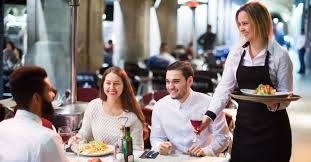
The food and beverage sector, closely tied to agricultural products like crops and livestock, is a unique area where basic technical skills significantly influence profitability and customer patronage.
Such skills involve utilizing service equipment, carrying plates, using a service salver, handling service plates and glasses, and managing large trays.
This article examines the essential skills needed for food and beverage service, emphasizing their role in enhancing customer satisfaction and operational efficiency, which supports agricultural supply chains.
Read Also: Goats Farming Complete Practical Guide
Essential Technical Skills in Food and Beverage Service
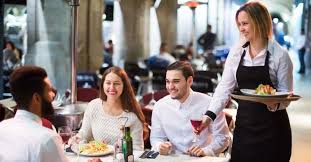
Six fundamental technical skills for food and beverage service are identified below, along with examples of their application.
| Technical Skill | Examples of Application |
|---|---|
| 1. Holding and using a service spoon and fork and other service equipment | For the service of food at a customer’s table, especially for silver service and for serving at a buffet |
| 2. Carrying plates | When placing and clearing plates from a customer’s table |
| 3. Using a service salver (round tray) | For carrying glasses, carrying tea and coffee services, as an underliner for entrée dishes, and for potato and vegetable dishes |
| 4. Using a service plate | For carrying items to and from a table, including clean cutlery, clearing side plates and knives, crumbing down, clearing accompaniments |
| 5. Carrying glasses | Carrying clean glasses by brand or on a salver and for clearing dirty glasses from a service area |
| 6. Carrying and using large trays | For bringing equipment or food and beverage items to the service area and for clearing used equipment from the service area |
Holding and Using a Service Spoon and Fork in Food Service
Expertise in this technique can only be developed with practice. The purpose of the service spoon and fork is to enable the waiter to serve food from a flat or dish onto the customer’s plate quickly and to present the food on the plate well.
The service fork should be positioned above or on top of the service spoon. The key to developing this skill is locking the ends of the service spoon and fork with the small finger and the third finger, as illustrated.
The spoon and fork are maneuvered with the thumb and the index and second fingers. Using this method, food items may be picked up from the serving dish between the service spoon and fork.
Alternatively, the service fork may be turned to mold with the shape of the items being served, for example, when serving bread rolls. There are occasions where two service forks may be used, for example, when serving fillets of fish, as this makes the service of these food items easier.
When using a serving spoon and fork for serving at a sweet or cheese trolley or at a buffet or guéridon, spoons, scoops, small sauce ladles, and larger soup ladles may be used.
Read Also: Introduction to Ruminant Animals Production
Carrying Plates in Food Service
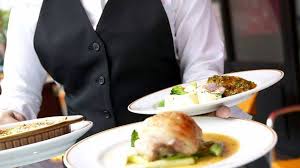
Clean plates can be carried in a stack, using both hands, or using a tray. When carrying clean plates to be placed on the customer’s table, a single hand is used to hold the plates (usually the left hand), and the right hand is used to place the plates at each cover on the customer’s table. If the plates are hot, the plates are held with a service cloth placed on the palm of the left hand.
A separate service cloth is then used on the right hand to hold the hot plates when placing them in front of the customer.
When carrying plates of pre-plated foods and when clearing plates from a customer’s table, a single hand is used to hold the plates (usually the left hand), and the right hand is used to place and remove plates from the customer’s table. Special hand positions are used as follows:
- The initial hand position for the first plate. Care must be taken to ensure that the first plate is held firmly as succeeding plates build up from here. The second plate will rest firmly on the forearm and the third and fourth fingers.
- The second plate is positioned on the left (holding) hand. To clear properly ensures efficiency, avoids the possibility of accidents, and creates minimal inconvenience to customers.
Well-developed clearing techniques enable more to be cleared in less time and in fewer journeys between the sideboard or workstation and the customer’s table.
In addition, clearing properly allows for stacking dirties neatly and safely at the sideboard or workstation.
Using a Service Salver in Beverage Service
A service salver is a round, normally silver or stainless steel tray (but now also sometimes of wood or plastic). A napkin (folded flat) is placed on the tray to help prevent items slipping on the tray as they are carried. There are also special non-slip mats now used instead of napkins. The service salver may be used to:
- Carry clean glasses to and from dirty glasses from a customer’s table.
- Carry clean cutlery to and from a customer’s table.
- Place clean cutlery on the table.
- Place clean cups and saucers on the table.
- Provide an underliner when silver-serving vegetables.
Carrying Glasses for Beverage Service
When carrying clean glasses on the service salver, they should be placed right side up to reduce the risk of them toppling over.
When placing on the table, the waiter should hold the salver in the left hand behind the customer and then place the glass at the top right-hand corner of the cover and the right way up.
The waiter should only hold glasses by the stem to ensure that the bowl of the wine glass is not touched; otherwise, finger marks will be left on the glass bowl.
Carrying Clean Cutlery in Food Service
When placing clean cutlery on a table or removing it, the items can be carried on a service salver. This is more efficient, hygienic, and safer, and generally more professional, than carrying these items in bunches in the hands.
The blades of the knives should be placed under the arch in the middle of the forks, and if carrying sweet spoons and forks, the prongs of the fork should go under the arch in the middle of the spoon.
The reason for this is to help hold the items steady on the service salver. Bearing in mind that the handles of the cutlery are generally the heaviest parts, this method prevents them from sliding about too much.
Carrying Cups and Saucers in Beverage Service
Tea and coffee cups are carried using a service salver by stacking the saucers, cups, and teaspoons separately. Then, before placing the cup, saucer, and teaspoon on the table, the cup is put into a saucer, together with a teaspoon, and then the whole service is placed in front of the customer.
This is a speedier and safer method (especially when larger numbers are involved) than carrying individual cups, saucers, and teaspoons to the table one by one.
Cups and saucers are placed on the table at the right-hand side of the customer. The reason for this is that the beverage will most likely be served from the right.
This avoids stretching across the front of the customers when laying the beverage service or when serving the beverage.
Silver Serving Vegetables in Food Presentation
When silver-serving vegetables and potatoes at the table, an underliner should be used to hold either one large vegetable dish or a number of smaller ones, depending on the customer’s orders. The purpose of the underliner is to:
- Add to the presentation of the food being served.
- Give the waiter more control when using the service spoon and fork to serve the vegetables from the vegetable dish onto the customer’s plate.
- Provide greater protection in case of spillage, therefore not detracting from the presentation of the food on the plate or the overall table presentation.
- Give the waiter added protection against heat and possible spillage on the uniform.
Using a Service Plate in Food Service
A service plate is a joint plate with a napkin upon it. It has several uses during meal service:
- For placing or removing clean cutlery from the table.
- For clearing side plates and side knives.
- For crumbing down after the main course or any other stage of the meal if necessary.
- For clearing accompaniments from the table as and when necessary.
Clearing Side Plates and Knives in Food Service
When clearing dirty side plates and side knives from the customer’s table, the use of a service plate provides a larger area on which to stack the side knives and any debris.
Using hand positions, the side plates may be stacked above the service plate, and all the debris in a separate pile, together with the side knives laid flat upon the service plate. This is a much safer and speedier method, especially when larger numbers are involved.
Crumbing Down for Table Maintenance
To freshen up the appearance of a table after the main course has been consumed and all dirty items of equipment cleared from the table, a procedure known as “crumbing down” is used.
The waiter brushes any crumbs and other debris lying on the tablecloth onto the service plate with the aid of either a folded service cloth or a small brush designed for the purpose. There are also metal crumb scoops that can be used.
Clearing Accompaniments in Food Service
The service plate is also used to clear items such as the cruet, cayenne pepper, pepper mill, or other accompaniments, which may not already be set on an underplate.
Carrying Glasses for Beverage Service
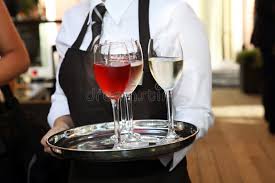
There are two basic methods of carrying glasses in the food and beverage service areas: by hand or on a service salver.
1. Carrying Glasses by Hand
Wine goblets should be positioned between alternate fingers as far as possible. The wine goblets should only be carried in one hand, allowing the other hand to remain free to steady oneself in case of emergencies.
This method allows wine goblets that are already polished to be handled. They can be carried about the room and set in their correct position on the table without the bowl of the glass being touched.
2. Carrying Glasses on a Service Salver
The method of carrying clean wine goblets about the restaurant uses the service salver. A service cloth can be placed underneath the salver on the palm of the hand to allow the service salver to be rotated more easily to remove each wine goblet in turn by the base and set it on the table.
The service salver is also used for clearing dirty wine goblets from the table. The first dirty wine goblet cleared should be placed on the service salver nearest to the server.
As the dirties are cleared, they should be placed on the service salver to ensure a better and more even distribution of weight to lessen the likelihood of accidents occurring.
Glass racks are often used to carry glasses during the setting up of functions. These racks enable the transportation of glasses in bulk once they have been washed and polished at a central point.
Carrying Trays in Food and Beverage Service
Trays are used for:
- Carrying food from the kitchen to the restaurant sideboard.
- Service in rooms and lounges.
- Clearing from sideboards.
- Clearing from tables (when the customer is not seated at the table).
- Carrying equipment.
The correct method of holding and carrying an oblong tray is to position the tray lengthwise onto the forearm and support it by holding the tray with the other hand.
The various technical skills that can boost performance in the food and beverage industry, reliant on agricultural products, have been highlighted.
Permanent service staff are usually experienced individuals who can handle any job concerning functions and banqueting. They generally perform most of the mise-en-place before the function (the laying of tables).
Do you have any questions, suggestions, or contributions? If so, please feel free to use the comment box below to share your thoughts. We also encourage you to kindly share this information with others who might benefit from it. Since we can’t reach everyone at once, we truly appreciate your help in spreading the word. Thank you so much for your support and for sharing!