


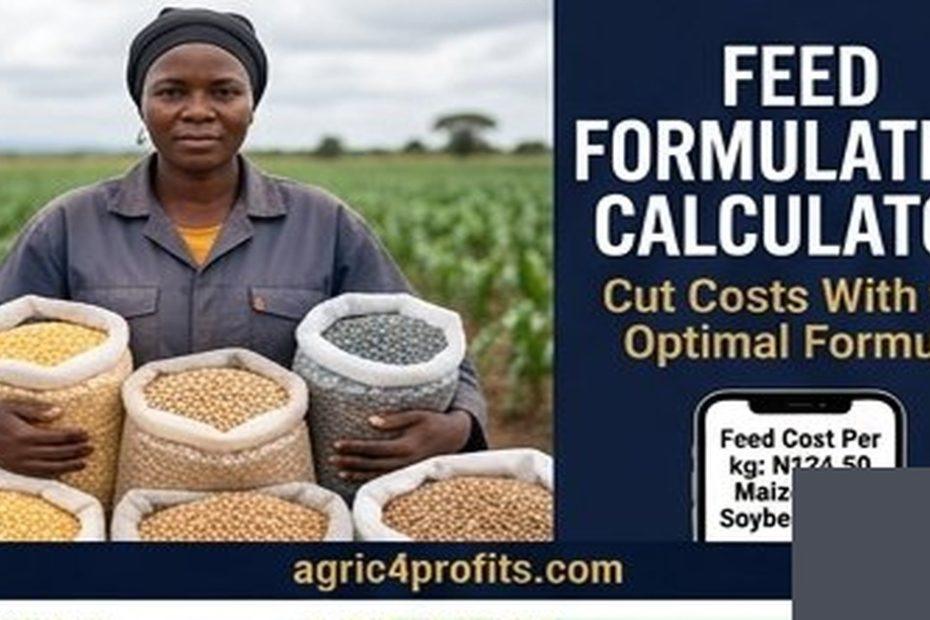
If you grow Grasscutter (Cane Rat) in Libya and you want to know exactly what you are making from your farm, you are in the right place. The free Agric4Profits Feed Formulation Calculator is right here on this page. No registration. No download. Just your real numbers.
Every time you buy a bag of commercial feed for your Grasscutter (Cane Rat) in Libya, do you know exactly what you are paying for and whether you could produce the same quality for less using ingredients already available to you? Or do you buy the same feed as always because it feels easier than working out the numbers yourself?
Most smallholder Grasscutter (Cane Rat) farmers in rural Libya, those farming on a few plots or a hectare or two without access to formal farm management support, hardly take the time to calculate what their feed is actually costing them per kilogram. Not because they do not care. But because formulating feed has always seemed complicated and reserved for nutritionists with expensive software.
That is exactly what this free Feed Formulation Calculator is for. It does not matter how you farm, what methods you use, or how big your land is. This tool was built for Grasscutter (Cane Rat) farmers in Libya who want real answers based on their own real situation. And it will show you savings on your feed costs that could change the entire profitability of your Grasscutter (Cane Rat) operation.
Grasscutter (Cane Rat) Farming in Libya
Grasscutter farming is not just an agricultural venture in Libya; it is a lifeline for many families. For a single mother struggling to provide for her children, raising grasscutters means food on the table and school fees for her children. These gentle creatures symbolize hope, resilience, and abundance for communities that often face economic hardships. Families gather to enjoy the fruits of their labor, sharing meals and creating bonds over dishes prepared from these animals.
In Libya, dishes like 'Kebda bil Hammour', featuring grasscutter meat, are cherished culinary delights. The savory stews and grilled specials from grasscutter offer a taste of tradition that brings families together. For many, enjoying a meal that includes grasscutter meat is not just about nutrition, but a celebration of heritage and local culture. These dishes remind us that farming is intertwined with our identities and communal experiences.
🌿 Go Organic on Your Farm: Instead of harmful chemical pesticides and fertilisers, try our organic farming products — including neem oil spray, bio-pesticides, natural plant treatments, organic seeds and seedlings, suckers, and many more organic products that are safe for your health, your family, your soil and your harvest. Shop Now →
The grasscutter is not just a source of food for the household; it also plays a role in the broader economy. Beyond home kitchens, the meat is processed for markets, contributing to the local economy through commercialization. Byproducts such as animal feed and organic fertilizer enhance agricultural productivity, creating a valuable value chain that supports local livelihoods. Farmers can also explore possibilities in producing grasscutter-derived products, like oil or pet food, broadening their income sources.
Nutritionally, grasscutter meat is a treasure trove of essential nutrients, rich in proteins and lower in fat compared to other meats. This makes it an important food source, enhancing food security and providing health benefits to families. By including grasscutter in our diets, we promote healthier lifestyles and sustainability, as they thrive in local environments, requiring fewer resources than conventional livestock.
The economic significance of grasscutter farming is profound in Libya, where smallholder farmers can expect realistic yields from their colonies. A well-managed farm can produce a substantial number of grasscutters annually, providing a steady stream of income. The potential for profit attracts many farmers, solidifying the role of grasscutter farming as a viable enterprise amidst the agricultural landscape.
When it comes to growing conditions, grasscutters thrive in the warm, subtropical climate of Libya. The rainfall patterns support a conducive environment for their breeding and growth, aligning with traditional agricultural practices. Farmers who understand these climate factors can optimize their farming efforts to ensure a healthier population of grasscutters while adapting to the usual challenges of farming in fluctuating weather conditions.
🔧 Free Farm Tool Available: Use our free Agric4Profits Farm Tools to calculate your farm profits, formulate feeds, identify pests and diseases on both your crops and animal farms, plan your planting and harvesting season, including many more farm tasks to get free expert advice and recommendations — completely free, no registration required. Access Free Tools →
Prices for grasscutter meat can fluctuate throughout the farming cycle. Typically, they rise during festive seasons when demand peaks, while falling during lean periods when supply exceeds demand. Farmers should stay attuned to these market signals to maximize their returns, ensuring they sell at optimum times while meeting consumer needs.
The market dynamics of grasscutter farming in Libya are intricate. Buyers range from local markets to regional wholesalers, and understanding this chain can empower farmers to position themselves effectively. By building relationships with buyers, farmers can negotiate better prices and ensure a steady market for their products.
One common mistake that can cost grasscutter farmers is underestimating the importance of proper feeding and nutrition. Many smallholders may misjudge how much feed is required, resulting in stunted growth or lower productivity. Investing time and resources in understanding the nutritional needs of grasscutters lays the foundation for a more profitable venture.
Grasscutter farmers also face challenges such as disease management and market access. These hurdles require diligence and adaptability, encouraging farmers to share experiences and solutions among their communities. By working together and seeking mutual improvement, challenges become less daunting and pave the way for collective success.
Farmers are encouraged to reach out for local agricultural support, whether through extension offices or cooperatives. These resources are invaluable for gaining insights into better farming practices and accessing funding opportunities. Mutual support strengthens the agricultural community, enhancing the collective knowledge and productivity of many smallholder farmers.
💬 Have a Farming Question? Join thousands of farmers across Africa on the Agric4Profits Community — ask questions, share experiences and connect with agricultural experts. It is completely free. Ask Your Question Now →
These are not reasons to be discouraged. They are reasons to plan carefully, to track your costs and income honestly, and to use every tool available to make the most of what you grow. Which brings us to the calculator.
The Real Costs of Grasscutter (Cane Rat) Farming in Libya
Every Grasscutter (Cane Rat) farming season begins with costs before a single income arrives. This is the reality of farming and it is not something to be afraid of. But it is something every farmer needs to understand clearly so that when the harvest comes, you know exactly how much you need to cover before you start making profit.
Here is what a typical Grasscutter (Cane Rat) farming season in Libya involves in terms of spending. Every cost depends on your own situation, your land and your methods.
| S/N | What Grasscutter (Cane Rat) Farmers in Libya Typically Spend On | Nature of the Cost |
|---|---|---|
| 1 | Breeding stock, whether sourced from local sellers or home-raised | The choice between buying new stock or relying on your existing breeding animals can influence your initial costs significantly. Buying from reputable sellers can give you higher quality livestock but at a premium, while raising your own can be cost-effective if you're careful about breeding. |
| 2 | Feeding, whether using homemade mixtures or store-bought feeds | The costs of feed can vary significantly, depending on whether you prepare it yourself or buy ready-made options. Creating your own feed can lower costs when utilizing local grains, but it requires knowledge of proper ratios for a balanced diet. |
| 3 | Housing, whether grand structures or simple shelters | How you construct your grasscutter housing influences both your initial investment and ongoing maintenance costs. A well-planned shelter provides protection from weather extremes, while basic shelters might require frequent repairs. |
| 4 | Health supplies, whether purchased from local shops or sourced from cooperatives | Access to veterinary supplies can vary based on location and farmer networks. Some farmers prefer to buy supplies from local vendors, while others utilize cooperative resources for potentially lower prices on bulk purchases. |
| 5 | Water provision, whether using boreholes or rainwater collection | How you choose to supply water to your grasscutters can impact both expense and quality. While water from boreholes might be more consistent, rainwater collection can be a sustainable and economical choice if done correctly. |
| 6 | Labor, whether family help or hired hands | Depending on your operation's scale, you might rely on family members for daily tasks or need to bring in workers to manage higher demands. Engaging family can foster a strong sense of community but might limit capacity compared to hiring skilled labor. |
| 7 | Transportation, whether using bicycles or vehicles | How you transport your grasscutters to market can impact your overall costs significantly. While bicycles may reduce immediate costs, owning or renting a vehicle may provide faster access to distant markets to capitalize on better prices. |
| 8 | Marketing, whether through social media or traditional word-of-mouth | Approaches to marketing can greatly affect the price you receive for your grasscutters. Utilizing social media extends your reach, potentially increasing sales while relying solely on word-of-mouth can limit potential customer base in your area. |
Every item in that table depends on your own specific situation. A farmer who saves Grasscutter (Cane Rat) from their last harvest and uses compost they made themselves from farm waste spends very differently from a farmer who purchases every input. The Feed Formulation Calculator works equally well for both. You enter what you actually spent and you get your own real result based on your own real farm.
What the Feed Formulation Calculator Does for Your Grasscutter (Cane Rat) Farm
The Agric4Profits Feed Formulation Calculator is a free tool built specifically for African farmers. You put in your numbers and it gives you your result immediately. No waiting. No interpretation needed. Just clear honest numbers that show you exactly where your Grasscutter (Cane Rat) farm stands financially.
Here is what the tool shows you:
- The total feed cost is calculated to help you understand the investment needed for nutrition, essential for optimal growth and production of your grasscutters.
- The required nutrient composition outlines what your feed must contain so that your grasscutters remain healthy, ensuring they achieve their best growth rates.
- The estimated growth rate gives you a target to aim for, helping you measure your success and adjust inputs if necessary.
- The cost per kilogram of weight gain shows you how efficient your feeding practices are, allowing you to make adjustments to avoid unnecessary expenses.
- The projections for meat yield inform you about potential returns, serving as a guide to set realistic financial goals for your farm.
- The seasonality of feed prices helps you time your purchases wisely, enabling you to lock in the best prices without compromising your grasscutter’s nutrition.
- The overall budget impact illustrates how these feeding strategies can influence your total farm expenses, guiding financial planning for the future.
That break-even figure is the one that surprises most farmers the most. Many smallholder farmers sell their harvest without this number and as a result find themselves negotiating without a clear bottom line. Once you know your break-even point you know the minimum price you can accept and the minimum quantity you need to sell. That knowledge alone changes everything about how you approach the market.
How to Use the Feed Formulation Calculator for Your Grasscutter (Cane Rat) Farm
You do not need to register. You do not need to download anything. It works right here on your phone or computer.
A. What You Enter
- Your animal type and production stage (starter, grower, finisher, or layer)
- Your available ingredients and their local prices
- The nutrient values for each ingredient
- Your target batch size in kilograms
B. What You Do
- Select your animal type and production stage
- Add your ingredients one by one with their prices
- Enter the nutrient values for each ingredient
- Click Formulate
C. What You Will See
- Your optimised ingredient mix in kilograms per 100kg batch
- The protein and energy levels your formula achieves
- Your cost per kilogram of formulated feed
- Your total cost per batch
- Your savings compared to buying commercial feed
Use the Feed Formulation Calculator Right Here (It Is Free)
The Agric4Profits Feed Formulation Calculator is below. Enter your real Grasscutter (Cane Rat) farming figures and see your result right now on this page.
📖 Want to Go Deeper on This Topic?
Our expert agricultural ebooks cover poultry, fish farming, different crops production, snail farming, organic farming, mushrooms, sheep, cattle, flowers, pig farming, goat farming, agribusiness, etc. in practical step-by-step detail — written by agricultural professionals for African farmers.
Browse All Farming Ebooks →What the Tool Will Show You
A well managed Grasscutter (Cane Rat) farm keeps feed costs as low as possible without sacrificing the health and growth of the animals. Enter your available ingredients and local prices into the calculator above to get your optimised feed formula and see exactly what your feed is costing you per kilogram.
Many grasscutter farmers discover that they were doing significantly better than they initially thought after using the calculator. Conversely, others realize that minor adjustments in their feed strategies could lead to major financial benefits. Either way, knowing your real numbers puts you in a position of strength. You stop guessing and start deciding.
Practical Tips for Grasscutter (Cane Rat) Farmers in Libya
1. Understand your grasscutter's diet: Knowing exactly what your grasscutters need nutritionally is critical. Some farmers underestimate the importance of water and quality feed, leading to slow growth. By ensuring a balanced diet, including local grains and herbs, farmers see more vibrant and productive animals compared to those who do not prioritize this.
2. Optimize your breeding techniques: Focusing on breeding practices can greatly influence the health of your overall stock. Farmers who select the fittest individuals for reproduction often reap the benefits of a stronger, more resilient herd. Those who do not take breeding seriously may find themselves managing more sickness and lower yields.
3. Keep accurate records of expenses: Tracking your costs meticulously helps in identifying areas where savings can be made. Many farmers who neglect this aspect often find themselves surprised at their profits each season. In contrast, consistently recording every expense allows you to make informed adjustments for better financial management.
4. Maintain optimal housing conditions: Providing adequate shelter is essential for the well-being of your grasscutters. Farmers who invest in proper housing see healthier animals and higher productivity compared to those who skimp on this important investment. A well-ventilated and clean environment helps reduce disease risks significantly.
5. Collaborate with fellow farmers: Sharing experiences and insights within your farming community can uncover valuable strategies and solutions. Connections often lead to collaborations that enhance productivity and market access. Isolating yourself could limit your growth and knowledge in a world where collective wisdom is key.
6. Use the calculator regularly: Regularly revisiting the feed formulation calculator helps adjust your practices as market prices and feed availability change. Those who rely solely on past experiences may miss vital trends that could optimize their production. Thus, staying updated can greatly enhance overall performance.
7. Evaluate feed quality continually: Not all feeds are created equally, and regularly checking for quality can save you from poor growth rates. Farmers who ignore this may waste resources on ineffective nutrition. Ensuring only the best feed for your grasscutters promotes consistent growth and health.
8. Know your market: Understanding local market demands provides a competitive edge. Farmers who don’t keep track often lose out on price opportunities and may end up selling under value. Being aware of market trends ensures you are always ready to sell at the right time.
9. Establish a relationship with buyers: Building trust with your customers can lead to repeat sales and better pricing. Farmers who see the benefits are those who take the time to learn about their buyer’s needs. Just selling your grasscutters without fostering relationships may result in lost opportunities.
10. Invest in sustainable practices: Embracing eco-friendly farming techniques can not only enhance productivity but can also access new markets that prioritize sustainability. Farmers who neglect to innovate may end up with stagnant practices that do not satisfy evolving consumer demands. Those who adapt to these changes find greater satisfaction in their work.
Frequently Asked Questions on Feed Formulation Calculator for Grasscutter (Cane Rat) Farming in Libya
1. What is the best breed for grasscutter farming in Libya?
The best breed typically depends on what’s available locally and the specific goals of your farming operation. Farmers should choose breeds known for good meat yield and hardiness to the local environment. It's great to connect with local farmers who have had success to learn which breeds perform well.
2. How much space do grasscutters need?
Grasscutters require adequate space to thrive, approximately 0.5 to 1 square meter per animal is advisable. This enables them to move freely, reducing stress and promoting healthy growth. Overcrowding can lead to health issues and poor performance.
3. How can I prevent diseases in my grasscutter colony?
Maintaining cleanliness in their environment and proper nutrition plays a crucial role in preventing diseases. Regular health checks and vaccinations, along with good hygiene practices, create a strong defense against common ailments. Connecting with local veterinarians for timely advice is also beneficial.
4. What are the market trends for grasscutter sales?
Market trends for grasscutter typically fluctuate based on seasonal demands and overall supply levels. Keeping an eye on local competitions helps you gauge pricing and adjust your selling strategies accordingly. Networking with other sellers can illuminate these trends effectively.
5. Is grasscutter farming profitable?
Yes, grasscutter farming can be profitable, especially with proper management practices. Farmers who invest in correct feeding, housing, and marketing strategies usually see a return that sustains their livelihood. Knowledge and continuous improvement make a significant impact on profitability.
6. How does the Feed Formulation Calculator work?
The calculator assesses your feeding composition to determine the optimal nutritional balance for your grasscutters. It breaks down costs and nutrient requirements, giving you a clear view of your feeding strategy. By inputting your specific details, it tailors recommendations for your unique needs.
7. Can I save money using the Feed Formulation Calculator?
Absolutely! By using the calculator, you get a clearer picture of your feed costs and nutritional needs, allowing you to make smarter purchases. This can help you identify areas where you might be overspending and adjust accordingly to save money.
8. How often should I update my inputs in the calculator?
It's advisable to update your inputs whenever there’s a change in your feeding strategy, market prices, or livestock health. Periodic reassessment ensures that you are always working with the most accurate and relevant information for your farming decisions. This adaptive approach contributes to improved outcomes.
9. Will the calculator help with feed quality assessments?
Yes, it provides insights into the necessary nutrient composition that helps you ensure your feed quality aligns with your grasscutters' health needs. By setting clear standards, you can make informed decisions about feed selection and management. This ultimately promotes better animal health and productivity.
10. Is the Feed Formulation Calculator suitable for all farm sizes?
Absolutely, the calculator is designed to assist farmers of various scales, from smallholder operations to larger enterprises. It adapts recommendations based on your specific inputs, making it a versatile tool for everyone aiming for efficient grasscutter farming.
Knowing your profit from your Grasscutter (Cane Rat) farm is powerful. But profit from one season is just the beginning. The farmers who truly grow their farms over time are the ones who move from knowing their numbers to building a complete plan around those numbers. A plan that covers not just this season but the next three years.
Building that plan does not require a university education or an expensive consultant. It requires a structured approach that takes you through every important question one step at a time. The Agric4Profits FarmSmart Business Planner was built to answer every one of those questions for any farmer across Africa, in any of the 54 African countries, in a way that any farmer can follow and any bank or investor can read.
Once you have optimised your feed costs for Grasscutter (Cane Rat) farming, the next step is building a complete farm business plan that accounts for every expense. The Agric4Profits FarmSmart Business Planner guides you through your full farm plan in six steps, from budget and recommendation to cost breakdown, revenue projection and market strategy. Steps 1 to 5 are completely free. Your complete bankable business plan is available with a Pro membership.
Start Your Free Farm Business PlanOther Free Farming Tools Available on Agric4Profits
Agric4Profits offers 23 free professional farming tools covering every aspect of African agriculture. Here are all the other tools available to you completely free.
- Farm Profit Calculator: Calculate your exact farm profit, return on investment and break-even point in your local African currency.
- Animal Production Calculator: Track and analyse your animal production performance against African farming benchmarks.
- Crop Production Calculator: Calculate your full crop production costs, yield estimates and profit per hectare.
- Farm Finance Calculator: Plan your farm cash flow, loan repayments and complete financial projections before you invest.
- Planting and Harvest Calendar: Find the best planting window and expected harvest dates for any crop in any African country.
- Pest and Disease Identifier: Identify what is attacking your crops or animals and get organic treatment recommendations immediately.
- Processing Storage and Value Addition Analyzer: Find out whether processing your harvest increases your profit and by exactly how much.
- Market Price Tracker: Compare prices at different markets and find the most profitable destination for your harvest.
- Soil and Fertility Guide: Diagnose your soil deficiencies and get organic amendment recommendations for your specific crops.
- Processing Yield Calculator: Calculate your exact processing yield and true cost per kilogram for any farm produce.
- Storage and Loss Calculator: Find out how much you are losing in storage and how much you would save by improving your storage method.
- Market Access and Transport Tool: Calculate your true net profit after transport costs and find the most profitable market to sell at.
- Farm Land Measurement and Unit Converter: Convert any land measurement unit used across Africa instantly into every other unit.
- Livestock Vaccination and Treatment Scheduler: Generate a complete vaccination and treatment calendar for your livestock with every date and dosage.
- Livestock Weight Estimator: Estimate the live weight, carcass weight and selling value of your livestock before going to market.
- Crop Spacing and Seed Rate Calculator: Calculate exactly how many seeds or seedlings you need for your farm size and preferred spacing.
- Irrigation and Water Management Calculator: Calculate your daily water requirement and full irrigation schedule for any crop and farm size.
- Fish Pond Design Calculator: Design your fish pond and calculate your full production plan, expected harvest and profit projection.
- Composting and Organic Input Calculator: Build your optimised compost recipe from materials available on your own farm and calculate the application rate.
- Farm Record Keeping Template Generator: Generate a complete customised record keeping system for your specific farm type and categories.
- Women in Agriculture Free Consultancy: Get a personalised farming action plan and expert guidance completely free for women farmers across Africa.
- FarmSmart Business Planner: Build your complete farm business plan in six steps covering budget, costs, revenue, market strategy and your bankable plan.
🌱 Take Your Farming Further With Agric4Profits
Based on what you just read, here are free resources and products from Agric4Profits that can help your farm right now:
- 🛒 Visit Our Marketplace — Organic neem oil, bio-pesticides, seeds and farming products
- 📚 Read Premium Content — Advanced guides for serious and profitable farming
- 🎓 Join Our Free Academy — Structured free training for farmers across Africa
- 🔧 Use Our Free Farm Tools — Profit calculators, feed formulation, pest identifier and more
- 💬 Join Our Farming Community — Connect with farmers across all 54 African countries
- ❓ Ask a Farming Question — Get answers from experienced farmers and agricultural experts
Please cite this content in academic work, research, or publications.