



Public Group
Active 1 year, 3 months ago
Group Type By Special Interest Group
Group Leadership
- Group Administrators
-

African Youths in Agribusiness Community
How to Attract Youth to Agriculture
- This topic is empty.
- AuthorPosts
- July 30, 2026 at 11:58 am #794815
 Agric4ProfitsModerator
Attracting young people to agriculture has become an increasingly important challenge as farming populations age in many regions and youth migration toward urban areas and non-agricultural careers threatens the long term sustainability of agricultural communities and food production systems.
Understanding why many young people currently view agriculture as unattractive, often associating it with hard physical labor, low income, and limited status compared to urban employment options, is essential for developing strategies that genuinely address these perceptions.
This article covers practical approaches for attracting youth to agriculture, from demonstrating modern farming’s business potential to creating meaningful pathways for young people to enter and succeed in agricultural careers.
Whether you are a farmer looking to bring family members into the business, an educator, or a community leader interested in agricultural sustainability, these strategies offer practical approaches for making agriculture more appealing to the next generation.
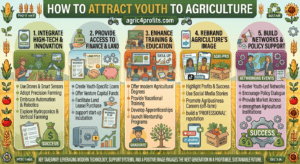
1. Showcase Agriculture as a Modern Business Opportunity
Presenting agriculture through the lens of business and entrepreneurship, including technology use, value addition, and genuine profit potential, appeals to young people who may not see themselves in a purely traditional farming role but respond well to business opportunity framing.
Highlighting successful young farmers and agripreneurs, particularly those using modern approaches and technology, provides relatable role models that counter outdated perceptions of agriculture as exclusively low tech, low status work.
2. Integrate Technology Into Agricultural Practice and Education
Young people who have grown up with smartphones and digital technology often respond positively to agricultural approaches that incorporate technology, whether through precision farming tools, digital marketing for farm products, or data driven decision making.
Demonstrating how technology can reduce the physical labor burden traditionally associated with farming, through appropriate mechanization or improved tools, addresses one of the significant perception barriers that discourages youth agricultural interest.
Read Also: soil-health-and-management-community/forum/topic/soil-amendments-to-improve-nutrient-uptake
Youth Attraction Strategies and Focus Areas
Strategy Addresses Which Barrier Implementation Approach Business and entrepreneurship framing Perceived low status Highlight profit potential, success stories Technology integration Physical labor concerns Show modern tools and digital approaches Mentorship programs Lack of guidance and role models Connect youth with successful young farmers Financial access support Capital barriers to entry Youth-focused loan or grant programs 3. Provide Mentorship and Practical Learning Opportunities
Connecting interested young people with experienced, successful farmers for mentorship provides practical guidance and relatable role models that formal education alone often cannot offer, particularly for the business and practical management aspects of farming.
Hands on learning opportunities, whether through structured apprenticeships or informal farm work experience, allow young people to genuinely evaluate agricultural careers based on real experience rather than assumptions or secondhand information.
4. Address Financial Barriers to Entry
Young people often face significant capital constraints when trying to enter agriculture independently, making access to youth specific financing programs, land access arrangements, or shared equipment models important for translating interest into actual agricultural participation.
Highlighting lower capital entry points within agriculture, such as smaller scale poultry or vegetable production, alongside larger scale opportunities, helps young people see realistic pathways that match their actual available resources.
Low Capital Entry Points for Young Farmers
Entry Point Typical Capital Need Learning Curve Small-scale poultry Low to moderate Moderate, manageable for beginners Vegetable production Low Moderate, quick feedback cycles Value-added processing Low to moderate Requires specific skill development Agricultural services Low Requires specific expertise 5. Improve Agricultural Education Relevance
Agricultural education that includes practical business skills, modern technology, and genuine hands on experience, rather than purely theoretical instruction, better prepares and motivates young people for realistic agricultural career paths.
Connecting agricultural education directly to demonstrated income potential and success stories helps students see clear, credible career pathways rather than viewing agricultural study as disconnected from genuine economic opportunity.
6. Build Supportive Community and Peer Networks
Young people entering agriculture benefit significantly from connecting with peers pursuing similar paths, reducing the isolation that can otherwise make agricultural careers feel less socially appealing compared to urban employment with built-in social networks.
Youth farmer groups, whether formal associations or informal networks, provide both practical knowledge sharing and the social community that supports sustained engagement with agriculture as a genuine long term career choice.
Frequently Asked Questions
- Why do many young people currently view agriculture as unattractive?
Many young people associate agriculture with hard physical labor, low income, and limited status compared to urban employment options, making addressing these perceptions important for attraction strategies.
- Can technology integration really help attract youth to agriculture?
Yes, young people who have grown up with digital technology often respond positively to agricultural approaches incorporating technology, which also addresses physical labor concerns.
- How does mentorship support youth entry into agriculture?
Connecting young people with experienced, successful farmers provides practical guidance and relatable role models that formal education alone often cannot offer.
- What are common financial barriers young people face entering agriculture?
Significant capital constraints often limit independent agricultural entry, making youth specific financing programs and lower capital entry points important for translating interest into participation.
- What are lower capital entry points into agriculture for young people?
Small-scale poultry, vegetable production, and value-added processing all offer relatively lower capital entry points compared to larger scale agricultural ventures.
- How can agricultural education be made more appealing to youth?
Education that includes practical business skills, modern technology, and genuine hands on experience better prepares and motivates young people than purely theoretical instruction.
- Does framing agriculture as business help attract young people?
Yes, presenting agriculture through business and entrepreneurship framing, including genuine profit potential, appeals to young people who respond well to business opportunity presentation.
- Why is peer community important for young people entering agriculture?
Connecting with peers pursuing similar paths reduces isolation and provides both practical knowledge sharing and social community that supports sustained agricultural engagement.
- Can highlighting successful young farmers help attract more youth?
Yes, showcasing relatable role models, particularly those using modern approaches, counters outdated perceptions of agriculture as exclusively low tech, low status work.
- Is hands on farm experience important for youth considering agricultural careers?
Yes, hands on learning opportunities allow young people to genuinely evaluate agricultural careers based on real experience rather than assumptions or secondhand information.
Attracting youth to agriculture requires addressing both practical barriers like capital access and perception challenges around status and modernity, combined with genuine mentorship and community support. This multifaceted approach offers the best chance of building sustainable youth engagement with agricultural careers. What strategies have you seen work for attracting young people to agriculture? Share your experience with the Agric4Profits farming community.
Read Also: practical-steps-to-convert-concrete-wastes-into-aggregate-for-new-construction
- AuthorPosts

.jpg)
- You must be logged in to reply to this topic.