



Public Group
Active 1 year, 3 months ago
Group Type By Special Interest Group
Group Leadership
- Group Administrators
-

Agri-Business Startups Network
Accessing Farm Input Loans and Grants
- This topic is empty.
- AuthorPosts
- July 30, 2026 at 10:33 am #794773
 Agric4ProfitsModerator
Access to capital remains one of the most significant barriers many farmers face when trying to expand production, adopt improved technologies, or simply maintain adequate input levels during challenging seasons. Loans and grants designed specifically for agricultural input purchases offer valuable pathways to address this capital constraint.
Many farmers, however, remain unaware of available financing options or find the application process intimidating enough to avoid pursuing genuinely accessible opportunities that could meaningfully improve their farm operations and profitability.
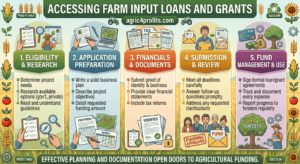
This article covers practical guidance for identifying and accessing farm input loans and grants, from understanding the different types of financing available to preparing strong applications that improve your chances of approval.
Whether you need financing for seeds and fertilizer, equipment, or broader farm improvement, understanding how to navigate available loan and grant opportunities can help you access the capital needed to strengthen your farming operation.
1. Understand the Different Types of Agricultural Financing
Agricultural financing options range from government backed loan programs and microfinance institutions to grants from development organizations and increasingly, digital lending platforms designed specifically for smallholder farmers with limited traditional collateral.
Each financing type carries different requirements, repayment terms, and application processes, making it important to understand which options genuinely fit your specific situation rather than assuming all agricultural financing works the same way.
2. Identify Financing Sources Available in Your Region
Local agricultural extension offices, farmer cooperatives, and community organizations often maintain current information about available loan and grant programs specific to your region, providing a valuable starting point for identifying realistic financing opportunities.
Government agricultural ministries and development agencies frequently run programs specifically targeting smallholder farmers, though awareness of these programs often remains limited without active outreach to identify what currently exists in your area.
Common Agricultural Financing Sources
Source Type Typical Requirements Best Suited For Government agricultural programs Registration, sometimes cooperative membership Input purchases, equipment Microfinance institutions Group guarantee or small collateral Smaller working capital needs Development organization grants Project proposal, sometimes matching funds Specific improvement projects Digital lending platforms Mobile money history, sometimes alternative data Quick, smaller loans Read Also: Marketing farm produce in local markets
3. Prepare Documentation Before Applying
Having basic farm records, including production history, land documentation, and any existing financial records, ready before beginning an application significantly speeds the process and demonstrates the kind of organized farm management that lenders and grant providers value.
For loan applications, understanding what collateral or guarantee requirements apply, and preparing accordingly, whether through group lending arrangements, asset documentation, or other mechanisms, avoids delays or rejection due to incomplete preparation.
4. Write a Clear, Specific Funding Request
Clearly articulating exactly what the financing will be used for, how it will improve farm productivity or income, and how loan repayment or grant objectives will be met, significantly strengthens applications compared to vague or overly general requests.
Including specific numbers, such as expected yield improvements or income increases from the planned use of funds, helps lenders and grant providers evaluate the concrete value proposition your application represents.
Application Preparation Checklist
Item Purpose Priority Level Basic farm records Demonstrates organized management Essential Clear funding use plan Shows specific, credible purpose Essential Collateral or guarantee documentation Meets lender requirements Essential for loans Expected outcome projections Strengthens value proposition High 5. Consider Group or Cooperative Financing Options
Joining or forming a farmer cooperative or group lending arrangement can improve access to financing that might be difficult to secure individually, since group arrangements often provide collective guarantee mechanisms that reduce lender risk.
Cooperative membership also sometimes provides direct access to specific loan or grant programs designed to work through organized farmer groups rather than individual applicants, expanding the range of financing options available.
6. Use Financing Responsibly and Track Results
Using borrowed capital specifically for its intended productive purpose, rather than diverting funds to unrelated expenses, protects both your farm’s financial health and your ability to access future financing based on a track record of responsible use.
Tracking the actual results achieved from financed improvements, comparing outcomes against initial projections, provides valuable evidence for future financing applications while also confirming whether the investment genuinely delivered the expected value.
Frequently Asked Questions
- What types of agricultural financing are available to smallholder farmers?
Options range from government backed loan programs and microfinance institutions to development organization grants and digital lending platforms, each with different requirements and terms.
- Where can farmers find information about available financing programs?
Local agricultural extension offices, farmer cooperatives, and community organizations often maintain current information about loan and grant programs specific to a given region.
- What documentation should farmers prepare before applying for financing?
Basic farm records including production history and land documentation, along with a clear funding use plan, significantly speed the application process and strengthen approval chances.
- Does joining a cooperative really improve access to financing?
Yes, group lending arrangements often provide collective guarantee mechanisms that reduce lender risk, and cooperative membership sometimes provides direct access to group-targeted programs.
- How specific should a funding request be in a loan or grant application?
Clearly articulating exactly what financing will be used for and how it will improve productivity or income, with specific numbers where possible, significantly strengthens applications.
- What collateral requirements typically apply to agricultural loans?
Requirements vary by lender and program, ranging from group guarantee arrangements to asset documentation, making it important to understand specific requirements before applying.
- Are digital lending platforms a realistic option for smallholder farmers?
Yes, digital platforms increasingly serve smallholder farmers, often using mobile money history or alternative data for smaller, quicker loans compared to traditional banking requirements.
- Why is it important to use agricultural financing for its intended purpose?
Using funds specifically for their intended productive purpose protects farm financial health and preserves the track record of responsible use needed for accessing future financing.
- Can tracking results from financed improvements help with future applications?
Yes, tracking actual outcomes against initial projections provides valuable evidence for future financing applications while confirming whether the investment delivered expected value.
- Are grants generally easier to access than loans for farmers?
Grants and loans have different requirements rather than one being universally easier, with grants often requiring detailed project proposals while loans typically require collateral or guarantee arrangements.
Accessing farm input loans and grants requires understanding available options, preparing thorough documentation, and presenting a clear, credible funding request. This preparation significantly improves your chances of securing the capital needed to strengthen your farming operation. What financing sources have worked well for your farm? Share your experience with the Agric4Profits farming community.
Read Also: Meaning and concepts of design of waste water treatment units
- AuthorPosts


- You must be logged in to reply to this topic.