


Public Group
Active 1 year, 3 months ago
Group Type By Special Interest Group
Group Leadership
- Group Administrators
-

Agri-Business Startups Network
How to Price Crops for Maximum Profit
- This topic is empty.
- AuthorPosts
- July 28, 2026 at 12:29 pm #793687
 Agric4ProfitsModerator
Pricing decisions directly determine farm profitability, yet many farmers set prices based primarily on what neighboring farms charge or vague market impressions rather than a clear understanding of their own production costs and the actual value their specific product offers.
Effective crop pricing balances covering true production costs, remaining competitive within the relevant market, and capturing appropriate value for any quality, freshness, or other differentiating factors your specific produce offers compared to alternatives.
This article covers practical approaches to crop pricing that support maximum sustainable profit, from understanding your true costs to reading market conditions and communicating value in ways that support stronger pricing than simply matching the lowest competitor.
Whether you sell through markets, direct channels, or wholesale arrangements, applying these pricing principles will help you set prices that genuinely reflect your costs and value rather than leaving profit on the table through underpricing.
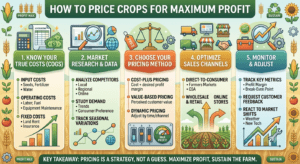
1. Calculate Your True Production Costs
Accurate pricing starts with understanding your complete production costs, including often overlooked expenses like labor, land costs, equipment depreciation, and post-harvest handling, not just the most visible direct input costs like seed and fertilizer.
Calculating cost per unit produced, rather than only tracking total farm expenses, provides the specific figure needed to ensure your pricing genuinely covers costs with adequate margin rather than relying on rough estimates that may significantly understate true production expense.
2. Research Market Prices and Conditions
Understanding current market prices for your specific crop and quality grade, gathered from multiple sources rather than a single reference point, provides essential context for positioning your own pricing appropriately within the actual market landscape.
Tracking how prices fluctuate seasonally and understanding the factors driving these fluctuations helps farmers anticipate favorable selling windows and avoid consistently selling during periods of oversupply and correspondingly lower prices.
Read Also: How-to-store seeds safely from pests
Cost Categories Often Overlooked in Pricing
Cost Category Why It’s Often Missed Impact on True Cost Farmer’s own labor Not a direct cash expense Can be significant portion of true cost Equipment depreciation Spread across many seasons Reduces apparent profitability if ignored Post-harvest losses Not tracked as a direct cost Effectively raises cost per marketable unit Land opportunity cost No direct cash payment if owned Relevant for true profitability comparison 3. Differentiate Based on Quality and Value-Added Factors
Produce with superior quality, unique varieties, specific growing practices, or added convenience through processing or packaging can often command prices above baseline commodity rates when this differentiation is clearly communicated to buyers.
Identifying what genuinely differentiates your produce from typical market offerings, and ensuring buyers understand this difference, supports pricing that captures appropriate value rather than defaulting to commodity level pricing regardless of actual quality differences.
4. Consider Timing Strategies for Better Pricing
Prices for many crops fluctuate predictably based on seasonal supply patterns, with prices typically lower during peak harvest periods when supply is abundant and higher during gaps in typical production timing.
Where production flexibility allows, planning some plantings to mature during typically higher priced windows, even if this means somewhat different production timing than the conventional local pattern, can improve overall pricing achieved across a season.
Strategy Best Application Key Consideration Cost-plus pricing Baseline for all situations Requires accurate cost calculation Market-based pricing Commodity crops with clear market prices Requires current market information Value-based pricing Differentiated or specialty products Requires clear value communication Timing-based pricing Crops with flexible planting windows Requires production planning adjustment Pricing Strategy Options
5. Avoid Common Pricing Mistakes
Simply matching the lowest price in the market, without regard to your own cost structure or the value differences your product may offer, often leads to unsustainable pricing that fails to properly compensate farm labor and investment over time.
Similarly, failing to periodically review and adjust pricing as costs change, continuing with outdated prices despite rising input costs, gradually erodes profitability even when the original pricing was appropriately calculated at the time it was set.
6. Review and Adjust Pricing Regularly
Regularly revisiting your pricing, ideally each season or whenever significant cost changes occur, ensures your prices continue reflecting current production costs and market conditions rather than becoming outdated over time.
Tracking actual profitability results against your pricing decisions provides practical feedback for refining your approach, helping identify whether current pricing genuinely supports the profit margins you are aiming to achieve.
Frequently Asked Questions
- What costs should be included when calculating true production costs?
Complete costs include often overlooked expenses like labor, land costs, equipment depreciation, and post-harvest handling, not just visible direct input costs like seed and fertilizer.
- Why is calculating cost per unit important for pricing?
Cost per unit produced provides the specific figure needed to ensure pricing genuinely covers costs with adequate margin, rather than relying on rough total farm expense estimates.
- How can farmers avoid consistently selling during low price periods?
Understanding seasonal price fluctuation patterns and, where production flexibility allows, planning some plantings to mature during typically higher priced windows can improve overall pricing achieved.
- Can quality differences justify higher pricing than typical market rates?
Yes, produce with superior quality, unique varieties, or specific growing practices can often command prices above baseline commodity rates when this differentiation is clearly communicated to buyers.
- What is the risk of simply matching the lowest market price?
Matching the lowest price without regard to your own cost structure often leads to unsustainable pricing that fails to properly compensate farm labor and investment over time.
- How often should crop pricing be reviewed and adjusted?
Regularly revisiting pricing, ideally each season or whenever significant cost changes occur, ensures prices continue reflecting current production costs and market conditions.
- Does land ownership mean land costs can be ignored in pricing calculations?
No, land opportunity cost remains relevant for true profitability comparison even without a direct cash payment, since the land could otherwise generate value through alternative use.
- How can farmers determine current market prices for their crops?
Gathering current market prices from multiple sources rather than a single reference point provides essential context for positioning pricing appropriately within the actual market landscape.
- Should farmer’s own labor be counted as a cost when pricing crops?
Yes, farmer’s own labor is often a significant portion of true production cost even though it is not a direct cash expense, making it important to include in cost calculations.
- What is value-based pricing and when does it apply?
Value-based pricing captures appropriate value for differentiated or specialty products by pricing based on the specific value offered rather than defaulting to commodity level rates.
Pricing crops for maximum sustainable profit requires understanding your true production costs, researching market conditions, and appropriately valuing any quality or timing advantages your produce offers. Regular review keeps pricing aligned with changing costs and market realities. What pricing strategies have helped improve profitability on your farm? Share your experience with the Agric4Profits farming community.
Read Also: How creating recyclable products support effective waste management
- AuthorPosts


- You must be logged in to reply to this topic.