



Public Group
Active 1 year, 3 months ago
Group Type By Special Interest Group
Group Leadership
- Group Administrators
-

Agri-Business Startups Network
Tips for Creating a Farm Business Plan
- This topic is empty.
- AuthorPosts
- August 3, 2026 at 2:40 pm #799600
 Agric4ProfitsModerator
A well developed farm business plan provides essential direction and discipline for agricultural operations, whether starting a new farming venture or formalizing and improving an existing operation, yet many farmers operate without this foundational planning document.
Beyond simply satisfying potential lenders or investors who often require formal business plans, the planning process itself forces valuable clarity about goals, resources, and strategy that improves decision making even for farmers who never share the document externally.
This article covers practical tips for creating an effective farm business plan, from essential components to include to approaches that make the planning process genuinely useful rather than merely a formality completed once and then ignored.
Whether you are seeking financing, planning a new agricultural venture, or simply want to bring more strategic clarity to an existing farm operation, these tips will help you create a business plan that genuinely serves your farm’s development.
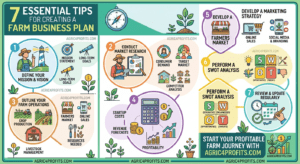
1. Start With Clear Goals and Vision
Articulating specific, concrete goals for your farming operation, whether focused on income targets, production scale, specific products, or lifestyle considerations, provides the essential foundation that all subsequent business plan sections should support and align with.
This vision section, while sometimes treated as merely introductory, actually shapes critical decisions throughout the rest of the plan, making genuine reflection on your actual goals worthwhile rather than rushing through this section to reach more technical content.
2. Include Realistic Market Analysis
Documenting actual market research, including demand assessment, competition analysis, and realistic pricing expectations for your planned products, grounds your business plan in genuine market reality rather than optimistic assumptions that could undermine actual business success.
This market analysis should draw on direct research, including conversations with potential buyers and observation of actual market conditions, rather than relying purely on general impressions or hopeful projections about demand.
Essential Farm Business Plan Components
Component Key Content Purpose Vision and goals Specific objectives, timeline Provides direction for all planning Market analysis Demand, competition, pricing research Grounds plan in market reality Production plan What, how much, timeline Details operational approach Financial projections Costs, revenue, profitability timeline Assesses viability, guides decisions Read Also: Starting a Small-Scale Fish Farm Business
3. Detail Your Production and Operational Plan
Specifying exactly what you plan to produce, at what scale, using which methods, and on what timeline provides the operational backbone that connects your market analysis and financial projections to concrete, actionable farm activities.
Including realistic timelines that account for seasonal factors, learning curves for new practices, and the typical gap between initial investment and revenue generation prevents the overly optimistic planning that often undermines actual business execution.
4. Build Realistic Financial Projections
Developing financial projections based on actual researched costs and realistic revenue expectations, rather than optimistic assumptions, provides the honest assessment needed to evaluate whether your planned venture is genuinely financially viable.
Including multiple scenarios, such as conservative, moderate, and optimistic projections, provides a more complete picture of potential outcomes than a single projection that might not adequately convey the range of realistic possibilities.
Business Plan Financial Projection Elements
Element What to Include Common Mistake to Avoid Startup costs All expenses including often overlooked items Underestimating hidden or indirect costs Operating expenses Ongoing costs by category Missing seasonal cost variation Revenue projections Realistic sales volume and pricing Overly optimistic demand assumptions Break-even timeline When the venture becomes profitable Underestimating time to profitability 5. Keep the Plan Practical and Usable
Creating a business plan detailed enough to provide genuine guidance while remaining concise enough that you will actually reference and use it going forward strikes an important balance that overly elaborate plans sometimes fail to achieve.
Structuring the plan for easy reference, with clear sections you can quickly return to for specific guidance, supports ongoing practical use rather than creating a document that, once completed, gets filed away and forgotten.
6. Review and Update the Plan Regularly
Treating your business plan as a living document that you revisit and update as actual results and market conditions develop, rather than a one time exercise, keeps it genuinely useful for ongoing decision making rather than becoming outdated and irrelevant.
Comparing actual results against your original projections during these reviews provides valuable learning that improves both your current operational decisions and the quality of future planning efforts.
Frequently Asked Questions
- Why is a business plan valuable even for farmers not seeking outside financing?
The planning process itself forces valuable clarity about goals, resources, and strategy that improves decision making even for farmers who never share the document externally.
- What market research should be included in a farm business plan?
Documenting actual demand assessment, competition analysis, and realistic pricing expectations, grounded in direct research rather than assumptions, provides essential market reality.
- Should financial projections include multiple scenarios?
Yes, including conservative, moderate, and optimistic projections provides a more complete picture of potential outcomes than a single projection that might not convey realistic possibilities.
- What is a common mistake in farm business plan production timelines?
Overly optimistic planning that does not account for seasonal factors, learning curves, and the typical gap between initial investment and revenue generation often undermines actual execution.
- How detailed should a farm business plan be?
The plan should be detailed enough to provide genuine guidance while remaining concise enough that you will actually reference and use it going forward, striking an important balance.
- Should a business plan be created once and left unchanged?
No, treating the plan as a living document that you revisit and update as actual results and market conditions develop keeps it genuinely useful for ongoing decision making.
- What financial elements are most commonly underestimated in business plans?
Startup costs often miss hidden or indirect expenses, while revenue projections frequently reflect overly optimistic demand assumptions rather than realistic market conditions.
- How does the vision and goals section affect the rest of a business plan?
This section shapes critical decisions throughout the rest of the plan, making genuine reflection on actual goals worthwhile rather than rushing through it as merely introductory.
- Can comparing actual results to projections improve future planning?
Yes, this comparison during regular reviews provides valuable learning that improves both current operational decisions and the quality of future planning efforts.
- What should a production plan section of a business plan include?
Specifying exactly what you plan to produce, at what scale, using which methods, and on what realistic timeline provides the operational backbone connecting analysis to concrete action.
Creating an effective farm business plan requires honest market analysis, realistic financial projections, and a practical structure that supports genuine ongoing use rather than becoming a forgotten formality. This disciplined planning process improves decision making whether or not the plan is ever shared with outside parties. What has helped you create a genuinely useful farm business plan? Share your experience with the Agric4Profits farming community.
Read Also: water-emergency-and-water-security
- AuthorPosts

- You must be logged in to reply to this topic.